
Published 12 March 2026 | Updated 26 May 2026
App
What are the 5 Best Practices for Successful Salesforce AppExchange App Development Services
The Salesforce ecosystem has become one of the most powerful platforms for enterprise applications. Businesses across industries rely on Salesforce to manage customer relationships, automate workflows, and improve business productivity. One of the most valuable parts of this ecosystem is the Salesforce AppExchange marketplace, where companies can publish applications that integrate seamlessly with Salesforce products.
Transform Your Digital Experience
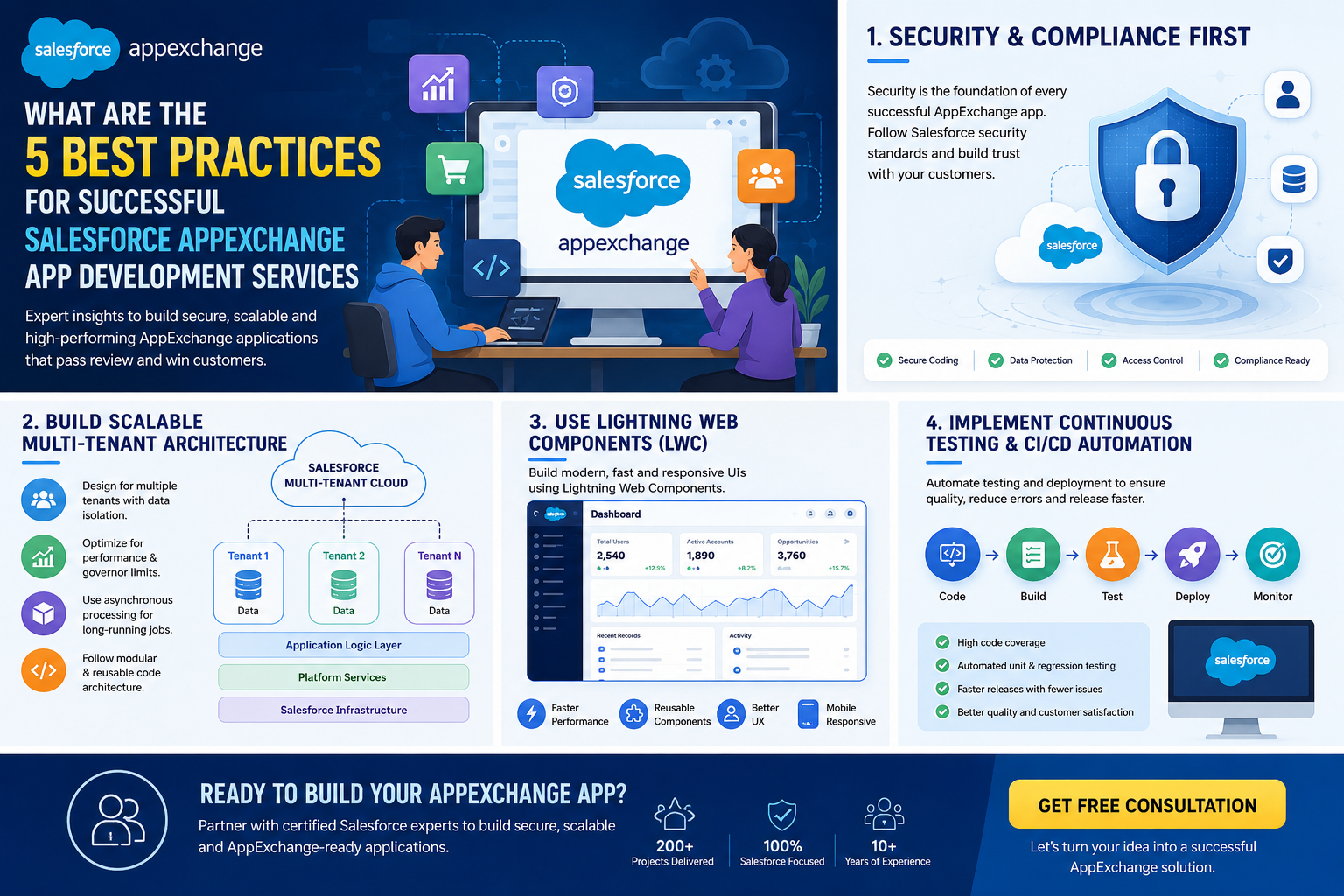
The 5 best practices for successful Salesforce AppExchange app development services include: following Salesforce security and compliance standards, using scalable architecture, building with Lightning Web Components (LWC), optimizing for multi-tenancy, and ensuring continuous testing and AppExchange security readiness. These practices help developers build secure, high-performance apps that pass Salesforce review faster and scale effectively.
- Successful Salesforce AppExchange app development services depend heavily on following Salesforce’s security-first approach, as security compliance is the primary factor for passing AppExchange review and gaining enterprise trust.
- Building a scalable multi-tenant architecture is essential because AppExchange applications must perform efficiently across thousands of Salesforce orgs without violating governor limits or affecting performance.
- Using Lightning Web Components (LWC) ensures modern, fast, and responsive user interfaces that improve adoption rates and align with Salesforce’s native experience.
- Preparing for Salesforce security review from the start significantly reduces delays, rework, and rejection risks during AppExchange submission.
- Implementing continuous testing and CI/CD automation improves release quality, reduces manual errors, and accelerates deployment cycles for AppExchange apps.
- Following these best practices improves not only technical performance but also increases approval success rate, customer adoption, and marketplace visibility in the Salesforce AppExchange ecosystem.
However, building and launching a successful application on AppExchange requires careful planning, technical expertise, and adherence to Salesforce standards. Organizations must follow proven development strategies to ensure their apps are secure, scalable, and user-friendly.
In this guide, we will explore the five best practices for successful Salesforce AppExchange App Development Services and how businesses can leverage them to build high-quality solutions. We will also discuss how PerfectionGeeks, a leading AppExchange app development Company, helps businesses develop and launch powerful applications on the Salesforce AppExchange marketplace.
What is Salesforce AppExchange App Development?
Salesforce AppExchange app development refers to the process of building cloud-based applications that integrate with Salesforce and are published on the AppExchange marketplace.
These apps extend Salesforce capabilities for CRM, automation, analytics, customer service, marketing, and enterprise operations.
A successful AppExchange app must:
- Be secure and scalable
- Follow Salesforce multi-tenant architecture
- Pass strict security review
- Deliver seamless user experience
- Support enterprise integrations
Why Businesses Invest in AppExchange App Development Services
Organizations across industries are investing in AppExchange apps because they provide several business advantages.
Key benefits include:
Faster implementation of new features
- Seamless integration with Salesforce CRM
- Increased productivity through automation
- Enhanced customer experience
- Access to Salesforce’s global marketplace
Because AppExchange apps must meet strict quality and security requirements, businesses often partner with experienced development companies such as PerfectionGeeks to build scalable and secure applications.
Salesforce AppExchange Development Experts Available
Why Best Practices Matter in Salesforce AppExchange Development
The AppExchange marketplace is extremely competitive, with thousands of apps competing for visibility and downloads. At the same time, Salesforce enforces one of the strictest security review processes in the SaaS industry.
Without proper best practices:
- Applications fail security review repeatedly
- Performance issues arise under enterprise-scale usage
- Integration with Salesforce becomes unstable
- Customer adoption drops due to poor user experience
On the other hand, applications built with structured Salesforce AppExchange app development services best practices benefit from faster approvals, better scalability, and higher marketplace rankings.
Industry data also shows that applications following Salesforce architecture and security guidelines have significantly higher approval rates and lower post-deployment failure rates.
1. Building Strong Security and Compliance Foundations
Security is the most critical pillar of Salesforce AppExchange development. Unlike general web applications, AppExchange apps operate inside enterprise Salesforce environments where sensitive customer data is constantly processed.
Because of this, Salesforce performs a detailed security review process before any app can be published.
A strong security-first approach means that security is not added at the end of development—it is built into every layer of the application.
Developers must ensure that all data access is strictly controlled through Salesforce’s built-in permission system. Every object, field, and record must respect role-based access, field-level security, and sharing rules. Ignoring these principles is one of the most common reasons for AppExchange rejection.
Authentication is another critical area. Instead of storing credentials inside the application, developers must use secure authentication protocols like OAuth 2.0. This ensures that users and external systems are validated securely without exposing sensitive information.
In addition, all API integrations must be protected with encrypted communication channels and proper input validation to prevent vulnerabilities such as injection attacks or data leakage.
When organizations invest in Salesforce AppExchange app development services, security becomes a long-term trust factor. A secure app not only passes Salesforce review but also builds confidence among enterprise customers who rely on it for critical business operations.
2. Designing Scalable Multi-Tenant Architecture
Salesforce operates on a multi-tenant architecture, which means multiple customers share the same infrastructure while keeping their data isolated.
For AppExchange developers, this introduces a major challenge: the application must perform efficiently across thousands of different Salesforce organizations without degradation.
A scalable architecture ensures that the application does not overload Salesforce governor limits such as CPU time, memory usage, or database query limits. This is where poor design often leads to runtime failures.
To build scalable applications, developers must carefully optimize database queries. Instead of writing inefficient loops or repeated SOQL queries, data should be retrieved in bulk operations that minimize system load.
Another important aspect is asynchronous processing. For large or time-consuming operations, developers should use batch processing or queue-based execution instead of synchronous processing. This prevents system bottlenecks and improves responsiveness.
A modular code structure also plays a key role in scalability. By separating business logic into reusable service layers and controllers, applications become easier to maintain, test, and extend in the future.
When properly implemented, scalable architecture ensures that a Salesforce AppExchange application can support enterprise-level workloads without performance degradation.
3. Using Lightning Web Components for Modern User Experience
User experience plays a major role in the success of any AppExchange application. Even if the backend is powerful, a poor interface can lead to low adoption rates.
This is where Lightning Web Components (LWC) becomes essential in Salesforce AppExchange app development services.
LWC is Salesforce’s modern UI framework built using standard web technologies such as JavaScript, HTML, and CSS. Unlike older frameworks, it provides better performance because it runs natively in the browser without unnecessary abstraction layers.
Applications built with LWC load faster, respond more smoothly, and provide a more modern user experience that aligns with Salesforce’s own interface design.
Another advantage of LWC is reusability. Developers can build components once and reuse them across multiple parts of the application, reducing development time and ensuring consistency.
From a business perspective, better UI leads to higher user engagement, improved productivity, and stronger adoption rates. In enterprise environments, this directly translates into better ROI from the application.
4. Preparing for Salesforce Security Review from Day One
One of the most overlooked aspects of AppExchange development is security review preparation. Many teams treat it as the final step, which often leads to delays, rework, or rejection.
In reality, security review should be part of the development lifecycle from the very beginning.
Salesforce evaluates applications based on strict criteria including code security, data handling, authentication mechanisms, and API usage. If issues are found late in the process, fixing them can significantly delay product launch.
To avoid this, development teams should conduct internal security audits throughout the development cycle. Tools like Salesforce Security Scanner can help identify vulnerabilities early.
Documentation is equally important. Salesforce expects detailed technical documentation explaining architecture, data flow, and security mechanisms. Without this, even technically strong applications may face delays in approval.
Companies using professional Salesforce AppExchange development services often integrate security testing into every sprint to ensure continuous compliance instead of last-minute fixes.
5. Continuous Testing and CI/CD Automation
Modern AppExchange development cannot rely on manual deployment and testing. As applications grow in complexity, automation becomes essential for maintaining quality and speed.
Continuous integration and continuous deployment (CI/CD) allow developers to automatically test and deploy code changes without manual intervention.
Salesforce DX plays a major role in this process by enabling version control, environment management, and automated deployment pipelines.
Testing is another critical area. Salesforce requires minimum test coverage for Apex code, but enterprise-grade applications should go beyond the minimum requirement. High test coverage ensures that new updates do not break existing functionality.
Automated testing also improves release speed and reduces human error. This is especially important for AppExchange apps that receive frequent updates and enhancements.
By implementing CI/CD pipelines, organizations can maintain consistent quality while accelerating development cycles.
Why These Best Practices Matter for Business Success
Following these best practices for Salesforce AppExchange app development services is not just a technical requirement—it directly impacts business success.
Applications that follow these principles:
- Pass Salesforce security review faster
- Deliver better performance under load
- Gain higher customer trust
- Achieve stronger adoption in the AppExchange marketplace
- Reduce long-term maintenance cost
In a competitive ecosystem like Salesforce, execution quality is often more important than product idea alone.
Common Challenges in AppExchange App Development
While AppExchange development offers significant opportunities, it also comes with challenges.
Some common challenges include:
- complex Salesforce security review process
- integration with multiple Salesforce products
- maintaining compatibility with platform updates
- ensuring strong user adoption
- designing scalable architecture
Working with an experienced AppExchange app development Company can help businesses overcome these challenges and accelerate their development process.
Why Choose Professional Salesforce AppExchange Development Services?
PerfectionGeeks Technologies provides end-to-end Salesforce AppExchange app development services including architecture design, development, security compliance, and AppExchange publishing support.
Key advantages:
- Certified Salesforce experts
- 200+ enterprise projects delivered
- Strong security compliance experience
- End-to-end ISV partner support
- Scalable cloud-native development
Pricing Overview (AppExchange Development Cost)
| App Type | Cost Range | Timeline |
|---|---|---|
| Basic App | $20,000 – $40,000 | 2–3 months |
| Mid-Level App | $40,000 – $80,000 | 3–5 months |
| Enterprise App | $80,000 – $150,000+ | 5–8 months |
Future of Salesforce AppExchange App Development
The Salesforce ecosystem continues to grow rapidly as businesses adopt cloud technologies and digital transformation strategies.
New technologies such as artificial intelligence, automation, and data analytics are shaping the future of AppExchange applications.
In the coming years, AppExchange apps are expected to focus on:
- AI-powered automation
- predictive analytics
- industry-specific CRM solutions
- deeper integrations with enterprise systems
Businesses that invest in professional Salesforce AppExchange App Development Services today can gain a strong competitive advantage in the evolving digital landscape.
Frequently Asked Questions
Quick answers related to this article from PerfectionGeeks.
1. What are Salesforce AppExchange App Development Services?
2. Why should businesses invest in AppExchange app development services?
3. What are the key requirements for publishing an app on Salesforce AppExchange?
4. How long does it take to develop a Salesforce AppExchange app?
5. Why choose PerfectionGeeks as an AppExchange app development Company?
Conclusion
Salesforce AppExchange provides a powerful platform for businesses to develop and distribute innovative applications that enhance CRM capabilities.
However, building a successful AppExchange app requires strategic planning, secure development practices, thorough testing, and ongoing maintenance.
By following the five best practices discussed in this guide—strategic planning, native architecture development, strong security compliance, comprehensive testing, and continuous support—businesses can create high-quality applications that succeed in the Salesforce marketplace.
Partnering with an experienced AppExchange app development Company like PerfectionGeeks can further simplify the process and ensure successful deployment.
With expert Salesforce AppExchange App Development Services, businesses can build scalable, secure, and innovative applications that deliver long-term value to Salesforce users worldwide.

Written By Shrey Bhardwaj
Director & Founder
Shrey Bhardwaj is the Director & Founder of PerfectionGeeks Technologies, bringing extensive experience in software development and digital innovation. His expertise spans mobile app development, custom software solutions, UI/UX design, and emerging technologies such as Artificial Intelligence and Blockchain. Known for delivering scalable, secure, and high-performance digital products, Shrey helps startups and enterprises achieve sustainable growth. His strategic leadership and client-centric approach empower businesses to streamline operations, enhance user experience, and maximize long-term ROI through technology-driven solutions.