
Published 18 September 2025 | Updated 8 July 2026
Technology
Business Communication Alert App — Complete Guide 2026
In today’s fast-paced digital world, businesses must communicate critical information instantly and efficiently. Whether it’s emergency notifications, cybersecurity threats, operational disruptions, employee safety alerts, or real-time business announcements, organizations increasingly rely on business communication alert apps to ensure rapid information delivery.
Modern emergency notification systems help companies improve crisis response, employee coordination, operational continuity, and organizational safety. From enterprises and healthcare providers to logistics companies and educational institutions, communication alert applications are becoming essential digital infrastructure.
What Is a Business Communication Alert App?A business communication alert app is a digital platform designed to send instant notifications, emergency alerts, operational updates, and crisis communication messages to employees, customers, or stakeholders in real time. These apps typically support:
Estimated Development Cost in 2026
Development costs depend on:
|
Why Businesses Need Communication Alert Apps
Organizations face increasing challenges such as:
- Cybersecurity incidents
- Operational disruptions
- Workplace emergencies
- Natural disasters
- IT outages
- Supply chain disruptions
Fast communication helps businesses:
- Protect employees
- Improve crisis management
- Reduce downtime
- Maintain operational continuity
- Improve response coordination
Real-time alerts significantly improve organizational resilience.
Key Features of Business Communication Alert Apps
1. Real-Time Push Notifications
Push notification systems enable businesses to send instant alerts directly to employee or customer devices.
Notifications may include:
- Emergency alerts
- Operational updates
- Security warnings
- IT outage notices
- Weather alerts
Real-time communication improves response speed.
2. Multi-Channel Communication
Modern alert systems support:
- SMS messaging
- Email alerts
- Voice notifications
- Mobile push notifications
- In-app communication
Multi-channel delivery improves communication reliability.
3. Geo-Targeted Alerts
Geo-location technology allows businesses to send alerts to specific regions or employee groups.
Examples include:
- Office-specific alerts
- Weather warnings
- Local emergency updates
- Facility-based notifications
Geo-targeting improves communication relevance and efficiency.
4. Emergency Response Management
Businesses can coordinate:
- Incident reporting
- Safety check-ins
- Employee status updates
- Evacuation procedures
- Crisis response workflows
This helps improve emergency preparedness.
5. Admin Dashboard & Analytics
Administrative dashboards provide:
- Alert monitoring
- Delivery reports
- User management
- Real-time analytics
- Incident tracking
Analytics improve operational visibility and decision-making.
6. AI-Powered Automation
AI features help:
- Automate notifications
- Detect incidents
- Analyze communication patterns
- Improve alert prioritization
AI-driven systems reduce manual operational effort.
7. Secure Communication Infrastructure
Security is critical in emergency communication systems.
Key security features include:
- End-to-end encryption
- Role-based access control
- Secure cloud storage
- Multi-factor authentication
- Compliance management
Secure infrastructure protects sensitive organizational data.
Industries Using Communication Alert Apps
Healthcare
Hospitals use alert systems for:
- Emergency coordination
- Staff communication
- Patient safety updates
- Critical incident management
Logistics & Transportation
Logistics companies use communication apps for:
- Fleet coordination
- Delivery disruptions
- Driver safety alerts
- Supply chain updates
Education
Schools and universities use alert platforms for:
- Campus emergencies
- Weather closures
- Security updates
- Student notifications
Enterprise Businesses
Large organizations use alert systems for:
- IT outage communication
- Cybersecurity alerts
- Internal communication
- Operational continuity
Government & Public Safety
Government agencies use emergency communication systems for:
- Public alerts
- Disaster response
- Emergency coordination
- Crisis communication
Technologies Used in Alert App Development
Modern communication alert apps use technologies such as:
- Cloud computing
- AI & machine learning
- GPS & geo-location APIs
- Push notification services
- Real-time messaging systems
- IoT integration
- Big data analytics
These technologies improve scalability, speed, and operational reliability.
Build a Secure Communication Alert App with PerfectionGeeksLooking to develop an emergency notification system or enterprise communication platform? At PerfectionGeeks Technologies, we specialize in:
Contact our experts today for a free consultation and project estimate. |
Factors Affecting Alert App Development Cost
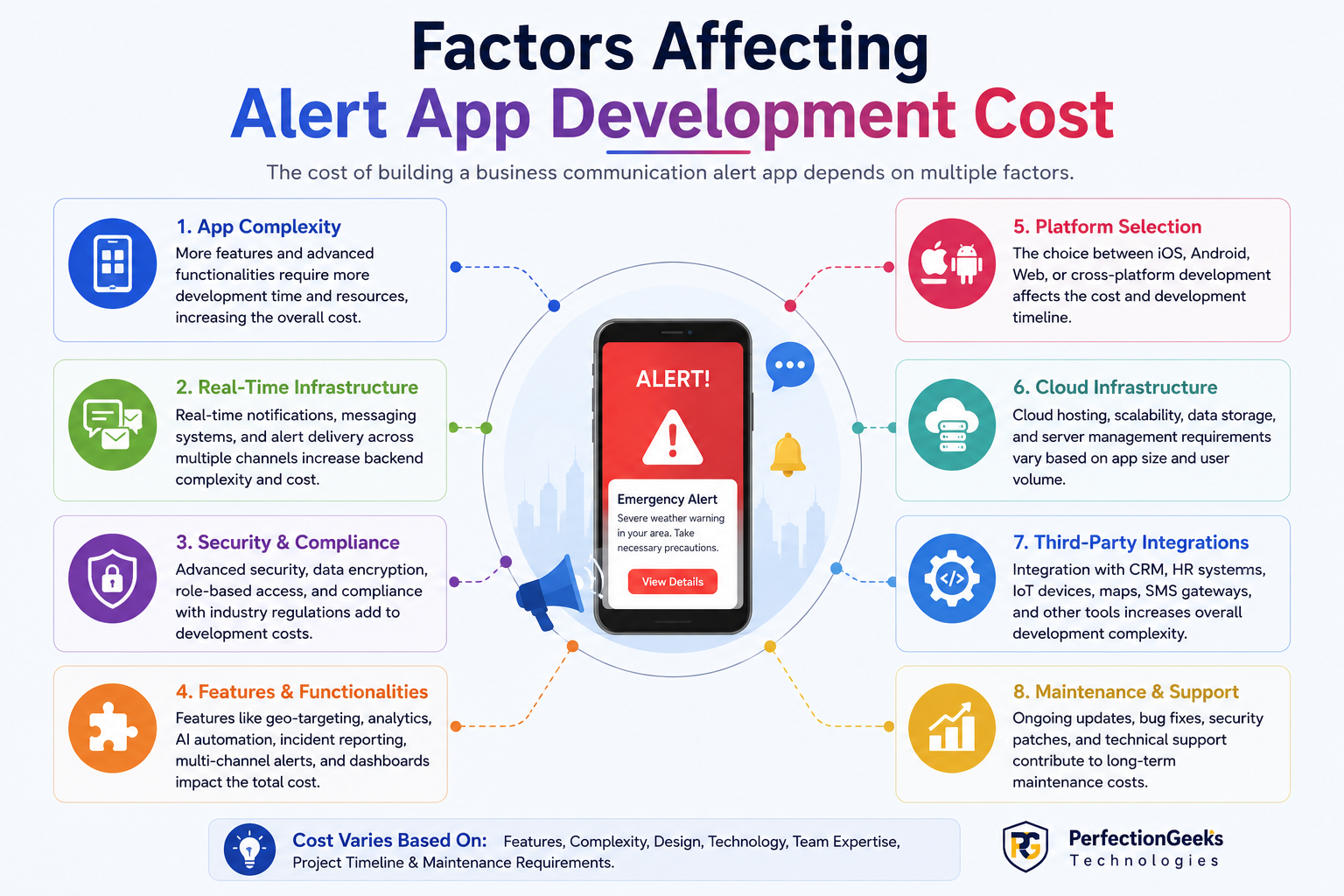
App Complexity
Basic notification apps cost less, while enterprise communication ecosystems require higher investment.
Real-Time Infrastructure
Real-time messaging and large-scale notification systems increase backend complexity.
Security & Compliance
Apps handling sensitive information require:
- Advanced encryption
- Secure cloud infrastructure
- Compliance frameworks
Security implementation significantly impacts costs.
Platform Selection
Development costs vary based on:
- Android apps
- iOS apps
- Web dashboards
- Cross-platform applications
AI & Automation Features
AI-powered communication automation and predictive alert systems increase development complexity.
Integration Requirements
Businesses may require integration with:
- CRM systems
- HR software
- Enterprise communication tools
- Cloud platforms
- IoT systems
Third-party integrations affect project budgets.
Benefits of Business Communication Alert Apps
Organizations using alert systems gain:
- Faster emergency response
- Improved employee safety
- Better operational continuity
- Reduced downtime
- Improved crisis management
- Enhanced communication efficiency
Digital alert systems are becoming essential for modern enterprises.
Future Trends in Emergency Communication Apps
AI-Powered Incident Detection
AI systems will increasingly identify risks automatically and trigger alerts in real time.
IoT-Based Emergency Monitoring
Connected devices and sensors will improve incident detection capabilities.
Predictive Risk Analytics
Businesses will use predictive analytics to identify potential operational disruptions before they occur.
Cloud-Native Communication Platforms
Cloud infrastructure will continue improving scalability and reliability.
Hyper-Personalized Alerts
AI will deliver more targeted and context-aware communication experiences.
Industry Statistics 2026
- Global investments in emergency communication systems continue increasing because of growing cybersecurity and operational risks.
- Businesses are prioritizing real-time communication infrastructure as part of digital transformation strategies.
- AI-powered incident management systems are improving operational resilience and crisis response efficiency.
- Cloud-based enterprise communication platforms are becoming the preferred solution for scalable business operations.
These trends highlight the growing importance of intelligent communication ecosystems.
Challenges in Communication Alert App Development
Notification Reliability
Ensuring instant and reliable message delivery across multiple channels is critical.
Security Risks
Communication systems handling sensitive data require strong cybersecurity protection.
Scalability Challenges
Large enterprises require infrastructure capable of supporting thousands of simultaneous alerts.
User Engagement
Businesses must ensure employees actively use and respond to communication systems.
Why Businesses Invest in Communication Alert Systems
Modern organizations benefit from:
- Better emergency preparedness
- Improved organizational coordination
- Faster operational response
- Reduced business disruption
- Stronger employee safety systems
- Enhanced operational resilience
Real-time communication platforms are now a core part of enterprise digital infrastructure.
Why Choose PerfectionGeeks for Alert App Development?
PerfectionGeeks Technologies delivers scalable and secure enterprise software solutions for startups and global organizations.
Our expertise includes:
- Emergency notification systems
- Real-time communication platforms
- AI-powered automation systems
- Enterprise mobile app development
- Cloud-based software solutions
- Secure infrastructure development
- IoT-enabled communication systems
With years of experience and 200+ successful digital projects delivered globally, we help businesses build future-ready communication ecosystems.
|
Frequently Asked Questions
Quick answers related to this article from PerfectionGeeks.
1. What is a business communication alert app?
2. How much does it cost to develop an emergency alert app?
3. What features are important in communication alert apps?
4. Which industries use communication alert systems?
5. Why are real-time alert systems important?
6. Why choose PerfectionGeeks for communication app development?
Conclusion
Business communication alert apps are transforming how organizations manage emergencies, operational disruptions, and real-time communication. From employee safety and incident response to enterprise coordination and operational continuity, modern alert systems are becoming essential business infrastructure.
As digital transformation accelerates in 2026, businesses must invest in scalable, secure, and intelligent communication ecosystems that improve organizational resilience and operational efficiency.
Partnering with an experienced technology company like PerfectionGeeks Technologies can help businesses build advanced communication alert platforms tailored to evolving operational needs.

Written By Shrey Bhardwaj
Director & Founder
Shrey Bhardwaj is the Director & Founder of PerfectionGeeks Technologies, bringing extensive experience in software development and digital innovation. His expertise spans mobile app development, custom software solutions, UI/UX design, and emerging technologies such as Artificial Intelligence and Blockchain. Known for delivering scalable, secure, and high-performance digital products, Shrey helps startups and enterprises achieve sustainable growth. His strategic leadership and client-centric approach empower businesses to streamline operations, enhance user experience, and maximize long-term ROI through technology-driven solutions.


