
Published 15 July 2025 | Updated 22 May 2026
Technology
How Cloud Data Analytics Enables Faster Business Decisions
In today's rapidly evolving business environment, companies must make fast, data-driven decisions to stay competitive. Traditional data analytics systems often involve delays caused by outdated infrastructure, limited scalability, or lack of real-time access. This is where cloud data analytics emerges as a game-changer. By integrating data analytics in cloud computing, organizations can access vast data sets, perform real-time analysis, and extract actionable insights with greater speed and accuracy. Whether it’s understanding customer behavior, forecasting trends, or optimizing supply chains, cloud-based data analytics empowers leaders to respond quickly and intelligently.
What is Cloud Data Analysis?Cloud data analysis is the process of collecting, processing, analyzing, and visualizing data using cloud-based platforms and tools. It enables businesses to access real-time insights, improve decision-making, reduce infrastructure costs, and scale analytics capabilities without investing in on-premise systems. Key Benefits of Cloud Data Analysis:
|
- Cloud data analysis enables businesses to transform raw data into actionable insights using scalable cloud-based platforms and tools.
- Real-time analytics helps organizations make faster and more informed decisions, improving operational efficiency and business performance.
- Cloud analytics eliminates the need for costly on-premise infrastructure, making advanced data analysis more accessible and cost-effective.
- Scalability and flexibility are major advantages, allowing businesses to handle growing data volumes without significant infrastructure investments.
- Cloud data analysis supports a wide range of industries, including retail, healthcare, finance, manufacturing, e-commerce, and logistics.
- Organizations can leverage cloud analytics to improve forecasting, customer experiences, fraud detection, and operational optimization.
- Cloud platforms provide a strong foundation for AI, machine learning, and predictive analytics initiatives, helping businesses stay competitive.
- Enhanced collaboration and accessibility allow teams to access insights from anywhere, improving productivity and decision-making.
- Data-driven organizations consistently outperform competitors by identifying opportunities faster and responding more effectively to market changes.
- As digital transformation accelerates, cloud data analysis is becoming a strategic necessity rather than a technological advantage.
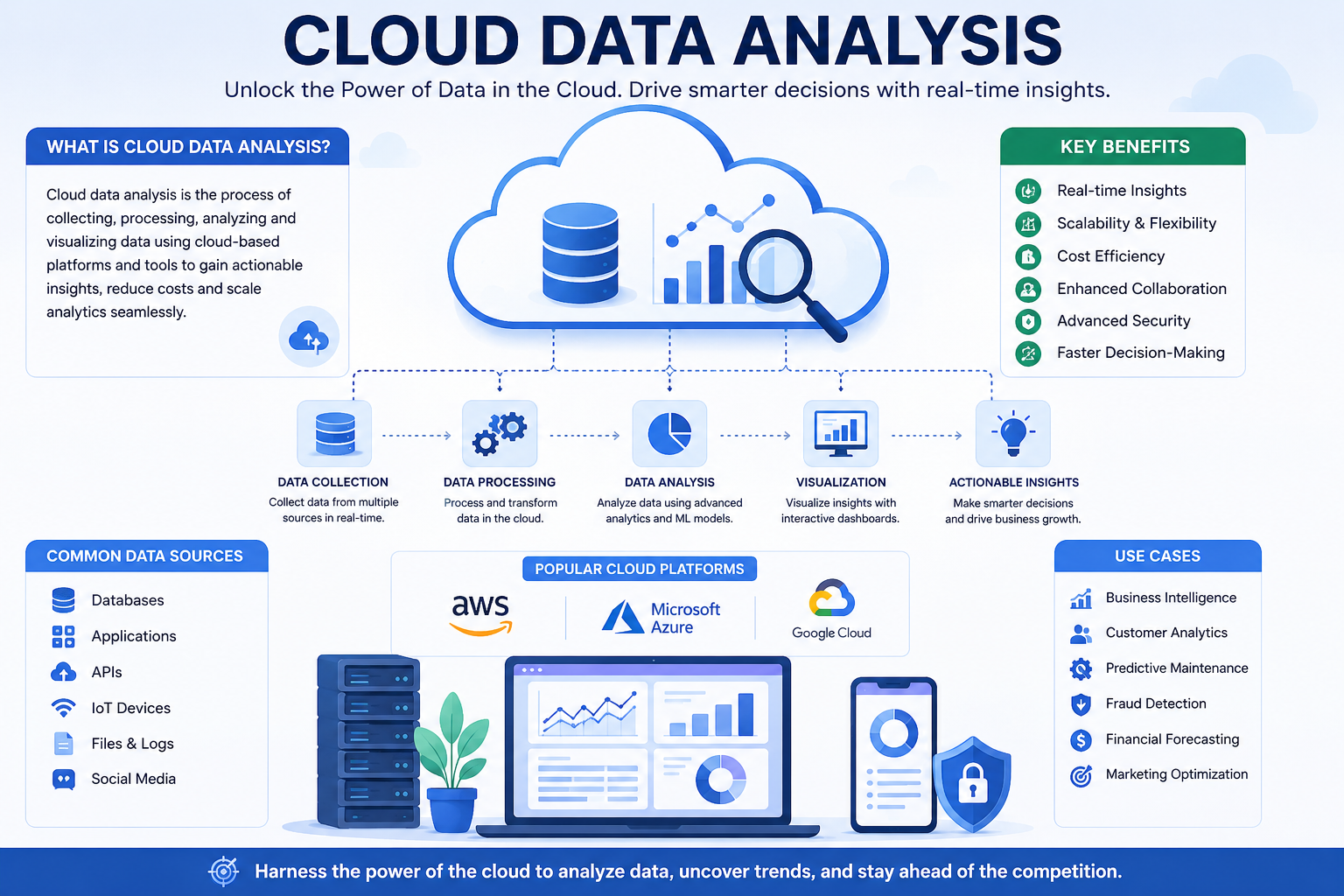
What is Cloud Data Analytics?
Cloud data analytics refers to the process of collecting, processing, and analyzing data stored in cloud environments using tools and technologies designed for scalability and efficiency. Unlike traditional analytics platforms, which require local infrastructure and manual intervention, cloud analytics operates over remote servers and is accessible from anywhere.
This model reduces infrastructure costs, supports scalability, and delivers real-time processing capabilities that are essential for modern businesses.
Benefits of Cloud Analytics for Business Decision-Making
1. Real-Time Data Access and Analysis
Modern organizations generate enormous volumes of data every minute. Using real-time data analytics, businesses can analyze incoming data as it’s created, helping them identify patterns, opportunities, and threats instantly.
For example, an e-commerce business can monitor user activity in real time to adjust product recommendations, pricing, or promotions instantly—enhancing customer satisfaction and boosting sales.
2. Faster Decision-Making
The ability to access up-to-the-minute data is crucial for agile decision-making. With cloud analytics solutions, leaders no longer need to wait hours or days for reports. Instead, data is processed in real-time and visualized through interactive dashboards, enabling quick interpretation and faster response times.
This speed is critical in industries like finance, logistics, and retail, where conditions change rapidly and decisions must be made within seconds.
3. Scalability and Flexibility
One of the key advantages of cloud computing for data analytics is the ease with which it can scale. As business data grows, companies can increase storage and processing capacity without investing in expensive hardware.
This flexibility allows organizations to manage sudden spikes in data volume, run complex queries, and accommodate growing analytics needs without performance issues.
4. Cost-Efficiency
Traditional on-premise analytics systems involve significant upfront investment in servers, software, and maintenance. In contrast, cloud analytics for business is offered on a pay-as-you-go model, allowing companies to pay only for the resources they use.
Additionally, cloud platforms eliminate the need for large IT teams to maintain and upgrade systems, reducing operational costs further.
5. Centralized and Accessible Data
In many businesses, data is stored in silos across departments. Cloud data analysis centralizes this data into a unified platform, making it easier to access, manage, and interpret.
Why Businesses Are Moving to Cloud Data Analysis
Traditional data systems often struggle to keep up with growing data volumes and real-time business demands. Cloud data analysis provides organizations with the ability to process large datasets efficiently while reducing infrastructure complexity.
Businesses are increasingly adopting cloud analytics because it offers:
- Faster access to business insights
- Reduced hardware and maintenance costs
- Improved data accessibility
- Better collaboration across teams
- Advanced security and compliance features
- Support for AI and machine learning workloads
For modern organizations, cloud-based analytics is no longer optional—it has become a strategic requirement for maintaining competitiveness.
☁️ Looking to Build a Data-Driven Business?Data is only valuable when it delivers actionable insights. PerfectionGeeks has helped businesses leverage cloud technologies, data analytics, AI, and scalable digital solutions to drive growth and innovation. ✔ Cloud Analytics Solutions Building a cloud-powered analytics solution?Talk to our experts today and get a free consultation.
|
Key Components of Cloud-Based Data Analytics
When businesses opt to develop cloud analytics solutions, they typically rely on the following components:
Data Storage – Cloud-based warehouses like Amazon Redshift, Google BigQuery, or Snowflake store structured and unstructured data at scale.
Data Integration – ETL (Extract, Transform, Load) tools consolidate data from multiple sources into one place.
Analytics Engine – Tools like Apache Spark or AWS Athena process large datasets quickly.
Visualization Tools – Dashboards from platforms like Tableau, Power BI, or Looker present insights in an easily digestible format.
Machine Learning Integration – Advanced cloud data analytics platforms offer predictive and prescriptive analytics using AI and ML models.
Overcoming Challenges with Cloud Analytics
While cloud-based data analytics brings numerous advantages, businesses may face a few challenges:
Data security and compliance require robust access controls and encryption measures.
Integration with legacy systems can be complex and may need custom solutions.
Skill gaps in cloud technology and analytics must be addressed through hiring or training.
Partnering with experienced cloud analytics providers helps mitigate these challenges and ensures a smooth transformation.
Future of Business Decision Making with Analytics
The future of business decision-making with analytics lies in greater automation, AI integration, and real-time insights. Cloud platforms are already evolving to offer predictive analytics, natural language queries, and intelligent forecasting.
As more organizations migrate to the cloud, the ability to react swiftly and accurately to data will define competitive advantage. Cloud analytics solutions will continue to empower businesses with the tools needed to make better, faster, and more confident decisions.
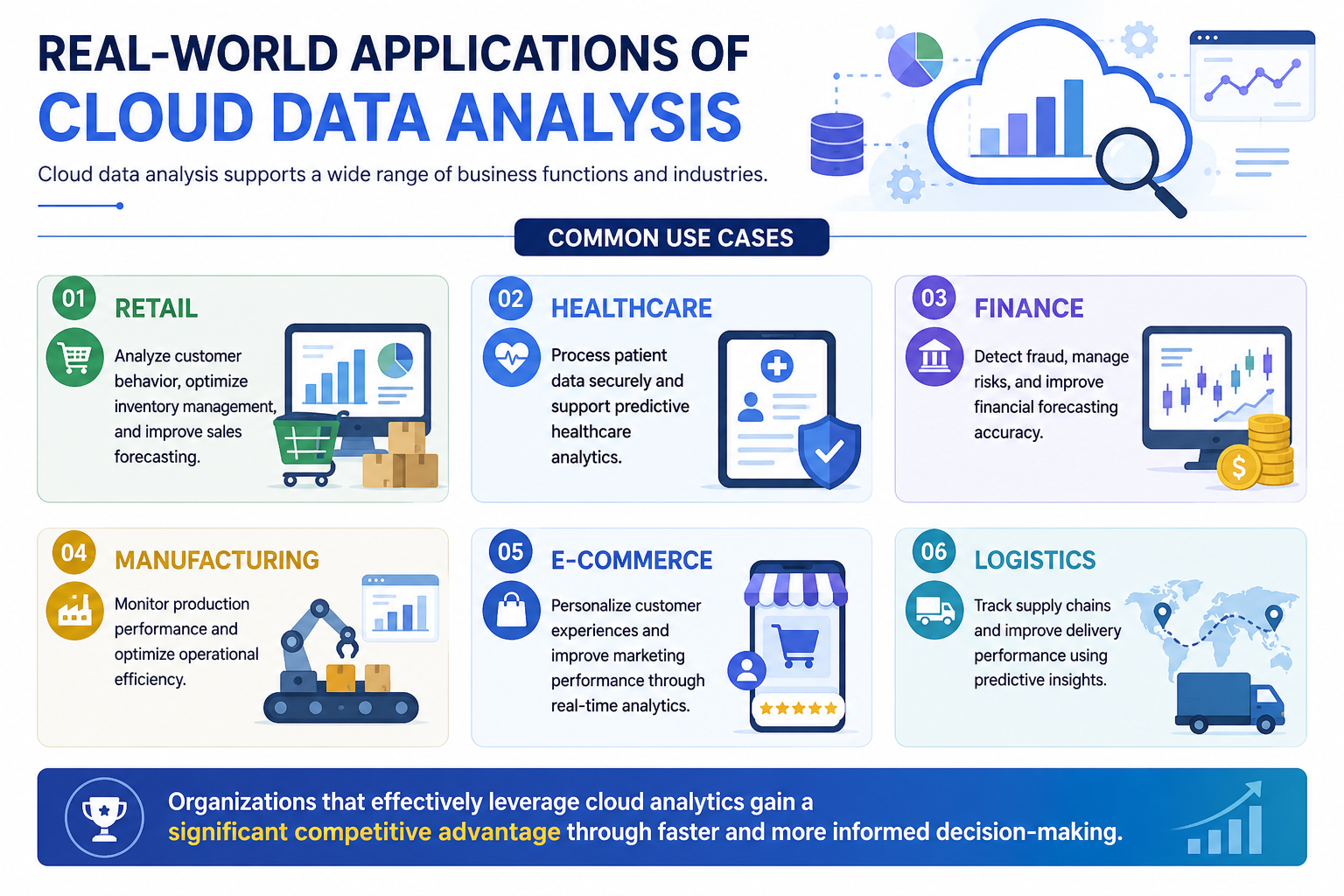
Real-World Applications of Cloud Data Analysis
Cloud data analysis supports a wide range of business functions and industries.
Common Use Cases
Retail
Analyze customer behavior, optimize inventory management, and improve sales forecasting.
Healthcare
Process patient data securely and support predictive healthcare analytics.
Finance
Detect fraud, manage risks, and improve financial forecasting accuracy.
Manufacturing
Monitor production performance and optimize operational efficiency.
E-commerce
Personalize customer experiences and improve marketing performance through real-time analytics.
Logistics
Track supply chains and improve delivery performance using predictive insights.
Organizations that effectively leverage cloud analytics gain a significant competitive advantage through faster and more informed decision-making.
Industry Statistics on Cloud Data Analysis
Cloud adoption continues to accelerate as organizations increasingly rely on data-driven decision-making.
Key Industry Insights
- More than 90% of enterprises use cloud services in some form to manage business operations and data workloads.
- Organizations generate massive volumes of structured and unstructured data every day, making cloud analytics essential for extracting meaningful insights.
- Businesses using cloud-based analytics platforms often experience faster reporting, improved operational efficiency, and better forecasting capabilities.
- Real-time analytics has become a priority for companies seeking to improve customer experiences and business agility.
- Cloud data analysis plays a critical role in AI, machine learning, predictive analytics, and business intelligence initiatives.
- Hybrid and multi-cloud strategies are becoming increasingly common as organizations seek greater flexibility and scalability.
- Data-driven companies consistently outperform competitors in decision-making speed and operational effectiveness.
As cloud technologies continue to evolve, cloud data analysis is becoming a core component of digital transformation strategies across industries.
As competition becomes increasingly data-driven, companies that invest in cloud analytics platforms, business intelligence tools, and predictive analytics capabilities will be better equipped to scale and innovate. |
Frequently Asked Questions
Quick answers related to this article from PerfectionGeeks.
1. What is cloud data analysis?
2. What are the benefits of cloud data analytics?
3. Which industries use cloud data analysis?
4. How does cloud data analysis support AI?
5. Is cloud data analysis secure?
Conclusion
Cloud data analysis is no longer just a technology trend—it's a business imperative. Organizations that invest in cloud analytics solutions today are better positioned to unlock valuable insights, drive innovation, improve customer experiences, and achieve sustainable growth in an increasingly data-driven world.

Written By Shrey Bhardwaj
Director & Founder
Shrey Bhardwaj is the Director & Founder of PerfectionGeeks Technologies, bringing extensive experience in software development and digital innovation. His expertise spans mobile app development, custom software solutions, UI/UX design, and emerging technologies such as Artificial Intelligence and Blockchain. Known for delivering scalable, secure, and high-performance digital products, Shrey helps startups and enterprises achieve sustainable growth. His strategic leadership and client-centric approach empower businesses to streamline operations, enhance user experience, and maximize long-term ROI through technology-driven solutions.