
Published 24 March 2026 | Updated 24 May 2026
Technology
How Cloud Modernization is Transforming Healthcare: Strategy, Benefits & ROI
Healthcare organizations are modernizing their IT systems to improve efficiency, patient care, and data management. Cloud modernization helps replace outdated infrastructure with scalable, secure, and high-performing cloud solutions. It supports faster access to medical data, reduces operational costs, and enables innovation through technologies like AI and analytics. This blog explores how cloud modernization is transforming healthcare, its key benefits, effective strategies, and the ROI it delivers to healthcare providers.
Quick AnswerHealthcare cloud modernization in healthcare refers to the process of upgrading traditional hospital IT systems into secure, scalable, and cloud-based infrastructure. It helps healthcare organizations improve patient data access, enhance system interoperability, reduce operational costs, and enable AI-driven healthcare services. In 2026, cloud modernization is becoming essential for digital transformation in healthcare due to the rise of telemedicine, real-time analytics, and connected health ecosystems. |
What Is Healthcare Cloud Modernization in Healthcare?
Healthcare cloud modernization refers to the process of upgrading traditional healthcare IT systems into modern cloud-based infrastructure. It involves moving electronic health records (EHR), hospital management systems, patient portals, and medical applications to secure cloud platforms.
Healthcare cloud modernization providers in the US design and implement these transformations to improve scalability, security, and real-time access to patient data. This modernization is critical for supporting AI-driven diagnostics, telemedicine, and digital health ecosystems in 2026.
Why Healthcare Cloud Modernization Is Important
Healthcare cloud modernization has become a foundational requirement for modern healthcare systems as hospitals, clinics, pharmaceutical companies, and digital health platforms transition toward data-driven and AI-enabled care delivery. Traditional healthcare IT infrastructure is no longer capable of handling the speed, scale, and complexity of modern healthcare data.
The growing demand for healthcare cloud modernization services is driven by the need for real-time data access, improved interoperability, stronger cybersecurity, and seamless integration with advanced technologies such as artificial intelligence (AI), machine learning (ML), and predictive analytics.
Healthcare organizations are adopting cloud modernization in healthcare because legacy systems often operate in silos, limiting the ability to share patient data across departments or institutions. This results in delayed decision-making, higher operational costs, and reduced quality of patient care.
In contrast, modern cloud-based healthcare systems enable a unified digital ecosystem where data flows securely and efficiently between different healthcare applications and stakeholders.
Ready to Transform Your Healthcare Infrastructure?
Modern healthcare requires scalable, secure, and intelligent digital systems. PerfectionGeeks helps healthcare organizations modernize legacy infrastructure with cloud-native solutions designed for performance, compliance, and long-term growth.
Whether you need healthcare cloud migration, AI integration, interoperability solutions, or complete healthcare IT modernization, our experts can help you build a future-ready healthcare ecosystem.
How Cloud Modernization in Healthcare Works
Healthcare cloud modernization is not just a technology upgrade — it is a structured transformation strategy that involves multiple phases to ensure security, compliance, and operational continuity. In modern healthcare cloud modernization services, every step is carefully planned to move sensitive medical data, applications, and workflows from legacy systems to scalable cloud environments without disrupting patient care or hospital operations. This process is a key part of healthcare IT modernization and supports long-term digital transformation in healthcare.
1. Comprehensive System Assessment
The first phase of healthcare cloud modernization in healthcare systems begins with a detailed assessment of existing IT infrastructure. Hospitals, clinics, and healthcare organizations analyze their current systems such as EHR platforms, patient management systems, billing software, and laboratory tools. The goal is to identify performance gaps, outdated technologies, and security vulnerabilities. This step helps define a clear roadmap for healthcare cloud migration and ensures that modernization aligns with business goals, compliance requirements, and future scalability needs.
2. Cloud Readiness & Strategy Development
In this stage, organizations design a tailored healthcare cloud modernization strategy based on their operational requirements and regulatory standards. Decisions are made regarding cloud deployment models such as public cloud, private cloud, or hybrid cloud depending on data sensitivity and workload type. This phase ensures that the chosen approach supports healthcare data management systems, improves scalability, and reduces long-term operational costs while maintaining compliance with healthcare regulations like HIPAA and GDPR.
3. Secure Data Migration Planning
Data migration is one of the most critical phases of cloud modernization in healthcare. It involves securely transferring patient records, medical imaging files, clinical applications, and administrative data from legacy systems to cloud platforms. Advanced migration tools and encryption techniques are used to ensure zero data loss, minimal downtime, and maximum data integrity. This step plays a major role in enabling seamless healthcare cloud transformation while maintaining uninterrupted access to critical patient information.
4. Security, Compliance & Risk Management
Security is a top priority in healthcare cloud modernization services, as healthcare data is highly sensitive and regulated. This phase focuses on implementing strong cybersecurity frameworks including end-to-end encryption, multi-factor authentication, identity access management, and continuous monitoring systems. Compliance with healthcare regulations ensures that patient data is protected at all times. Strong governance also helps organizations reduce risks of breaches and maintain trust in their healthcare cloud infrastructure.
5. Integration with Modern Healthcare Technologies
Once data is migrated, the next step in healthcare cloud modernization in 2026 is integrating advanced technologies such as artificial intelligence (AI), machine learning (ML), Internet of Things (IoT), and big data analytics. This integration allows healthcare providers to enable predictive diagnostics, remote patient monitoring, and real-time data insights. It also improves interoperability between different healthcare systems, making the entire ecosystem more connected and efficient.
6. Optimization & Continuous Improvement
The final phase of healthcare cloud modernization solutions focuses on continuous optimization of cloud performance. This includes monitoring system performance, reducing operational costs, improving scalability, and enhancing user experience for healthcare professionals. AI-driven analytics and automation tools are often used to detect inefficiencies and improve system responsiveness. Continuous improvement ensures that healthcare organizations remain competitive in the evolving landscape of healthcare digital transformation.
Key Benefits of Cloud Modernization in Healthcare
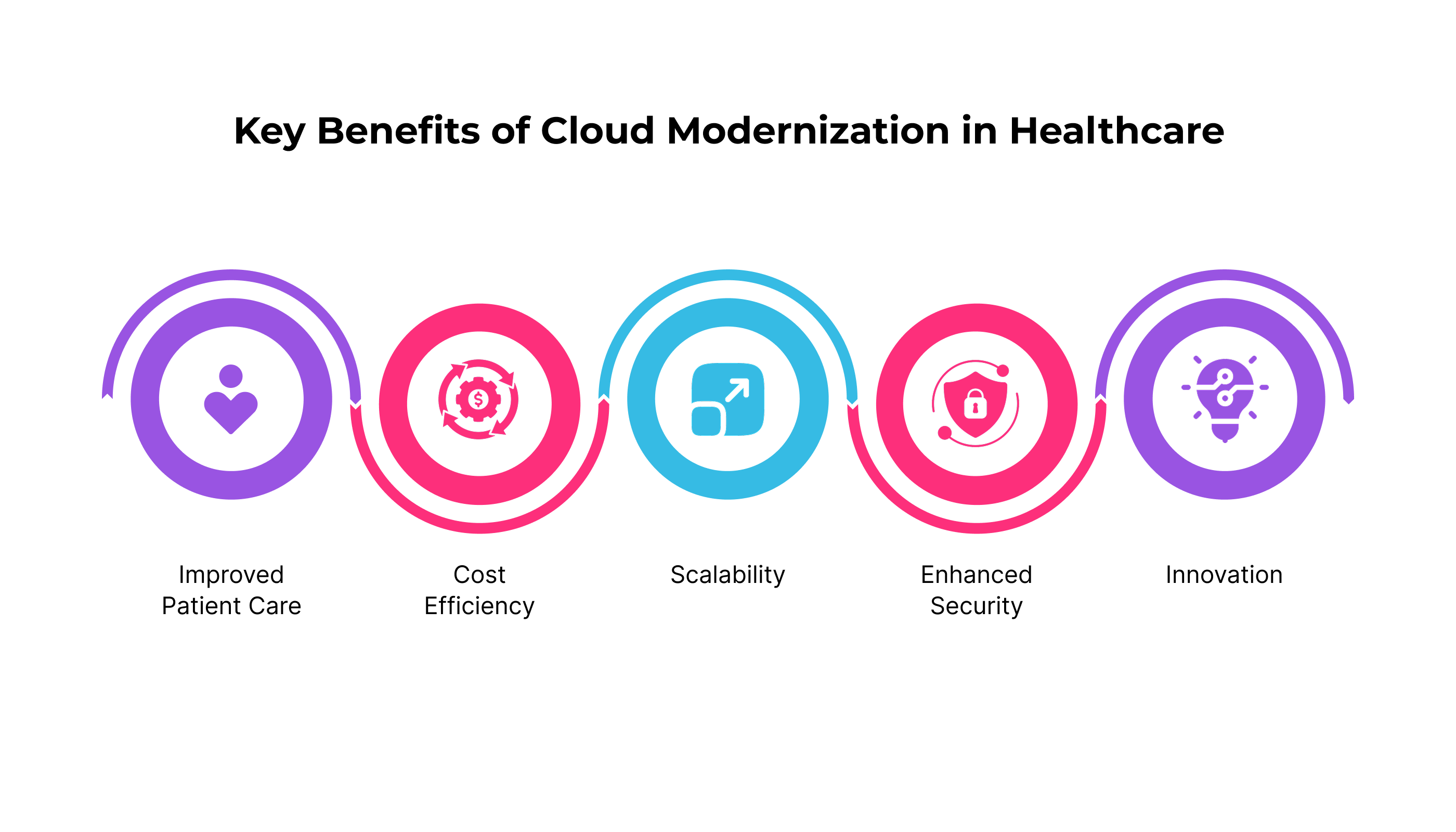
1. Improved Patient Care: Doctors can access patient records instantly from anywhere, which helps in faster diagnosis and treatment. Real-time data improves decision-making and leads to better patient outcomes.
2. Cost Efficiency: Cloud reduces the need for expensive hardware, servers, and maintenance. With a pay-as-you-go model, healthcare organizations only pay for what they use, saving overall costs.
3. Scalability: Healthcare systems can easily scale up or down based on patient data and demand. This flexibility ensures smooth operations even during peak times.
4. Enhanced Security: Cloud providers offer advanced security features like encryption and compliance standards. This helps protect sensitive patient data and reduces the risk of data breaches.
5. Innovation: Cloud enables the use of advanced technologies like AI, telemedicine, and predictive analytics. This supports smarter healthcare solutions and improves overall service quality.
Key Use Cases by Healthcare Organization Type
| Organization Type | Primary Use Case | Cloud Solution | Typical ROI Timeline |
|---|---|---|---|
| Large Hospital Networks | EHR consolidation & interoperability | Hybrid Cloud (Azure + on-prem) | 18–24 months |
| Ambulatory Care Centers | Patient scheduling & billing automation | Public Cloud (AWS) | 12–18 months |
| Digital Health Startups | Telehealth platform & patient app | Cloud-native (GCP/AWS) | 6–12 months |
| Specialty Clinics | Diagnostic imaging & AI analytics | Public Cloud + AI/ML services | 12–18 months |
| Payers & Insurance | Claims processing & fraud detection | Private Cloud | 18–30 months |
Cloud Modernization Strategy for Healthcare Organizations
A successful cloud modernization strategy healthcare organizations adopt should be well-planned, secure, and aligned with business goals. Below is a detailed explanation of each step along with additional important points:
1. Assessment of Current Systems
Healthcare organizations must first evaluate their existing IT infrastructure, including hardware, software, and data systems. This helps identify gaps, inefficiencies, and outdated technologies. Understanding current system limitations makes it easier to plan the modernization journey. It also helps prioritize which systems should be upgraded or migrated first. A proper assessment reduces risks and ensures smoother implementation.
2. Clear Goal Setting
Setting clear and measurable goals is essential for a successful strategy. Organizations should define what they want to achieve, such as cost reduction, better patient care, improved data access, or faster innovation. Clear objectives help guide decision-making throughout the process. They also make it easier to measure success and ROI after implementation. Without defined goals, cloud adoption may not deliver expected results.
3. Choosing the Right Cloud Solutions
Selecting the right cloud solutions for healthcare industry is a critical step. Organizations must consider factors like scalability, security, compliance, and performance. Options include public, private, or hybrid cloud models depending on specific needs. The chosen solution should support healthcare regulations and handle sensitive patient data securely. The right platform ensures long-term flexibility and growth.
4. Staff Training and Change Management
Employees play a key role in the success of cloud modernization. Healthcare staff must be trained to use new systems efficiently. Without proper training, adoption can be slow and errors may increase. Change management strategies help reduce resistance and improve acceptance. Continuous support and learning programs ensure smooth transition and better productivity.
5. Governance and Security
Strong governance policies are necessary to manage cloud operations effectively. This includes setting rules for data access, usage, and compliance. Security is especially important in healthcare due to sensitive patient information. Organizations must implement encryption, identity management, and regular audits. A strong governance framework ensures data protection and regulatory compliance.
6. Data Migration Planning
A detailed data migration plan is essential to move information from legacy systems to the cloud. This includes identifying which data to migrate, ensuring data quality, and minimizing downtime. Proper planning helps avoid data loss or corruption. It also ensures continuity of healthcare services during the transition.
7. Selecting the Right Cloud Partner
Choosing an experienced cloud service provider is crucial for success. The provider should have expertise in healthcare cloud services and understand industry regulations. A reliable partner can guide the entire modernization process and reduce risks. They also provide ongoing support and maintenance.
Step-by-Step Guide to Healthcare Cloud Modernization
A structured healthcare cloud migration process is essential for successful implementation of healthcare cloud modernization services with minimal disruption to clinical operations, patient care, and administrative workflows. A well-planned approach ensures smooth cloud modernization in healthcare, improved scalability, and compliance with healthcare regulations while modernizing legacy systems.
Step 1: Evaluate Existing Infrastructure
The first step in healthcare IT modernization is a complete evaluation of existing healthcare infrastructure. This includes analyzing current systems such as electronic health records (EHR), hospital management systems, billing platforms, and laboratory information systems. The objective is to identify outdated technologies, performance issues, and integration challenges. This assessment helps define a clear roadmap for healthcare cloud modernization in healthcare systems and ensures that future upgrades align with organizational goals and digital transformation strategies.
Step 2: Define Compliance Requirements
In this phase, healthcare organizations ensure that all systems comply with strict healthcare data privacy and security standards. Regulations such as HIPAA, GDPR, and other regional healthcare compliance frameworks must be followed during the entire healthcare cloud migration process. Defining compliance requirements early helps reduce risks related to data breaches, legal issues, and operational disruptions while strengthening trust in healthcare cloud modernization solutions.
Step 3: Select Cloud Platform
Choosing the right cloud platform is a critical decision in healthcare cloud modernization strategy. Organizations typically evaluate leading providers such as AWS, Microsoft Azure, or Google Cloud based on scalability, security features, cost efficiency, and compliance readiness. The selected platform must support healthcare workloads, enable interoperability, and integrate with advanced tools used in healthcare digital transformation, including AI, analytics, and automation systems.
Step 4: Execute Migration
This step involves securely transferring healthcare applications, databases, and sensitive patient records from legacy systems to cloud infrastructure. A carefully executed migration ensures zero data loss, minimal downtime, and uninterrupted access to critical healthcare services. In cloud modernization in healthcare, this phase is often supported by encryption, backup systems, and migration tools to maintain data integrity and operational continuity.
Step 5: Testing & Validation
After migration, systems are rigorously tested to ensure performance, reliability, security, and interoperability. This includes validating healthcare applications, checking system response times, and ensuring seamless data flow across platforms. In healthcare cloud modernization services, testing plays a key role in identifying issues early and ensuring that the new cloud environment meets all operational and compliance requirements.
Step 6: Continuous Optimization
The final step in healthcare cloud modernization in 2026 focuses on continuous monitoring and optimization. Healthcare organizations use AI-based analytics, automation tools, and performance monitoring systems to improve efficiency, reduce costs, and enhance system reliability. Continuous optimization ensures that the cloud infrastructure remains scalable, secure, and aligned with evolving healthcare needs.
ROI of Cloud Modernization in Healthcare
The return on investment (ROI) from IT modernization for healthcare facilities is significant because it impacts both financial performance and patient outcomes. By moving from traditional IT systems to cloud modernization services, healthcare organizations reduce infrastructure costs, improve efficiency, and unlock new opportunities for revenue growth.
- Reduced Costs: Traditional IT systems require heavy upfront investments in servers, hardware, and maintenance. Cloud offers a pay-as-you-go model, eliminating unnecessary expenses and allowing organizations to scale resources only when needed.
- Improved Patient Satisfaction: With cloud application modernization, patient data becomes easily accessible, enabling faster diagnoses, smoother workflows, and better communication between doctors and patients. This leads to higher satisfaction and trust.
- Operational Efficiency: Cloud systems automate compliance, security, and data management, reducing manual errors and freeing staff to focus on patient care.
- New Revenue Streams: Cloud enables telemedicine, remote monitoring, and digital health services, which expand the reach of healthcare facilities and create new income opportunities.
ROI Comparison Table
| Aspect | Traditional IT Systems | Cloud Modernization Services |
| Infrastructure Costs | High upfront costs | Pay-as-you-go model |
| Scalability | Limited | Highly scalable |
| Security & Compliance | Manual, error-prone | Automated, cloud provider managed |
| Patient Data Access | Slow, fragmented | Real-time, centralized |
| Innovation Speed | Low | High |
Challenges in Cloud Modernization and Their Solutions
1. Data Security Concerns
Healthcare data is highly sensitive and includes patient records, medical history, and personal information. Any breach can lead to serious legal and financial consequences. Many organizations worry about storing this data on the cloud.
Solution: Partner with trusted cloud providers that offer strong security features like encryption, multi-factor authentication, and compliance with standards such as HIPAA. Regular security audits and monitoring also help protect data.
2. Integration Issues
Many healthcare organizations still use legacy systems that were not designed for cloud environments. Integrating these old systems with modern cloud platforms can be complex and time-consuming. It may also lead to data inconsistency or system downtime.
Solution: Use APIs and middleware to connect old and new systems smoothly. A phased migration approach can also help reduce risks and ensure better compatibility.
3. Resistance to Change
Healthcare staff may be comfortable with existing systems and hesitate to adopt new technologies. Lack of technical knowledge and fear of change can slow down the modernization process. This can impact productivity and delay implementation.
Solution: Provide proper training, workshops, and continuous support. Change management strategies and clear communication about benefits can help employees adapt more easily.
4. Cost Management
Cloud migration requires initial investment in tools, infrastructure, and training. Without proper planning, costs can increase quickly. Many organizations worry about managing these expenses.
Solution: Adopt a phased implementation strategy instead of migrating everything at once. Monitor usage and optimize resources regularly to control costs and improve ROI.
5. Compliance and Regulatory Challenges
Healthcare organizations must follow strict regulations related to data privacy and security. Managing compliance across different regions can be difficult when using cloud platforms. Non-compliance can result in penalties and loss of trust.
Solution: Choose cloud providers that comply with healthcare regulations like HIPAA or GDPR. Implement strong governance policies and regularly review compliance requirements.
6. Data Migration Risks
Moving large volumes of patient data from legacy systems to the cloud can be risky. There is a chance of data loss, corruption, or downtime during migration. This can affect patient care and operations.
Solution: Use secure data migration tools and create proper backup systems. Test the migration process in stages to ensure accuracy and minimize risks.
7. Downtime and System Disruptions
During cloud migration, systems may experience downtime, which can impact hospital operations and patient services. Even short interruptions can cause delays in treatment and communication.
Solution: Plan migration during low-traffic hours and use backup systems to ensure continuity. A well-structured implementation plan helps minimize disruptions.
Expert Tips for Healthcare Cloud Modernization in 2026
Implementing the right strategies can significantly improve the success of healthcare cloud modernization solutions. These expert practices help healthcare organizations achieve better scalability, stronger security, and improved patient outcomes in modern digital ecosystems.
Adopt hybrid cloud models for sensitive healthcare workloads securely
Hybrid cloud allows healthcare organizations to keep critical patient data in private environments while using public cloud for scalable workloads. This approach improves flexibility, security, and cost efficiency in healthcare cloud modernization in 2026.
Implement AI-powered diagnostic systems and predictive healthcare tools
AI and predictive analytics help healthcare providers detect diseases earlier and improve treatment accuracy. Integrating AI into cloud modernization in healthcare enables smarter decision-making and more personalized patient care.
Use zero-trust security architecture for stronger cybersecurity
Zero-trust security ensures that every user and device is continuously verified before accessing healthcare data. This strengthens protection against cyber threats and enhances trust in healthcare IT modernization systems.
Ensure full interoperability across healthcare platforms
Interoperability allows different healthcare systems such as EHRs, labs, and billing systems to communicate seamlessly. This improves data flow, reduces duplication, and enhances efficiency in healthcare cloud modernization services.
Continuously monitor cloud performance, usage, and cost efficiency
Ongoing monitoring helps identify performance issues, optimize resources, and reduce unnecessary cloud spending. This is essential for maintaining efficiency in long-term healthcare cloud transformation projects.
Invest in advanced healthcare data analytics
Data analytics helps healthcare providers gain insights from patient data, improve treatment plans, and support strategic decision-making. In modern healthcare cloud modernization, analytics plays a key role in improving overall healthcare outcomes.
Future Trends in Healthcare Cloud Modernization (2026 & Beyond)
AI-Driven Personalized Medicine
Cloud platforms combined with AI can analyze patient data to create personalized treatment plans. This helps doctors provide more accurate and effective care. It also improves patient outcomes by focusing on individual health needs. Over time, treatments become more precise and efficient.
Blockchain Integration
Blockchain technology helps in securely storing and sharing patient data across different healthcare providers. It ensures that data cannot be easily changed or misused. This increases trust and transparency in healthcare systems. It also improves data accuracy and security.
Edge Computing
Edge computing processes data closer to the patient instead of sending it to distant servers. This allows faster response times, especially for critical health monitoring. It is useful for devices like wearable health trackers. Real-time data helps doctors take quick action when needed.
Expanded Telehealth Services
Telehealth is growing with advanced technologies like virtual reality (VR) and immersive tools. Patients can consult doctors remotely in a more interactive way. This improves access to healthcare, especially in remote areas. It also saves time and reduces hospital visits.
Predictive Healthcare Models
Cloud and AI analyze large amounts of data to predict future health issues. Doctors can identify risks early and take preventive measures. This reduces hospital admissions and improves patient care. It helps shift healthcare from treatment to prevention.
Before You Leave — Get a Free Healthcare Cloud Consultation
Modernize your healthcare systems with secure and scalable cloud solutions.
Speak with our healthcare cloud modernization experts and receive a customized transformation strategy for your organization.
Frequently Asked Questions
Quick answers related to this article from PerfectionGeeks.
1. What is healthcare cloud modernization in healthcare?
2. Why is healthcare cloud modernization important for hospitals and clinics?
3. What are the benefits of healthcare cloud modernization services?
4. How can PerfectionGeeks help with cloud modernization in healthcare?
5. How long does healthcare cloud migration take?
Conclusion
Cloud modernization is transforming healthcare by enabling better patient outcomes, reducing costs, and driving innovation. With cloud modernization services, hospitals and clinics can modernize IT systems, adopt scalable solutions, and ensure compliance. A strong cloud modernization strategy healthcare approach ensures smooth migration and long-term success. Though challenges exist, the benefits of healthcare cloud services far outweigh the risks. By embracing cloud solutions for healthcare industry, organizations can unlock efficiency, innovation, and measurable ROI.

Written By Shrey Bhardwaj
Director & Founder
Shrey Bhardwaj is the Director & Founder of PerfectionGeeks Technologies, bringing extensive experience in software development and digital innovation. His expertise spans mobile app development, custom software solutions, UI/UX design, and emerging technologies such as Artificial Intelligence and Blockchain. Known for delivering scalable, secure, and high-performance digital products, Shrey helps startups and enterprises achieve sustainable growth. His strategic leadership and client-centric approach empower businesses to streamline operations, enhance user experience, and maximize long-term ROI through technology-driven solutions.