Published 31 July 2025 | Updated 23 May 2026
App
COBOL Modernization Solutions for Financial Services: Complete Guide 2026
Financial institutions worldwide still rely heavily on COBOL-based banking systems to process millions of transactions daily. From core banking operations and payment processing to insurance claims and ATM networks, COBOL applications continue to power mission-critical financial services infrastructure. However, legacy systems now face rising maintenance costs, cybersecurity risks, regulatory pressure, and integration challenges with modern digital platforms.
As customer expectations shift toward real-time banking experiences and AI-driven financial services, enterprises are actively investing in COBOL modernization solutions to remain competitive.
What is COBOL modernization in financial services?COBOL modernization refers to upgrading legacy COBOL banking and financial systems into scalable, secure, and cloud-compatible platforms. This process may include application rehosting, code refactoring, API integration, cloud migration, UI modernization, and microservices transformation while preserving critical business logic. Why do banks modernize COBOL systems?Banks modernize COBOL systems to:
Is COBOL still used in banking?Yes. According to industry estimates, over 70% of global financial transactions still depend on COBOL systems. Many banks continue using COBOL because of its reliability and proven transaction-processing capabilities. |
- COBOL systems continue to power a major portion of global banking and financial transactions due to their reliability and stability.
- Legacy COBOL applications face growing challenges including high maintenance costs, limited scalability, security concerns, and integration issues with modern technologies.
- Financial institutions are investing in COBOL modernization to support digital banking, cloud adoption, AI integration, and real-time financial services.
- Common COBOL modernization approaches include rehosting, refactoring, replatforming, and complete application rebuilding depending on business goals.
- Modernization helps banks and financial organizations improve operational efficiency, enhance cybersecurity, reduce infrastructure costs, and deliver better customer experiences.
- API integration and microservices architecture enable legacy financial systems to connect seamlessly with mobile apps, fintech platforms, and cloud ecosystems.
- AI-powered automation and cloud technologies are accelerating legacy application modernization across the banking and insurance sectors.
- Choosing an experienced modernization partner is essential to preserve critical business logic, minimize downtime, and ensure regulatory compliance.
- A phased modernization strategy helps organizations reduce risks while transforming mission-critical banking infrastructure.
- COBOL modernization is no longer just a technical upgrade — it has become a strategic initiative for long-term digital transformation and competitive growth in financial services.
Why COBOL Still Dominates Banking and Financial Systems
COBOL has remained a backbone technology for financial institutions for decades because it was designed for high-volume transaction processing and data integrity. Major banks, insurance companies, and payment processors continue relying on COBOL applications due to their stability and reliability.
Common Financial Systems Running on COBOL
- Core banking platforms
- Loan processing systems
- Insurance policy management
- ATM transaction systems
- Credit card processing
- Payment gateways
- Treasury management systems
- Pension and payroll systems
Many of these systems were developed decades ago and expanded over time. While they remain functional, maintaining and scaling them has become increasingly difficult.
Major Challenges with Legacy COBOL Systems
1. Aging Infrastructure
Most COBOL applications run on legacy mainframes that are expensive to maintain and difficult to scale.
2. Shortage of COBOL Developers
Finding experienced COBOL programmers is becoming a major challenge for financial organizations globally.
3. Integration Limitations
Legacy banking systems often struggle to integrate with:
- Mobile banking applications
- AI-powered analytics tools
- Cloud platforms
- Open banking APIs
- FinTech ecosystems
4. Rising Operational Costs
Maintaining outdated hardware and software environments significantly increases operational expenses.
5. Security and Compliance Risks
Financial institutions must comply with evolving regulations and cybersecurity standards. Legacy systems may lack modern encryption, authentication, and monitoring capabilities.
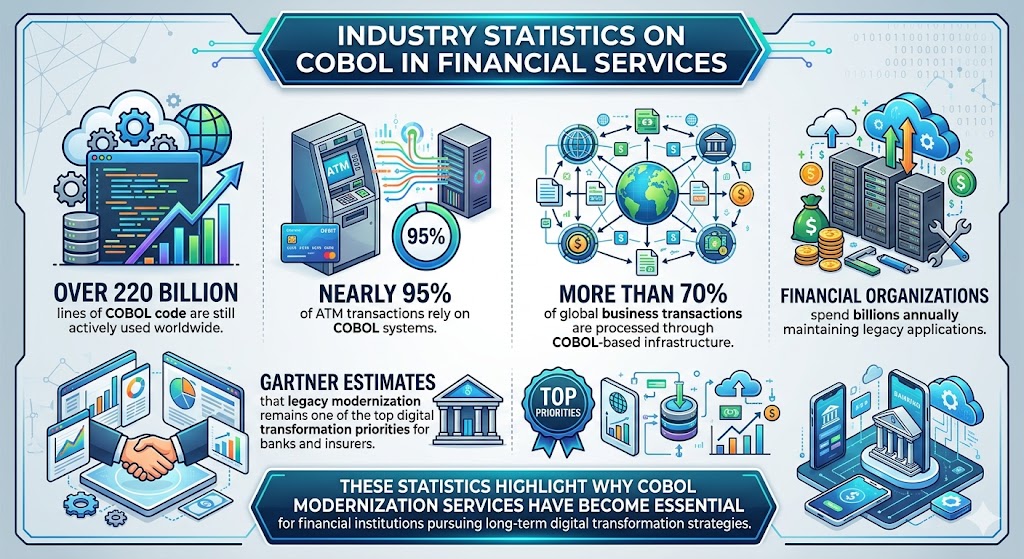
Industry Statistics on COBOL in Financial Services
- Over 220 billion lines of COBOL code are still actively used worldwide.
- Nearly 95% of ATM transactions rely on COBOL systems.
- More than 70% of global business transactions are processed through COBOL-based infrastructure.
- Financial organizations spend billions annually maintaining legacy applications.
- Gartner estimates that legacy modernization remains one of the top digital transformation priorities for banks and insurers.
These statistics highlight why COBOL modernization services have become essential for financial institutions pursuing long-term digital transformation strategies.
Benefits of COBOL Modernization Solutions
Improved Operational Efficiency
Modernized systems improve transaction speed, reduce downtime, and enhance operational workflows.
Enhanced Customer Experience
Banks can deliver seamless digital experiences through mobile banking apps, AI chatbots, and real-time financial services.
Better Scalability
Cloud-enabled architectures help organizations scale infrastructure based on business demands.
Stronger Security
Modern security frameworks help financial organizations meet evolving compliance and cybersecurity requirements.
Easier Integration
API-driven modernization enables seamless connectivity with modern applications and FinTech ecosystems.
Reduced Maintenance Costs
Migrating away from aging infrastructure lowers long-term maintenance and operational expenses.
Popular COBOL Modernization Approaches
Rehosting (Lift and Shift)
This approach migrates COBOL applications from mainframes to cloud or distributed platforms without major code changes.
Best For:
- Faster migration timelines
- Lower modernization risk
- Cost reduction initiatives
Refactoring
Refactoring restructures COBOL code to improve maintainability and performance while preserving business logic.
Best For:
- Long-term modernization
- Improving application agility
- Performance optimization
Replatforming
Applications are moved to modern infrastructure while retaining core functionalities.
Best For:
- Hybrid cloud adoption
- Infrastructure optimization
Rebuilding or Replacing
In some cases, organizations rebuild applications using modern technologies such as Java, .NET, or cloud-native frameworks.
Best For:
- Complete digital transformation
- Legacy retirement strategies
Accelerate Your Financial System ModernizationLegacy banking systems should not limit innovation. Modernize your COBOL infrastructure with scalable, secure, and cloud-ready solutions tailored for financial institutions. Why Choose PerfectionGeeks?
Explore customized COBOL modernization strategies with PerfectionGeeks. |
Key Technologies Used in COBOL Modernization
Cloud Computing
Financial organizations are migrating COBOL workloads to cloud platforms for flexibility and scalability.
APIs and Microservices
Microservices architecture improves modularity and integration capabilities.
AI and Automation
AI-driven tools help automate code analysis, testing, and migration processes.
DevOps
Modern DevOps pipelines accelerate deployment and improve software delivery efficiency.
Containerization
Technologies like Docker and Kubernetes simplify application deployment and scalability.
COBOL Modernization Use Cases in Financial Services
Core Banking Transformation
Banks modernize legacy systems to enable real-time banking and omnichannel experiences.
Insurance Platform Modernization
Insurance companies modernize claims management and policy administration systems.
Payment Processing Modernization
Modern infrastructure helps financial institutions support instant payments and digital wallets.
Fraud Detection Integration
Modernized systems can integrate with AI-based fraud detection and analytics tools.
How to Choose the Right COBOL Modernization Partner
Selecting the right modernization company is critical for minimizing risk and ensuring successful transformation.
Important Factors to Consider
- Experience in financial software development
- Mainframe modernization expertise
- Cloud migration capabilities
- Regulatory compliance knowledge
- API and microservices expertise
- End-to-end testing and support
A trusted modernization partner helps organizations modernize without disrupting mission-critical financial operations.
Common Risks in COBOL Modernization Projects
Data Migration Complexity
Migrating decades of financial data requires careful validation and testing.
Downtime Risks
Banks must ensure uninterrupted services during modernization.
Compliance Challenges
Financial institutions must maintain compliance throughout the transformation process.
Business Logic Preservation
COBOL systems contain decades of valuable business rules that must be retained accurately.
Proper planning, phased migration, and automated testing significantly reduce modernization risks.
Future Trends in COBOL Modernization
AI-Assisted Code Conversion
AI tools are increasingly helping automate legacy code analysis and migration.
Hybrid Cloud Banking
Banks are adopting hybrid cloud strategies for flexibility and security.
Open Banking Integration
Modern APIs enable seamless integration with third-party financial platforms.
Hyperautomation
Automation technologies streamline financial workflows and reduce operational inefficiencies.
Real-Time Data Processing
Modernized infrastructures support faster analytics and transaction processing.
|
Frequently Asked Questions
Quick answers related to this article from PerfectionGeeks.
1. What is COBOL modernization?
2. Why is COBOL still important in banking?
3. How long does COBOL modernization take?
4. What are the benefits of modernizing COBOL applications?
5. Can COBOL systems integrate with modern applications?
6. Is cloud migration possible for COBOL applications?
Conclusion
COBOL systems have powered the financial industry for decades, but evolving customer expectations, cybersecurity threats, and digital transformation demands require a modern approach. Financial institutions that invest in COBOL modernization solutions gain improved scalability, stronger security, better integration capabilities, and enhanced operational efficiency.
Whether through rehosting, refactoring, replatforming, or complete transformation, modernizing legacy banking infrastructure helps organizations stay competitive in the rapidly evolving financial landscape.
Businesses looking to future-proof their financial systems should adopt a phased modernization strategy backed by experienced technology partners and cloud-ready architectures.

Written By Shrey Bhardwaj
Director & Founder
Shrey Bhardwaj is the Director & Founder of PerfectionGeeks Technologies, bringing extensive experience in software development and digital innovation. His expertise spans mobile app development, custom software solutions, UI/UX design, and emerging technologies such as Artificial Intelligence and Blockchain. Known for delivering scalable, secure, and high-performance digital products, Shrey helps startups and enterprises achieve sustainable growth. His strategic leadership and client-centric approach empower businesses to streamline operations, enhance user experience, and maximize long-term ROI through technology-driven solutions.