
Published 20 November 2025 | Updated 25 May 2026
Technology
How Edge Computing Revolutionizes IoT App Speed & Efficiency — Complete Guide 2026
The Internet of Things (IoT) has transformed the way devices communicate and interact with each other, creating smarter homes, cities, and industries. But as IoT applications grow in scale and complexity, traditional cloud computing faces challenges in managing the vast amount of data generated by IoT devices. This is where edge computing steps in, revolutionizing the speed and efficiency of IoT apps.
How Does Edge Computing Improve IoT Performance?Edge computing improves IoT app speed and efficiency by processing data near IoT devices instead of sending all data to centralized cloud servers. Key benefits include:
Industries such as healthcare, manufacturing, smart cities, logistics, and automotive are increasingly adopting edge computing to improve IoT performance and scalability. |
- Edge computing improves IoT app speed by processing data closer to connected devices instead of centralized cloud servers.
- Reduced latency enables real-time decision-making for IoT applications such as autonomous vehicles, healthcare systems, and industrial automation.
- Edge computing lowers bandwidth usage by filtering and processing critical data locally before sending it to the cloud.
- Enhanced security and localized data processing help reduce cybersecurity risks in IoT ecosystems.
- Industries including healthcare, manufacturing, automotive, retail, and smart cities are rapidly adopting edge computing solutions.
- Combining edge computing with AI and 5G technology is driving the next generation of intelligent IoT applications.
- Edge-enabled IoT systems offer better reliability and can continue operating even with unstable internet connectivity.
- Businesses using edge computing gain improved operational efficiency, faster analytics, lower infrastructure costs, and better scalability.
- Real-time analytics and smart automation are becoming major drivers of digital transformation across industries.
- Partnering with an experienced IoT development company like PerfectionGeeks Technologies helps businesses build secure, scalable, and future-ready edge computing solutions.
What Is Edge Computing?
Edge computing is a distributed computing model where data processing occurs closer to the physical location of IoT devices, sensors, or users.
Instead of sending all information to a centralized cloud server, edge devices process critical data locally and only send necessary information to the cloud.
This architecture enables:
- Real-time analytics
- Faster decision-making
- Improved responsiveness
- Better network optimization
Edge computing is becoming essential for modern IoT application development.
Why Traditional Cloud Computing Faces Challenges in IoT
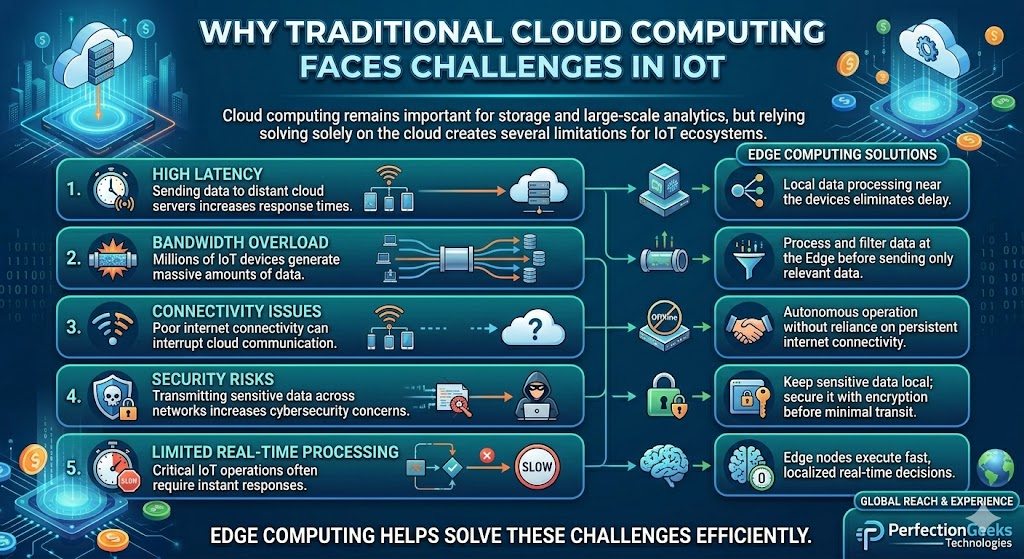
Cloud computing remains important for storage and large-scale analytics, but relying solely on the cloud creates several limitations for IoT ecosystems.
Common Challenges
High Latency
Sending data to distant cloud servers increases response times.
Bandwidth Overload
Millions of IoT devices generate massive amounts of data.
Connectivity Issues
Poor internet connectivity can interrupt cloud communication.
Security Risks
Transmitting sensitive data across networks increases cybersecurity concerns.
Limited Real-Time Processing
Critical IoT operations often require instant responses.
Edge computing helps solve these challenges efficiently.
How Edge Computing Revolutionizes IoT App Speed
1. Real-Time Data Processing
Edge computing enables IoT devices to process information instantly at the local level.
Examples include:
- Autonomous vehicles
- Industrial automation systems
- Smart healthcare devices
- Smart surveillance systems
Real-time processing reduces delays and improves decision-making accuracy.
2. Reduced Network Latency
Latency is one of the biggest problems in cloud-based IoT systems.
Edge computing reduces latency by minimizing the distance data must travel.
Benefits include:
- Faster app performance
- Improved user experiences
- Better IoT responsiveness
- Reliable automation systems
This is especially important for mission-critical IoT applications.
3. Lower Bandwidth Usage
IoT devices continuously generate large volumes of data.
Edge computing filters and processes relevant information locally before sending selected data to the cloud.
This:
- Reduces bandwidth consumption
- Improves network efficiency
- Lowers cloud infrastructure costs
Businesses can operate IoT systems more efficiently at scale.
4. Enhanced IoT Security
Security is a major concern in connected ecosystems.
Edge computing improves cybersecurity by:
- Reducing unnecessary data transmission
- Encrypting local processing
- Limiting centralized attack surfaces
- Supporting real-time threat detection
This helps protect sensitive business and customer information.
5. Improved Reliability & Offline Functionality
Edge-enabled IoT systems can continue operating even with unstable internet connectivity.
This is critical for:
- Remote industrial facilities
- Smart agriculture
- Transportation systems
- Oil & gas operations
Local processing ensures uninterrupted performance.
Key Industries Benefiting from Edge Computing in IoT
Healthcare
Edge computing supports:
- Remote patient monitoring
- Smart medical devices
- Real-time diagnostics
- Emergency healthcare systems
Healthcare organizations require fast and secure data processing.
Manufacturing & Industry 4.0
Industrial IoT systems use edge computing for:
- Predictive maintenance
- Robotics automation
- Machine monitoring
- Production optimization
Smart factories depend on low-latency processing for operational efficiency.
Automotive Industry
Connected vehicles and autonomous driving systems require:
- Instant sensor processing
- Real-time navigation
- Vehicle-to-vehicle communication
- AI-driven safety systems
Edge computing is critical for automotive innovation.
Smart Cities
Smart city infrastructure uses edge computing for:
- Traffic management
- Smart surveillance
- Energy optimization
- Public safety monitoring
Real-time processing improves urban efficiency.
Retail & eCommerce
Retail businesses use edge computing for:
- Smart inventory management
- In-store analytics
- Personalized shopping experiences
- Automated checkout systems
This improves customer engagement and operational efficiency.
Build High-Performance IoT Solutions with PerfectionGeeksLooking to develop scalable IoT applications powered by edge computing? At PerfectionGeeks Technologies, we specialize in:
Contact our experts today for a free consultation. |
Edge Computing vs Cloud Computing
| Feature | Edge Computing | Cloud Computing |
|---|---|---|
| Data Processing | Near devices | Centralized servers |
| Latency | Very low | Higher |
| Speed | Faster real-time response | Slower for real-time operations |
| Bandwidth Usage | Reduced | Higher |
| Connectivity Dependence | Lower | Higher |
| Scalability | Distributed | Centralized |
Both technologies work best when combined strategically.
Future Trends in Edge Computing & IoT
AI-Powered Edge Computing
AI integration enables:
- Smart automation
- Predictive analytics
- Intelligent decision-making
- Autonomous IoT systems
5G + Edge Computing
The growth of 5G networks will significantly improve:
- IoT connectivity
- Real-time communication
- Ultra-low latency applications
Edge AI for Smart Devices
Smart devices are becoming capable of running AI algorithms locally without relying fully on cloud servers.
Decentralized IoT Infrastructure
Future IoT ecosystems will rely more on distributed computing models for scalability and reliability.
Industry Statistics 2026
- Billions of IoT devices are expected to remain connected globally as digital transformation accelerates.
- Businesses are increasingly investing in edge computing to support low-latency applications and real-time analytics.
- Manufacturing, healthcare, and automotive industries continue leading edge computing adoption.
- IoT-driven automation and AI integration are becoming major priorities for enterprise digital transformation strategies.
These trends show why edge computing is becoming a core technology for modern IoT ecosystems.
Benefits of Edge Computing for Businesses
Businesses adopting edge computing gain:
- Faster IoT application performance
- Improved operational efficiency
- Reduced cloud costs
- Better cybersecurity
- Real-time analytics capabilities
- Lower downtime risks
- Enhanced customer experiences
Edge computing also supports scalable digital transformation initiatives.
Why Choose PerfectionGeeks for Edge Computing & IoT Development?
PerfectionGeeks Technologies provides innovative IoT and edge computing solutions tailored to startups, enterprises, and industrial businesses.
Our expertise includes:
- IoT application development
- AI-powered IoT solutions
- Edge computing integration
- Cloud infrastructure development
- Smart automation systems
- Industrial IoT platforms
- Real-time analytics solutions
With years of experience and 200+ successful digital solutions delivered globally, we help businesses build intelligent and scalable IoT ecosystems.
“Edge computing is transforming IoT by enabling real-time intelligence, faster data processing, and smarter automation. Businesses adopting edge-powered IoT systems today will gain a major competitive advantage in the future digital economy.” — Shrey Bhardwaj, Founder, PerfectionGeeks Technologies |
Frequently Asked Questions
Quick answers related to this article from PerfectionGeeks.
1. What is edge computing in IoT?
2. How does edge computing improve IoT speed?
3. What are the benefits of edge computing?
4. Which industries use edge computing?
5. How does edge computing improve security?
6. Why choose PerfectionGeeks for IoT development?
Conclusion
Edge computing is revolutionizing IoT application speed and efficiency by bringing data processing closer to connected devices. From reducing latency and improving security to enabling real-time analytics and automation, edge computing is becoming a critical technology for the future of IoT.
As industries continue adopting connected ecosystems, businesses must invest in scalable and intelligent edge-enabled infrastructure to remain competitive.
Partnering with an experienced IoT development company like PerfectionGeeks Technologies can help businesses build secure, scalable, and high-performance IoT solutions powered by edge computing.

Written By Shrey Bhardwaj
Director & Founder
Shrey Bhardwaj is the Director & Founder of PerfectionGeeks Technologies, bringing extensive experience in software development and digital innovation. His expertise spans mobile app development, custom software solutions, UI/UX design, and emerging technologies such as Artificial Intelligence and Blockchain. Known for delivering scalable, secure, and high-performance digital products, Shrey helps startups and enterprises achieve sustainable growth. His strategic leadership and client-centric approach empower businesses to streamline operations, enhance user experience, and maximize long-term ROI through technology-driven solutions.


