Published 12 February 2026 | Updated 12 February 2026
app
How Headless CMS Enhances Mobile App Experiences
Mobile apps need more than attractive design to succeed. They require fast performance, real-time updates, and personalized content that adapts to user behavior. This is where a headless CMS makes a real difference. By separating the backend from the frontend, it allows businesses to manage and deliver content seamlessly across platforms. In this blog, we explore how headless CMS enhances mobile app experiences and supports long-term digital growth.
What is a Headless CMS?
A headless CMS is a content management system that separates the backend (where content is stored and managed) from the frontend (where content is displayed). In a traditional CMS, the backend and frontend are tightly connected. But in a headless CMS, content is delivered via APIs. This means the same content can be sent to mobile apps, websites, smart devices, and other platforms without redesigning everything.
In simple words, a headless CMS for mobile app allows developers to manage content in one place and display it anywhere. This flexibility is the main reason why modern businesses are adopting headless CMS platforms.
Why Mobile Apps Need Modern Content Management
Mobile users expect instant updates. They do not want to wait for app store updates just to see new banners, offers, or content changes.Traditional systems make this process slow and complex. But a mobile app CMS built on headless architecture allows content changes without redeploying the app.
Here’s why mobile apps need modern content management:
- Real-time content updates
- Faster feature launches
- Personalized user journeys
- Multi-device compatibility
- Better scalability
For example, if you run an eCommerce app, you may need to update product details, offers, or pricing daily. With headless CMS implementation, you can do it instantly from the backend without pushing a new app version.
This improves both efficiency and user satisfaction.
The Impact of Headless CMS on Mobile App Performance and User Experience
Now let’s clearly understand how this architecture directly improves mobile app experiences.
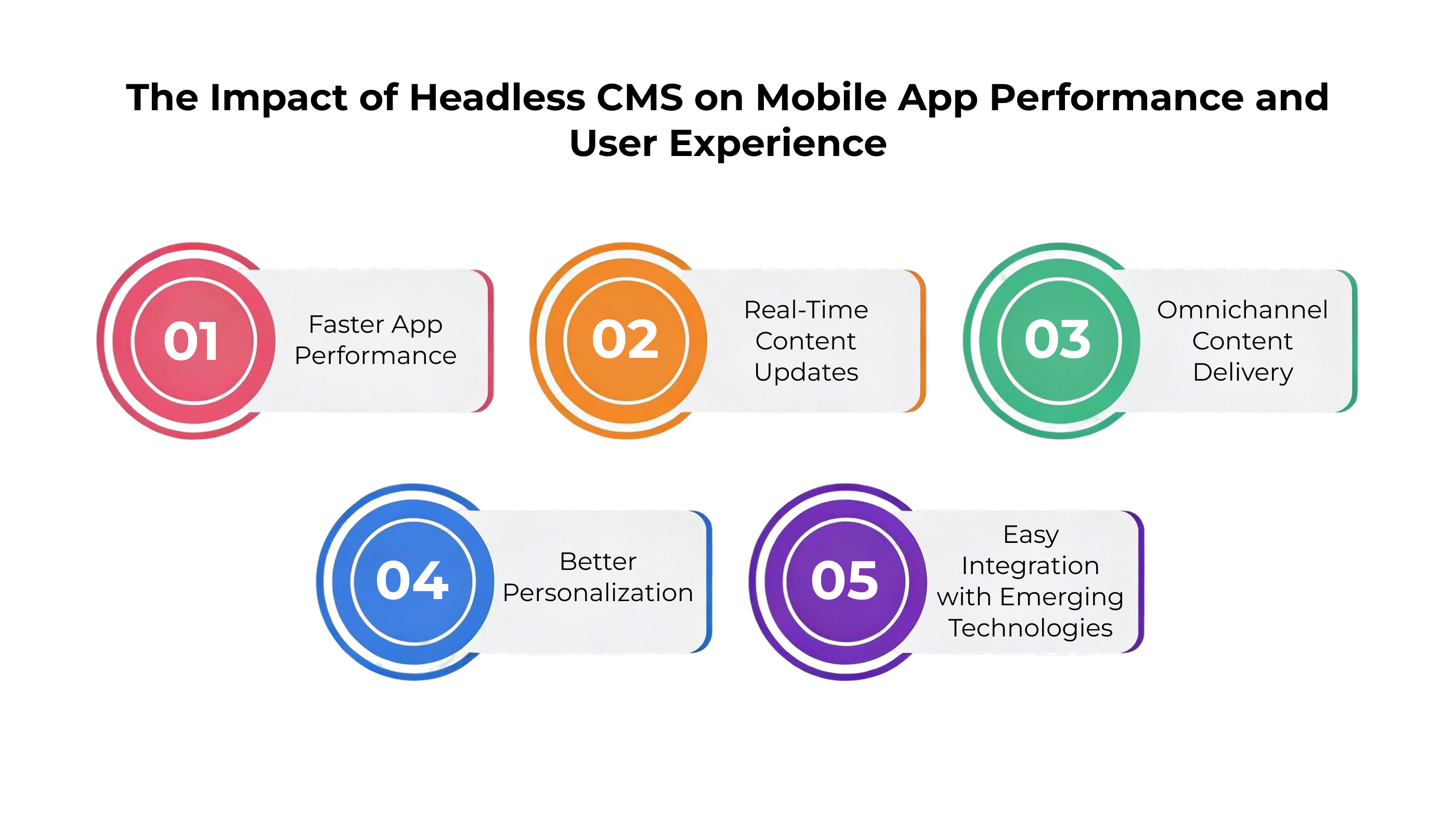
1. Faster App Performance
A headless CMS delivers content through lightweight APIs instead of rendering everything from a heavy backend system. This reduces the load on the mobile application and improves how quickly data is fetched and displayed. As a result, users experience faster loading times, smoother scrolling, and better responsiveness. Since speed plays a major role in user retention, a high-performing app keeps users engaged and reduces uninstall rates.
2. Real-Time Content Updates
With headless CMS for mobile app development, businesses can update content instantly from the backend without submitting a new version to the app store. Marketing banners, promotional campaigns, blog sections, or product descriptions can be modified in real time. This flexibility allows companies to respond quickly to market trends, seasonal offers, or user feedback, improving agility and keeping content fresh at all times.
3. Omnichannel Content Delivery
Modern users interact with brands across multiple platforms including mobile apps, websites, smartwatches, and voice assistants. Headless CMS platforms support omnichannel content delivery by allowing businesses to create content once and distribute it everywhere through APIs. This ensures consistent branding and messaging across all digital touchpoints while maintaining a smooth and unified user experience.
4. Better Personalization
Personalization is one of the biggest drivers of user engagement. A digital experience platform powered by headless architecture can display different content based on user behavior, preferences, and browsing patterns. For example, users may see recommended products, customized notifications, or location-based offers. When integrated with a digital experience analytics platform, businesses can continuously analyze data and refine content strategies to improve engagement and conversions.
5. Easy Integration with Emerging Technologies
A headless CMS is built with flexibility in mind, making it easy to integrate with modern technologies such as AI recommendation engines, IoT devices, chatbots, and voice search systems. This allows mobile apps to evolve with technological advancements without needing a complete backend rebuild. Because of this adaptability, headless CMS solutions are considered future-ready and ideal for growing digital ecosystems.
Traditional CMS vs Headless CMS for Mobile Apps
Here’s a simple comparison:
| Feature | Traditional CMS | Headless CMS |
| Frontend & Backend | Connected | Separated |
| Mobile App Flexibility | Limited | High |
| Content Delivery | Fixed Templates | API-Based |
| Real-Time Updates | Difficult | Easy |
| Omnichannel Support | Limited | Strong |
| Scalability | Moderate | High |
If your goal is to improve mobile app experiences, choosing the best headless CMS for mobile apps becomes an important decision.
Choosing the Best Headless CMS for Mobile Apps
When selecting among headless CMS platforms, consider:
- API performance
- Scalability
- Security features
- Integration capabilities
- Analytics support
- Cost
Some platforms are better suited for startups, while others are enterprise-focused.If you want customized solutions, working with a professional headless CMS development company can help.
Role of Headless CMS Development in App Success
Headless CMS development plays a crucial role in building scalable, high-performing, and future-ready mobile applications. It creates a flexible backend structure that allows apps to deliver dynamic content quickly and efficiently across multiple platforms. By separating content management from frontend design, businesses gain full control over user experience, performance optimization, and personalization strategies. A well-planned headless CMS implementation ensures smoother updates, faster deployment cycles, and long-term scalability, all of which directly contribute to app growth and user satisfaction.
- Enables faster content delivery through API-based architecture.
- Supports real-time updates without app store approvals.
- Improves app scalability as user traffic increases.
- Enhances personalization using structured content models.
- Allows seamless integration with third-party tools and analytics platforms.
- Reduces long-term maintenance complexity.
- Provides flexibility to use modern frontend frameworks.
- Ensures consistent content delivery across multiple digital channels.
Case Study: Retail App Transformation Using Headless CMS
A retail company had a traditional mobile app. Updating content required app store approvals. Campaign launches were delayed. The app also faced performance issues during high traffic.
They partnered with a headless CMS development company to migrate to a headless architecture.
After headless CMS implementation, results included:
- 35% faster load time
- Instant content updates
- 20% higher user engagement
- Better personalization through analytics
The integration with a digital experience analytics platform helped them understand customer behavior and optimize offers.
Challenges of Implementing Headless CMS in Mobile Apps
While the benefits are strong, there are challenges too.
1. Initial Complexity
Unlike traditional CMS platforms, headless systems require structured technical planning from the beginning. API architecture, database structure, and content modeling must be carefully designed. If the foundation is weak, scaling the mobile app later can become difficult and expensive.
2. Skilled Development Required
Headless CMS development is not plug-and-play. It requires experienced developers who understand APIs, frontend frameworks, and backend integration. Without proper expertise, businesses may face performance issues, broken integrations, or security gaps.
3. Higher Initial Investment
The upfront cost of headless CMS implementation can be higher compared to traditional CMS solutions. Custom development, cloud setup, and API configuration require investment. However, the long-term ROI often justifies the cost due to scalability and reduced maintenance.
4. Content Strategy Planning
Since the frontend and backend are separated, businesses must clearly define content workflows and structure. Poor planning can lead to disorganized content management and inefficiencies in the long run.
5. Integration with Legacy Systems
Many businesses already use CRM systems, ERP tools, payment gateways, or marketing platforms. Integrating these with a new headless CMS can be technically complex and time-consuming, especially if legacy systems are outdated.
6. Managing Multiple APIs
Headless architecture depends heavily on APIs. If not properly managed, multiple API calls can affect performance and increase maintenance complexity. Proper optimization is essential for smooth mobile app experiences.
Future of Headless CMS in Mobile App Experiences
1. Smarter AI-Driven Personalization
Headless CMS will work more closely with AI tools to deliver highly personalized content inside mobile apps. Instead of static layouts, users will see recommendations, offers, and updates tailored to their behavior, location, and preferences, improving engagement and retention.
2. Stronger Omnichannel Integration
Mobile apps will connect seamlessly with websites, smart devices, wearables, and voice assistants. Headless CMS makes this possible by delivering content through APIs to multiple platforms from a single backend, ensuring a consistent brand experience everywhere.
3. Real-Time Content Updates and Automation
Future mobile apps will rely heavily on automated content triggers. Businesses will update campaigns, notifications, and in-app content instantly without app store approvals, making marketing and user communication much faster.
4. Expansion into IoT and Emerging Technologies
As IoT devices and connected ecosystems grow, headless CMS will power content delivery beyond smartphones. Apps integrated with smartwatches, smart homes, and connected cars will benefit from the flexible API-based structure.
5. Advanced Analytics and Data-Driven Decisions
Integration with digital experience analytics platforms will become deeper. Businesses will use real-time insights to refine content strategies, optimize user journeys, and improve overall mobile app experiences.
6. Greater Scalability and Developer Flexibility
With growing user bases and new frontend frameworks, headless CMS will continue offering flexibility to developers. It allows businesses to scale their mobile apps quickly without rebuilding backend systems, supporting long-term digital growth.
Frequently Asked Questions
Quick answers related to this article from PerfectionGeeks.
1. What is a headless CMS and how does it improve mobile app experiences?
2. Is headless CMS suitable for startups building their first mobile app?
3. How does PerfectionGeeks help businesses implement headless CMS for mobile apps?
4. Is headless CMS secure for enterprise mobile applications?
Conclusion
Mobile users expect speed, personalization, and seamless interaction. Traditional content systems struggle to meet these expectations. A headless CMS changes the way mobile apps manage and deliver content. From faster loading times and real-time updates to omnichannel support and advanced personalization, headless architecture significantly improves mobile app experiences.Although implementation requires planning and expertise, the long-term benefits outweigh the challenges. Businesses that invest in the right headless CMS platforms and partner with experienced companies like PerfectionGeeks can build scalable, high-performing mobile apps ready for the future.

Written By Shrey Bhardwaj
Director & Founder
Shrey Bhardwaj is the Director & Founder of PerfectionGeeks Technologies, bringing extensive experience in software development and digital innovation. His expertise spans mobile app development, custom software solutions, UI/UX design, and emerging technologies such as Artificial Intelligence and Blockchain. Known for delivering scalable, secure, and high-performance digital products, Shrey helps startups and enterprises achieve sustainable growth. His strategic leadership and client-centric approach empower businesses to streamline operations, enhance user experience, and maximize long-term ROI through technology-driven solutions.