
Published 23 September 2025 | Updated 23 May 2026
Technology
The Importance of Entropy in Machine Learning and AI Models
In machine learning and artificial intelligence (AI), handling uncertainty is a key part of building accurate and reliable models. One of the most essential concepts for managing uncertainty is entropy in machine learning. Entropy measures the unpredictability or disorder in data, and it plays a critical role in guiding algorithms, improving predictions, and ensuring AI models work efficiently.
What Is Entropy in Machine Learning?In machine learning, entropy is a statistical measure used to calculate uncertainty, randomness, or impurity within a dataset. It helps machine learning algorithms determine how informative a feature is when making predictions or classifying data. Entropy plays a critical role in decision trees, information gain calculations, classification models, and artificial intelligence systems because it helps identify the best splits within training data. Why Entropy Is Important in Machine LearningEntropy helps machine learning models:
Lower entropy indicates more organized and predictable data, while higher entropy represents greater uncertainty and complexity within a dataset. |
- Entropy is a fundamental concept in machine learning and AI used to measure uncertainty, randomness, and data impurity within datasets.
- Decision tree algorithms use entropy to identify the best data splits and improve prediction accuracy through information gain calculations.
- Lower entropy indicates more organized and predictable data, while higher entropy represents greater uncertainty and disorder.
- Algorithms such as ID3, C4.5, Random Forest, and classification models heavily rely on entropy for optimized decision-making.
- Entropy helps improve feature selection, reduce model complexity, and enhance the overall efficiency of machine learning systems.
- AI and machine learning applications use entropy in data classification, predictive analytics, natural language processing, and recommendation systems.
- Understanding entropy is essential for building accurate, scalable, and intelligent AI models across various industries.
- As AI technologies continue to evolve, entropy remains a critical component for improving data-driven automation and intelligent decision systems.
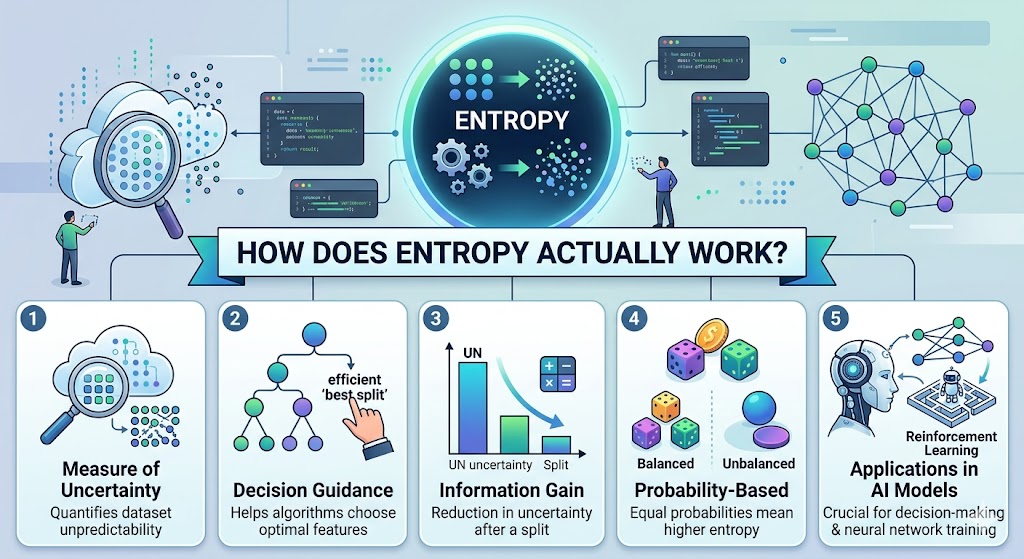
How Does Entropy Actually Work?
Understanding how entropy works is easier when broken down into simple points:
Measure of Uncertainty: Entropy quantifies how unpredictable a dataset is.
Decision Guidance: It helps algorithms choose the best features for splitting data, as seen in decision trees.
Information Gain: Entropy is used to calculate the reduction in uncertainty after a split, guiding better decision-making.
Probability-Based: It considers the probability of different outcomes—balanced probabilities mean higher entropy.
Applications in AI Models: Entropy helps in decision-making, neural network training, and reinforcement learning exploration.
Machine Learning and AI Industry Statistics
The adoption of machine learning and artificial intelligence technologies is rapidly increasing across industries worldwide.
Key Industry Insights
- Businesses are increasingly using machine learning algorithms to automate decision-making and improve operational efficiency.
- AI-powered systems are transforming industries such as healthcare, finance, ecommerce, cybersecurity, and manufacturing.
- Data-driven organizations rely heavily on classification algorithms, predictive analytics, and intelligent automation.
- Decision trees and entropy-based models remain foundational concepts in supervised machine learning.
- The growing availability of large datasets is increasing demand for advanced machine learning optimization techniques.
Why Entropy Matters in Modern AI Systems
Entropy is essential in machine learning because it helps algorithms:
- Analyze data uncertainty
- Improve predictive accuracy
- Optimize decision-making models
- Reduce classification errors
- Enhance feature selection processes
As AI systems become more complex, understanding entropy and information theory is becoming increasingly important for data scientists and machine learning engineers.
Build Intelligent AI Solutions with PerfectionGeeksLooking to develop advanced machine learning or AI-powered applications? PerfectionGeeks specializes in AI and machine learning development services tailored for startups, enterprises, and digital transformation projects. Our team helps businesses build scalable AI systems using modern technologies such as machine learning, deep learning, predictive analytics, NLP, and intelligent automation. Our AI & Machine Learning Services
Why Choose PerfectionGeeks?
Ready to Build AI-Powered Solutions?Contact PerfectionGeeks today for a free consultation. |
Entropy in Decision Trees
One of the most common applications of entropy in AI is in decision trees. Decision trees split data into branches based on features that reduce uncertainty the most. The metric that guides this choice is information gain, derived directly from entropy.
Features with higher information gain are chosen because they reduce unpredictability. This systematic use of entropy makes decision trees one of the most reliable models for classification tasks.
Entropy in Classification Problems
In classification tasks, entropy in machine learning measures the disorder in class labels. If all classes are equally represented, entropy is high due to uncertainty. If most data belongs to one class, entropy is low, showing predictability.
By using entropy, models can identify the most informative features and reduce errors. This improves overall predictive performance in AI systems.
Entropy in Neural Networks
In AI models entropy, entropy plays a crucial role through cross-entropy loss functions in neural networks. Cross-entropy measures the difference between predicted probabilities and actual labels, penalizing incorrect predictions.
This allows neural networks to learn efficiently, improve accuracy, and handle multi-class classification problems effectively. It ensures that AI models converge faster during training and produce reliable outputs.
Entropy in Reinforcement Learning
Entropy is also used in reinforcement learning to balance exploration and exploitation. High entropy encourages agents to explore different actions rather than sticking to a single predictable choice. This helps agents find better strategies and achieve higher rewards over time.
Why Entropy is Important
The role of entropy in machine learning and AI models is critical for several reasons:
Guides Decision-Making: Helps algorithms choose the best features or actions based on uncertainty.
Improves Accuracy: Ensures models focus on meaningful patterns in data.
Reduces Errors: Prevents decisions based on noise or irrelevant features.
Supports Efficient Learning: Entropy-based loss functions optimize model training.
Encourages Exploration: Ensures better strategies in reinforcement learning.
By understanding and applying machine learning entropy, developers can build models that are accurate, efficient, and adaptable to real-world scenarios.
Applications of Entropy in Machine Learning
Entropy is widely used across multiple machine learning models and AI applications to improve prediction accuracy and optimize data analysis.
Decision Trees
Entropy is most commonly used in decision tree algorithms such as ID3 and C4.5 to determine the best feature splits based on information gain.
Feature Selection
Machine learning engineers use entropy to identify the most informative variables within datasets.
Natural Language Processing (NLP)
Entropy helps NLP models analyze language complexity, predict word distributions, and improve text classification systems.
Cybersecurity & Fraud Detection
Entropy-based algorithms help detect anomalies, suspicious behavior, and unpredictable activity patterns in cybersecurity systems.
Data Compression & Information Theory
Entropy also plays a major role in data encoding, compression algorithms, and information transmission efficiency.
Deep Learning Optimization
Modern AI systems use entropy-related loss functions such as cross-entropy loss to optimize neural network training and improve classification performance.
Understanding entropy allows developers and data scientists to build more accurate, scalable, and intelligent machine learning systems.
Entropy vs Information Gain in Machine Learning
Entropy and information gain are closely connected concepts in supervised machine learning.
While entropy measures uncertainty or impurity within a dataset, information gain measures how much uncertainty is reduced after splitting the data based on a particular feature.
Machine learning algorithms use information gain to:
- Select optimal features
- Improve classification efficiency
- Reduce prediction errors
- Build accurate decision tree models
Understanding the relationship between entropy and information gain is essential for building effective classification algorithms and AI systems.
Concepts like entropy and information gain continue to form the foundation of modern AI systems and predictive analytics technologies. |
Frequently Asked Questions
Quick answers related to this article from PerfectionGeeks.
1. What is entropy in machine learning?
2. Why is entropy important in decision trees?
3. What is the difference between entropy and information gain?
4. Which algorithms use entropy in machine learning?
5. What is cross-entropy loss in deep learning?
6. How is entropy used in artificial intelligence?
Conclusion
Entropy is more than just a theoretical concept—it is a practical tool that guides machine learning and AI models entropy in handling uncertainty and making smarter decisions. From decision trees to neural networks and reinforcement learning, entropy ensures algorithms can learn effectively, reduce errors, and produce reliable predictions.
For businesses and organizations seeking advanced AI solutions, partnering with experts is essential. PerfectionGeeks offers professional machine learning and AI services, helping companies leverage entropy and other key concepts to develop intelligent, efficient, and high-performing systems.

Written By Shrey Bhardwaj
Director & Founder
Shrey Bhardwaj is the Director & Founder of PerfectionGeeks Technologies, bringing extensive experience in software development and digital innovation. His expertise spans mobile app development, custom software solutions, UI/UX design, and emerging technologies such as Artificial Intelligence and Blockchain. Known for delivering scalable, secure, and high-performance digital products, Shrey helps startups and enterprises achieve sustainable growth. His strategic leadership and client-centric approach empower businesses to streamline operations, enhance user experience, and maximize long-term ROI through technology-driven solutions.

