Published 19 March 2026 | Updated 26 May 2026
Technology
Why Companies Are Switching to MACH Architecture for Digital Transformation
Digital transformation is no longer optional. Businesses today need to move faster, adapt quickly, and deliver seamless digital experiences to customers. However, many companies still rely on outdated systems that slow down innovation. This is where MACH architecture comes into the picture. If you’ve been hearing about MACH but are not sure what it really means or why companies are adopting it so quickly, this guide will explain everything in the simplest way possible.
Transform Your Digital Experience
MACH architecture benefits businesses by providing flexible, scalable, and future-ready digital infrastructure built on Microservices, API-first, Cloud-native, and Headless technologies. It helps companies accelerate digital transformation, improve customer experiences, reduce deployment time, and integrate modern technologies faster.
In 2026, MACH architecture is becoming essential for enterprises looking to build agile digital ecosystems that support omnichannel experiences, scalability, and continuous innovation.
- Companies are switching to MACH architecture for scalability and flexibility
- MACH enables faster deployment and cloud-native digital ecosystems
- Businesses gain improved customer experiences through headless systems
- API-first development simplifies integrations and innovation
- MACH architecture reduces technical debt and improves agility
- In 2026, MACH architecture is becoming essential for digital transformation success
What Is MACH Architecture? A Simple Introduction
MACH architecture is a modern way of building digital systems that are fast, flexible, and ready for the future. The term MACH stands for:
- Microservices
- API‑first
- Cloud‑native
- Headless
MACH architecture breaks large applications into smaller, independent parts that work together smoothly. Each part can be updated, replaced, or improved without affecting the entire system, making development faster and more efficient. This approach is closely connected to composable architecture
Why Companies Are Switching to MACH Architecture
There are several major reasons businesses are adopting MACH architecture benefits in 2026.
1. Faster Innovation Cycles
Businesses need to release features quickly to remain competitive. With microservices architecture, development teams can work on multiple services independently, accelerating deployment and reducing bottlenecks. This improves time-to-market significantly.
2. Better Scalability
One of the biggest MACH architecture benefits is independent scalability.
Instead of scaling the entire application, businesses can scale only the services experiencing high demand. This improves performance while reducing infrastructure costs.
3. Improved Customer Experience
Modern customers expect seamless digital experiences across:
- Websites
- Mobile apps
- Smart devices
- Kiosks
- Marketplaces
- Social commerce platforms
Headless architecture allows businesses to deliver omnichannel experiences efficiently.
4. Easier Third-Party Integrations
API-first architecture simplifies integrations with:
- Payment gateways
- ERP systems
- CRM platforms
- AI tools
- Analytics systems
- Marketing automation software
This creates a more connected digital ecosystem.
5. Reduced Technical Debt
Legacy systems become increasingly difficult and expensive to maintain. MACH architecture reduces technical debt by allowing modular upgrades without rebuilding the entire system.
6. Cloud-Native Flexibility
Cloud-native systems improve:
- Scalability
- Uptime
- Disaster recovery
- Global deployment
- Infrastructure optimization
Businesses can scale dynamically based on demand.
7. Faster Time-to-Market
Development teams can build and deploy services independently. This dramatically reduces development timelines and accelerates innovation.
8. Improved Security
Microservices isolate system components, reducing the impact of failures and cyberattacks. Cloud-native security tools and API authentication improve overall protection.
How MACH Architecture Works
MACH architecture works by dividing applications into smaller independent services connected through APIs and cloud infrastructure.
Instead of maintaining one large application, businesses manage multiple modular services that operate independently.
For example:
| Service | Function |
|---|---|
| Authentication Service | User login & security |
| Product Service | Product catalog management |
| Payment Service | Transaction handling |
| Analytics Service | Data tracking & insights |
| Notification Service | Alerts & communication |
Each service can be updated, scaled, and deployed separately without affecting the entire platform.
This creates a highly agile digital ecosystem.
Looking to modernize your digital infrastructure with MACH architecture?
PerfectionGeeks helps businesses build scalable, API-first, cloud-native digital ecosystems for long-term growth.
Core Components of MACH: Microservices, API-First, Cloud-Native, and Headless
To understand the MACH framework, let’s break down its four main components:
1. Microservices Architecture
Microservices divide a large application into many small, independent services. Each service handles one specific function and can be updated or scaled without affecting the others. This makes systems faster, more flexible, and much easier to maintain over time.
2. API‑First Architecture
In an API‑first approach, APIs are designed before the actual application features. This ensures smooth communication between different systems and tools. It also speeds up development and gives businesses the flexibility to integrate new technologies whenever needed.
3. Cloud‑Native Architecture
Cloud‑native applications are built to run directly on the cloud rather than on physical servers. This allows businesses to scale instantly, improve performance, and reduce infrastructure costs. It also ensures better reliability and easier deployment of new updates.
4. Headless Architecture
Headless architecture separates the frontend (what users see) from the backend (where data and logic live). This gives teams more creative freedom to design unique experiences. It also supports multi‑channel delivery — from websites and mobile apps to IoT devices — all from the same backend.
Why Traditional Monolithic Architectures Are Failing Modern Businesses
Before MACH architecture became popular, most companies relied on monolithic systems — large, tightly connected structures where everything was built as one unit. While this approach worked years ago, it struggles to meet today’s fast‑moving digital demands.
1. Slow and Painful Updates: In monolithic systems, even a small change requires updating and redeploying the entire application. This slows down innovation and makes it difficult for businesses to respond quickly to new customer needs or market trends.
2. Limited Scalability: Monolithic architectures cannot scale individual features. If one part of the system needs more power, the whole application must scale together, which wastes resources and increases costs.
3. High Risk of System‑Wide Failure: Because everything is tightly connected, a single bug or error can bring down the entire system. This makes monolithic applications fragile and harder to maintain as they grow.
4. Poor Flexibility for Modern Tools: Integrating new technologies, third‑party services, or modern digital experiences is difficult with monolithic systems. Their rigid structure makes it hard to adapt to new trends like mobile apps, IoT, or omnichannel experiences.
In today’s fast‑changing digital world, these limitations create major roadblocks for growth. That’s why businesses are shifting toward modern digital transformation architecture models like MACH, which offer flexibility, speed, and long‑term scalability.
Step-by-Step MACH Adoption Guide
Step 1: Evaluate Existing Systems
The first step in MACH adoption is understanding the limitations of your current infrastructure. Businesses analyze existing applications, databases, integrations, and workflows to identify performance bottlenecks, scalability issues, and outdated technologies. This evaluation helps organizations create a clear digital transformation roadmap and prioritize modernization efforts effectively.
Step 2: Build API Strategy
An API-first strategy is essential for successful MACH architecture implementation. Businesses define how different systems, applications, and services will communicate through APIs to ensure seamless data exchange and future scalability. A strong API framework also improves third-party integrations, automation, and omnichannel connectivity across digital platforms.
Step 3: Create Microservices
In this stage, applications are divided into smaller independent services known as microservices. Each microservice handles a specific business function such as payments, authentication, inventory, or analytics. This modular approach improves flexibility, enables faster updates, and allows teams to scale individual services without affecting the entire application.
Step 4: Move to Cloud Infrastructure
Businesses migrate their applications and services to cloud-native environments such as AWS, Microsoft Azure, or Google Cloud. Cloud infrastructure provides better scalability, performance, disaster recovery, and operational flexibility compared to traditional on-premise systems. It also supports automated deployments and real-time resource optimization.
Step 5: Implement Headless Frontend
Headless architecture separates the frontend presentation layer from backend operations. This allows businesses to deliver consistent digital experiences across websites, mobile apps, smart devices, kiosks, and other channels without changing backend systems. Headless systems improve personalization, speed, and omnichannel customer engagement.
Step 6: Continuous Optimization
MACH adoption is an ongoing process that requires regular monitoring and optimization. Businesses continuously track system performance, API efficiency, security vulnerabilities, cloud costs, and scalability metrics to maintain operational excellence. Continuous improvements help organizations adapt quickly to changing business needs and customer expectations.
Benefits of MACH Architecture for Digital Transformation
The benefits of MACH architecture are a major reason behind its rapid adoption. It gives businesses the power to modernize quickly and operate more efficiently.
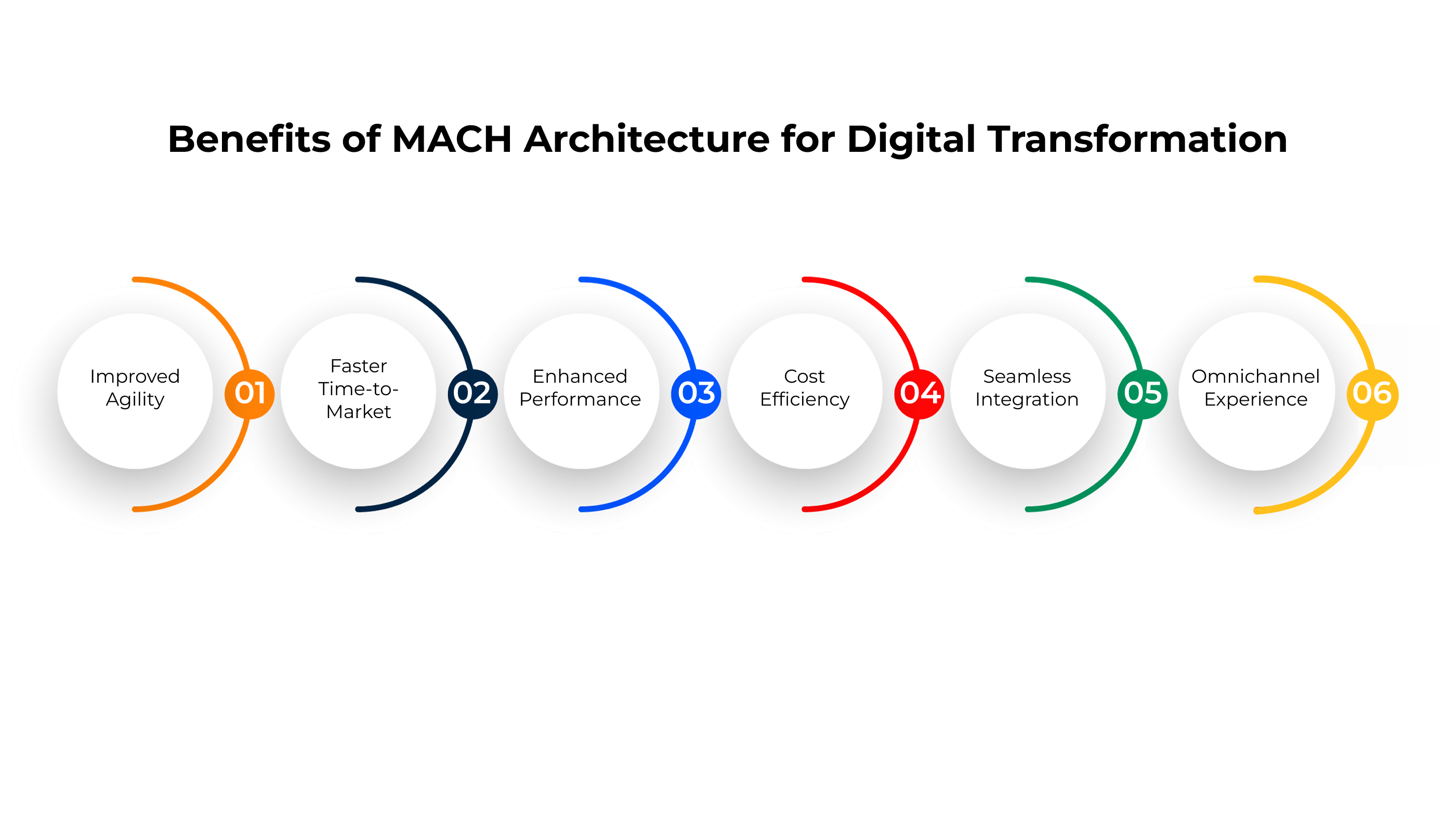
1. Improved Agility
Teams can work independently on different services without waiting for others. This speeds up development and makes the entire organization more agile.
2. Faster Time‑to‑Market
New features, updates, and improvements can be launched much faster. This helps businesses stay ahead of competitors and respond quickly to customer needs.
3. Enhanced Performance
Cloud‑native systems offer better speed, uptime, and reliability. Applications can handle high traffic smoothly and deliver a better user experience.
4. Cost Efficiency
With cloud‑native architecture, businesses pay only for the resources they use. This reduces infrastructure costs and eliminates the need for expensive hardware.
5. Seamless Integration
The API‑first approach makes it easy to connect with third‑party tools, internal systems, and new technologies. Integrations become faster, smoother, and more reliable.
6. Omnichannel Experience
Headless architecture allows businesses to deliver content across websites, mobile apps, kiosks, wearables, and IoT devices — all from one backend. This ensures consistent experiences everywhere.
MACH Architecture vs Monolithic Architecture: A Detailed Comparison
Here’s a simple comparison to understand the difference:
| Feature | MACH Architecture | Monolithic Architecture |
| Structure | Modular (microservices) | Single large system |
| Flexibility | High | Low |
| Scalability | Easy and selective | Difficult |
| Deployment | Independent services | Entire system |
| Innovation Speed | Fast | Slow |
| Risk | Low (isolated issues) | High (system-wide impact) |
| Integration | Easy (API-first) | Complex |
This table clearly shows why MACH is considered a modern application architecture.
Real-World Use Cases of MACH Architecture Across Industries
Many industries are already using MACH to transform their digital systems.
E-commerce
- Personalized shopping experiences
- Faster checkout systems
- Multi-channel selling
Banking and Finance
- Secure and scalable systems
- Real-time transactions
- Easy integration with fintech services
Healthcare
- Patient data management
- Telemedicine platforms
- Scalable digital services
Media and Entertainment
- Content streaming across platforms
- Personalized recommendations
- Faster content delivery
Travel and Hospitality
- Real-time booking systems
- Dynamic pricing
- Seamless user experiences
These examples show how MACH supports digital transformation architecture across industries.
Challenges in Adopting MACH Architecture and How to Overcome Them
While MACH architecture brings powerful benefits, the transition isn’t always simple. Businesses often face a few challenges during adoption — but with the right approach, each one can be managed effectively.
1. Complexity in Managing Multiple Microservices
MACH breaks systems into many small services, which can feel overwhelming at first. Managing, monitoring, and coordinating these services requires proper tools and structured processes.
Solution: Use strong orchestration tools and work with experienced development teams who understand microservices well.
2. Higher Initial Investment
Setting up MACH architecture may require more upfront cost compared to traditional systems. This includes cloud setup, new tools, and skilled resources.
Solution: Focus on long‑term ROI — MACH reduces maintenance costs, speeds up development, and delivers better scalability over time.
3. Skill Gaps Within Teams
Many teams are not fully familiar with microservices, APIs, cloud‑native systems, or headless architecture. This can slow down adoption and create confusion.
Solution: Invest in training, workshops, or partner with experts who specialize in MACH implementation.
4. Integration Challenges
Connecting multiple independent services can be tricky, especially when dealing with older systems. Poorly designed integrations can lead to performance issues.
Solution: Use well‑defined APIs, integration platforms, and follow best practices for API‑first development.
5. Security Concerns
More services mean more endpoints, which can increase security risks if not handled properly. Each microservice needs its own protection and monitoring.
Solution: Implement strong security practices, API gateways, authentication layers, and continuous monitoring tools.
6. Organizational Resistance to Change
Teams used to monolithic systems may resist switching to a new architecture. Change can feel risky or uncomfortable.
Solution: Communicate the long‑term benefits clearly and adopt MACH in phases to reduce disruption.
7. Migration Complexity
Moving from a monolithic system to MACH is not a one‑step process. It requires careful planning and gradual migration.
Solution: Start with the most critical services, migrate step‑by‑step, and test thoroughly at each stage.
Common Mistakes to Avoid
1. Migrating Everything at Once
Many businesses make the mistake of replacing all legacy systems in a single phase. This often creates operational downtime, integration failures, and employee confusion. A gradual migration strategy allows teams to test systems step-by-step, reduce risks, and maintain business continuity during transformation.
2. Ignoring API Governance
APIs are the backbone of MACH architecture, but without proper governance, businesses may face security vulnerabilities, inconsistent integrations, and performance issues. Strong API governance ensures standardized communication, scalability, access control, and long-term system reliability across all services.
3. Poor Team Collaboration
MACH adoption is not only a technical change but also an organizational transformation. When development, operations, marketing, and business teams work separately, projects become slower and less efficient. Cross-functional collaboration helps align goals, improve workflows, and ensure smoother implementation.
4. Weak Security Planning
Cloud-native and API-driven environments increase the number of digital touchpoints that require protection. Businesses that neglect security planning may experience data breaches, compliance issues, and system vulnerabilities. Implementing strong authentication, encryption, and continuous monitoring is essential for secure operations.
5. Underestimating Cloud Costs
Although cloud infrastructure offers scalability and flexibility, unmanaged cloud resources can lead to unexpectedly high operational expenses. Businesses should continuously monitor usage, optimize workloads, and automate resource allocation to maintain cost efficiency while scaling digital operations.
Expert Tips for 2026
1. Start with High-Impact Services
Businesses should begin MACH adoption with services that directly impact customer experience or operational efficiency. Migrating high-value systems first helps organizations achieve faster ROI, demonstrate success early, and build confidence for larger digital transformation initiatives.
2. Invest in API Security
As APIs become central to business communication, protecting them becomes increasingly important. Companies should implement secure authentication methods, rate limiting, encryption, and API monitoring tools to prevent cyber threats and ensure reliable data exchange across platforms.
3. Use AI & Automation
AI-powered analytics and automation tools help businesses improve decision-making, customer personalization, and operational efficiency. Combining MACH architecture with AI enables real-time insights, predictive analytics, intelligent workflows, and automated customer engagement strategies.
4. Focus on Omnichannel Strategy
Modern customers interact with brands across websites, mobile apps, marketplaces, social platforms, and smart devices. MACH architecture supports seamless omnichannel experiences by enabling businesses to deliver consistent content, services, and interactions across every digital touchpoint.
5. Prioritize Cloud Optimization
Cloud-native systems require ongoing monitoring and optimization to maintain performance and cost control. Businesses should regularly analyze infrastructure usage, automate scaling, remove unused resources, and improve workload distribution to maximize cloud efficiency and stability.
Future of MACH Architecture (2026 and Beyond)
The future of MACH architecture is expected to drive the next phase of enterprise digital transformation through highly flexible, scalable, and intelligent ecosystems. As businesses continue modernizing digital operations, MACH will become the preferred foundation for innovation-driven organizations.
Key future trends include:
AI-Driven Ecosystems
Artificial intelligence will become deeply integrated into MACH platforms, enabling smarter automation, predictive analytics, intelligent customer experiences, and real-time business decision-making.
Hyper-Personalization
Businesses will use customer data, AI, and composable technologies to deliver highly personalized digital experiences tailored to individual user behaviors, preferences, and interactions.
IoT Integrations
MACH architecture will support seamless connectivity between enterprise systems and IoT devices, enabling real-time monitoring, smart automation, and connected digital ecosystems across industries.
Real-Time Analytics
Modern organizations increasingly require instant access to business insights. MACH-based platforms will provide real-time analytics capabilities that improve operational visibility, customer understanding, and strategic planning.
Automation-First Platforms
Future enterprise systems will prioritize automation to reduce manual processes, improve productivity, and accelerate digital operations through AI-powered workflows and intelligent integrations.
Composable Enterprise Systems
Organizations will increasingly adopt composable architectures where independent services, applications, and APIs can be assembled quickly to meet changing business requirements with greater agility.
As global digital transformation accelerates, MACH architecture is expected to become the core foundation for future-ready, scalable, and innovation-focused business ecosystems.
Frequently Asked Questions
Quick answers related to this article from PerfectionGeeks.
1. What is MACH architecture?
2. Why are companies adopting MACH architecture?
3. What are the main MACH architecture benefits?
4. Is MACH architecture suitable for startups?
5. Which industries use MACH architecture?
6. How does MACH differ from monolithic architecture?
Conclusion
The shift to MACH architecture is not just a trend—it’s a necessity for businesses aiming to succeed in the digital era. With its flexible, scalable, and future-ready approach, MACH empowers companies to innovate faster and deliver better customer experiences. From microservices architecture to API-first architecture, and from cloud native architecture to headless architecture, every component of the MACH framework plays a crucial role in building modern digital systems. Although there are challenges in adopting MACH, the long-term benefits far outweigh the initial hurdles. Companies that embrace this composable architecture approach are better positioned to adapt, grow, and lead in their industries.
If you’re planning your digital transformation journey, partnering with experts like PerfectionGeeks Technologies can make the transition smoother. With the right strategy and execution, your business can fully leverage MACH and build a powerful, scalable, and future-ready digital ecosystem.

Written By Shrey Bhardwaj
Director & Founder
Shrey Bhardwaj is the Director & Founder of PerfectionGeeks Technologies, bringing extensive experience in software development and digital innovation. His expertise spans mobile app development, custom software solutions, UI/UX design, and emerging technologies such as Artificial Intelligence and Blockchain. Known for delivering scalable, secure, and high-performance digital products, Shrey helps startups and enterprises achieve sustainable growth. His strategic leadership and client-centric approach empower businesses to streamline operations, enhance user experience, and maximize long-term ROI through technology-driven solutions.
.webp)