Published 16 January 2026 | Updated 29 May 2026
app
Mobile App Trends Business 2026: The Complete 2026 Guide
The mobile app industry is evolving faster than ever. Businesses across the USA, UK, UAE, Canada, and Australia are rapidly investing in next-generation mobile technologies to improve customer engagement, automate operations, and drive digital growth.
From AI-powered personalization and super apps to blockchain integration and immersive AR experiences, the future of mobile applications is no longer just about functionality — it’s about intelligent ecosystems that create seamless user experiences.
According to Statista, global mobile app revenues are projected to exceed $935 billion by 2026, while Gartner reports that more than 70% of customer interactions will involve AI-powered technologies by the end of 2026.
If businesses want to remain competitive in the digital-first economy, understanding the latest mobile app trends business 2026 strategies is essential.
- Mobile app trends in 2026 are heavily driven by AI, automation, cloud-native technologies, and personalized user experiences.
- Businesses across the USA, UK, UAE, Canada, and Australia are investing in next-generation mobile apps to improve customer engagement and digital transformation.
- AI-powered features like chatbots, predictive analytics, voice assistants, and recommendation engines are becoming standard in modern mobile applications.
- Cross-platform frameworks such as Flutter and React Native continue to dominate app development due to faster deployment and lower development costs.
- Super apps, fintech platforms, healthcare apps, and on-demand service applications are among the fastest-growing mobile app categories in 2026.
- 5G technology is enabling faster app performance, real-time streaming, AR/VR experiences, and improved cloud connectivity.
- Blockchain integration is increasing in fintech, digital wallets, NFT platforms, and secure mobile transactions.
- Cybersecurity, biometric authentication, and privacy-focused app development are critical priorities for businesses and users.
- Cloud-native infrastructure, DevOps automation, and scalable backend systems are essential for handling growing mobile app traffic and real-time analytics.
- Businesses that adopt emerging mobile app trends early gain competitive advantages through innovation, customer retention, operational efficiency, and better scalability.
What is Mobile App Trends Business 2026?
Mobile App Trends Business 2026 refers to the emerging technologies, development practices, user expectations, and innovation strategies shaping the future of mobile applications for businesses worldwide.
These trends focus on:
- AI-driven applications
- Hyper-personalized user experiences
- Cross-platform development
- 5G-enabled mobile ecosystems
- Blockchain integration
- AR/VR experiences
- Super apps and mini-app ecosystems
- Privacy-first mobile architectures
- IoT-connected applications
Definition Box
Businesses in industries like healthcare, fintech, retail, logistics, education, and real estate are increasingly adopting these innovations to gain a competitive advantage.
|
Why Mobile App Trends Business 2026 Matters in 2026
Mobile apps are no longer optional for businesses. They have become central to customer acquisition, digital operations, and brand engagement.
Rising Mobile Usage Worldwide
Key Industry Statistics
| Statistic | Source |
|---|---|
| Global smartphone users expected to reach 7.7 billion in 2026 | Statista |
| Mobile commerce contributes over 73% of eCommerce sales | Shopify Research |
| AI in mobile apps market projected to grow at 26% CAGR | Grand View Research |
| 5G adoption expected to surpass 5 billion users by 2030 | GSMA |
These numbers clearly show why businesses across developed markets are investing heavily in future-ready mobile applications.
Why Businesses Must Adapt
1. Customer Expectations Have Changed
Users now expect:
- Instant performance
- AI-powered recommendations
- Personalized experiences
- Seamless payment systems
- Voice-enabled interactions
2. Competition is Increasing
Businesses without advanced mobile capabilities risk losing customers to competitors offering faster, smarter, and more engaging experiences.
3. AI and Automation Improve Efficiency
AI-driven mobile apps help businesses:
- Automate customer support
- Analyze user behavior
- Reduce operational costs
- Increase customer retention
4. Mobile Commerce is Dominating
The growth of mobile-first shopping experiences in the USA, UAE, UK, Canada, and Australia is driving businesses to invest in intelligent mobile ecosystems.
How to Mobile App Trends Business 2026: Step-by-Step
Implementing future-ready mobile app strategies requires careful planning and execution.
Step 1: Define Business Goals
Start by identifying:
- Target audience
- Revenue objectives
- Customer pain points
- App functionality requirements
Businesses should align mobile strategies with long-term digital transformation goals.
Step 2: Research Market Trends
Analyze:
- Industry competitors
- User behavior patterns
- Regional market preferences
- Emerging technologies
For example:
- UAE businesses focus heavily on smart city integrations
- USA startups prioritize AI and SaaS mobility
- UK companies emphasize data privacy compliance
Step 3: Choose the Right Development Approach
Comparison Table: Native vs Cross-Platform Apps
| Feature | Native Apps | Cross-Platform Apps |
| Performance | Excellent | Very Good |
| Development Cost | Higher | Lower |
| Time to Market | Longer | Faster |
| Maintenance | Separate codebases | Single codebase |
| Best For | Complex apps | Startups & MVPs |
Technologies like Flutter and React Native are becoming increasingly popular in 2026.
Step 4: Integrate AI and Automation
Modern apps should include:
- AI chatbots
- Predictive analytics
- Recommendation engines
- Voice recognition
- Behavioral personalization
AI integration significantly improves customer engagement and retention.
Step 5: Prioritize Security and Compliance
Businesses must comply with:
- GDPR (UK & Europe)
- HIPAA (Healthcare USA)
- PCI-DSS (Payments)
- UAE cybersecurity frameworks
Security-first mobile architecture is now a critical business requirement.
Step 6: Optimize for Scalability
Future-ready apps should support:
- Cloud-native infrastructure
- API integrations
- Microservices architecture
- Multi-device compatibility
Scalable infrastructure ensures long-term growth without performance bottlenecks.
Build Future-Ready Mobile Apps with PerfectionGeeksWant to develop AI-powered, scalable, and secure mobile applications for your business? PerfectionGeeks specializes in:
👉 Explore Our Mobile App Development Services: |
Key Benefits
Businesses investing in mobile app trends business 2026 gain significant competitive advantages.
1. Improved Customer Engagement
AI-powered personalization helps businesses deliver:
- Customized recommendations
- Real-time support
- Intelligent notifications
This leads to higher user retention rates.
2. Faster Business Operations
Automation streamlines:
- Inventory management
- Customer support
- Data processing
- Employee workflows
3. Better Revenue Opportunities
Businesses can monetize apps through:
- Subscription models
- In-app purchases
- Marketplace ecosystems
- Premium services
4. Enhanced Data Insights
Advanced analytics tools help companies:
- Understand customer behavior
- Predict trends
- Improve marketing performance
5. Competitive Market Positioning
Businesses adopting modern technologies earlier often dominate their industry segments.
Tools & Technologies
The future of mobile app development relies on advanced frameworks and technologies.
Popular Frontend Frameworks
| Technology | Purpose |
| Flutter | Cross-platform apps |
| React Native | Hybrid mobile development |
| Swift | iOS app development |
| Kotlin | Android app development |
Backend Technologies
| Technology | Use Case |
| Node.js | Scalable APIs |
| Python | AI & machine learning |
| Firebase | Real-time databases |
| AWS | Cloud infrastructure |
Emerging Technologies in 2026
Artificial Intelligence
AI is driving:
- Chatbots
- Predictive analytics
- Smart automation
Blockchain
Used for:
- Secure transactions
- Decentralized applications
- Digital identity verification
AR/VR
Popular in:
- Gaming
- Retail
- Education
- Real estate
Internet of Things (IoT)
IoT-enabled apps connect:
- Smart devices
- Wearables
- Industrial systems
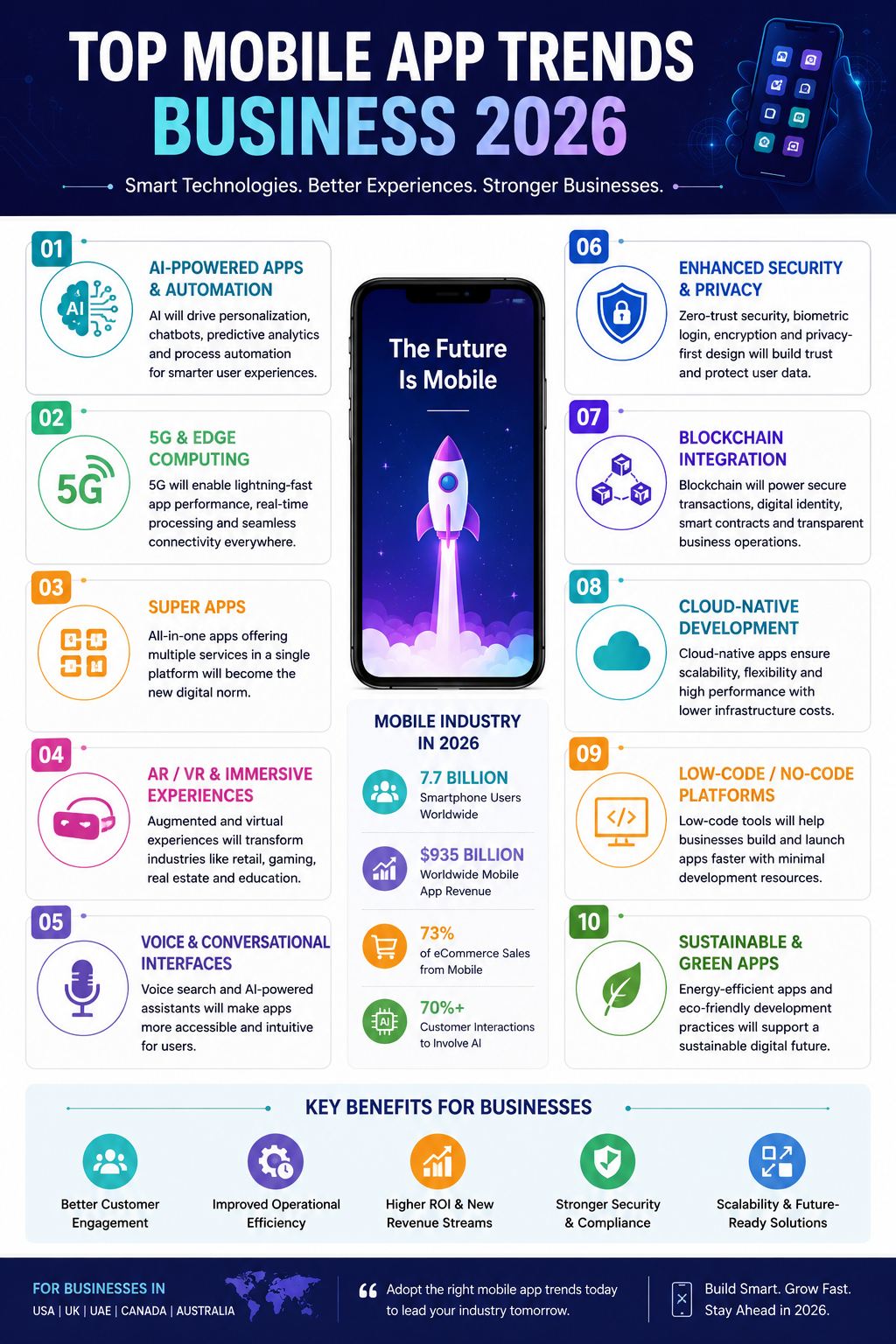
Infographic: Top Mobile App Trends Business 2026
Most Influential Technologies in 2026
| Trend | Business Impact |
| AI Integration | Very High |
| 5G Connectivity | High |
| AR/VR Experiences | High |
| Super Apps | Medium-High |
| Blockchain Security | High |
| Voice Interfaces | Medium |
| IoT Connectivity | High |
Cost & Timeline
The cost of mobile app development in 2026 depends on complexity, features, technologies, and location.
Estimated Development Costs
| App Type | Estimated Cost (USD) | Timeline |
| Basic Business App | $15,000 – $35,000 | 2–4 Months |
| AI-Powered App | $40,000 – $120,000 | 4–8 Months |
| Enterprise Mobile Platform | $100,000+ | 8–14 Months |
| Super App Development | $150,000 – $500,000+ | 12–18 Months |
Factors Affecting Costs
- App complexity
- AI integration
- Security requirements
- Third-party APIs
- Cross-platform compatibility
- UI/UX customization
Development costs in the USA, UK, UAE, Canada, and Australia are generally higher compared to offshore development models.
Real-World Examples
1. Starbucks Mobile App
Starbucks uses AI-powered personalization and loyalty integration to improve customer retention and mobile ordering experiences.
Key Features
- Predictive recommendations
- Mobile payments
- Rewards ecosystem
2. Uber Super App Expansion
Uber expanded beyond ride-sharing into:
- Food delivery
- Freight
- Financial services
This demonstrates the growing super app ecosystem trend.
3. Dubai Smart Government Apps
The UAE government continues investing in AI-driven mobile applications for:
- Smart city management
- Public services
- Digital identity systems
This reflects how governments are adopting future-ready mobile ecosystems.
Frequently Asked Questions
Quick answers related to this article from PerfectionGeeks.
1. What is mobile app trends business 2026?
2. How does mobile app trends business 2026 work?
3. What are the benefits of mobile app trends business 2026?
4. How long does mobile app trends business 2026 take?
5. What are the best tools for mobile app trends business 2026?
Conclusion
The mobile app industry in 2026 is being shaped by AI, automation, immersive technologies, and hyper-personalized user experiences.
Businesses across the USA, UK, UAE, Canada, and Australia are investing in intelligent mobile ecosystems to improve customer engagement, streamline operations, and drive digital transformation.
Companies that adopt future-ready mobile app strategies early will gain:
- Higher customer retention
- Stronger digital presence
- Better scalability
- Increased revenue opportunities
As mobile technologies continue evolving, businesses must focus on innovation, security, scalability, and user-centric experiences to remain competitive.
Partnering with an experienced mobile app development company can help organizations successfully navigate the rapidly changing digital landscape.
Ready to Build the Future?
PerfectionGeeks helps startups, enterprises, and global brands develop scalable and AI-powered mobile applications tailored for future business growth.

Written By Shrey Bhardwaj
Director & Founder
Shrey Bhardwaj is the Director & Founder of PerfectionGeeks Technologies, bringing extensive experience in software development and digital innovation. His expertise spans mobile app development, custom software solutions, UI/UX design, and emerging technologies such as Artificial Intelligence and Blockchain. Known for delivering scalable, secure, and high-performance digital products, Shrey helps startups and enterprises achieve sustainable growth. His strategic leadership and client-centric approach empower businesses to streamline operations, enhance user experience, and maximize long-term ROI through technology-driven solutions.