
Published 9 December 2025 | Updated 23 May 2026
Technology
How Predictive Analytics Is Transforming the Oil and Gas Industry: 10 Key Use Cases
Predictive analytics is rapidly becoming a game-changing technology in the oil and gas sector. As the industry faces rising operational costs, complex drilling environments, fluctuating energy demand, and increasing safety requirements, companies are turning to advanced predictive analytics models, predictive analytics tools, and AI-powered oil and gas analytics software to improve decision-making. By adopting modern predictive analytics oil and gas solutions, enterprises can reduce downtime, optimize production, enhance safety, and achieve long-term operational efficiency.
What Is Predictive Analytics in the Oil and Gas Industry?Predictive analytics in the oil and gas industry refers to the use of artificial intelligence, machine learning, big data, and statistical modeling to predict future operational outcomes, equipment failures, maintenance needs, and production performance. Oil and gas companies use predictive analytics to improve operational efficiency, reduce downtime, optimize asset management, enhance safety, and lower operational costs across upstream, midstream, and downstream operations. Key Benefits of Predictive Analytics in Oil and Gas
As digital transformation accelerates, predictive analytics is becoming a critical technology for modern oil and gas operations. |
- Predictive analytics in the oil and gas industry uses AI, machine learning, and big data to improve operational efficiency and decision-making.
- Oil and gas companies use predictive analytics to forecast equipment failures, optimize drilling operations, and reduce operational downtime.
- Predictive maintenance systems help organizations lower maintenance costs and extend the lifespan of critical industrial assets.
- Real-time monitoring and IoT integration enable energy companies to collect valuable operational data for predictive modeling and analytics.
- Machine learning algorithms improve production forecasting, anomaly detection, pipeline monitoring, and supply chain optimization.
- AI-powered predictive analytics enhances workplace safety by identifying potential operational risks and hazardous conditions before failures occur.
- Digital transformation is driving increased adoption of predictive analytics technologies across upstream, midstream, and downstream oil and gas operations.
- Data-driven decision-making is becoming essential for improving profitability, sustainability, and operational performance in the energy sector.
- Scalable cloud infrastructure and advanced analytics platforms are critical for managing large volumes of industrial data efficiently.
- PerfectionGeeks provides AI, IoT, machine learning, and predictive analytics solutions tailored for modern oil and gas industry requirements.
10 Key Use Cases of Predictive Analytics in the Oil and Gas Industry
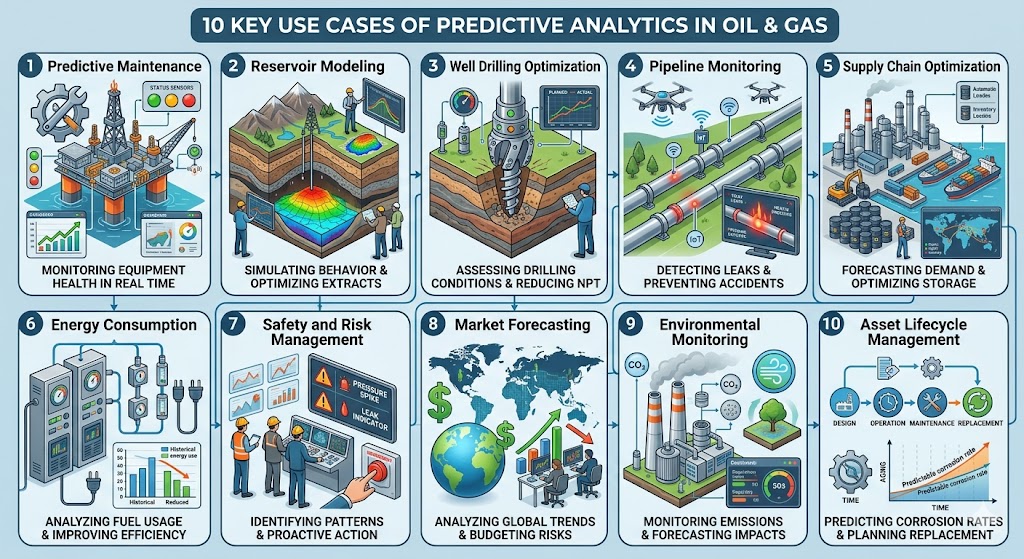
1. Predictive Maintenance of Equipment
Predictive maintenance is one of the most impactful applications of predictive analytics in the industry. Instead of relying on time-based schedules, companies use predictive analytics tools and machine learning to monitor equipment health in real time. Algorithms assess vibration data, temperature changes, corrosion levels, and pressure fluctuations to detect early signs of failure. This reduces unexpected downtime, avoids emergency repairs, and extends the lifespan of critical assets.
2. Reservoir Modeling and Production Forecasting
Reservoir performance directly impacts long-term profitability. With advanced predictive analytics models, engineers can simulate reservoir behavior, analyze depletion patterns, estimate future yield, and optimize extraction strategies.This allows companies to plan production accurately and maximize recovery rates from existing wells.
3. Well Drilling Optimization
Drilling activities involve significant risks and high operational costs. Predictive analytics oil and gas solutions help teams assess drilling conditions, identify potential hazards, analyze rock formations, and predict pressure levels. Real-time predictive insights reduce non-productive time (NPT), improve drilling accuracy, and enhance worker safety.
4. Pipeline Monitoring and Leak Detection
Pipeline leaks pose major environmental and financial risks. By leveraging IoT-integrated oil and gas analytics software, companies can analyze flow rates, pressure data, and temperature variations across the pipeline network. Machine learning algorithms identify unusual activity, predict leak-prone zones, and provide early alerts—helping companies prevent accidents and stay compliant with safety regulations.
5. Supply Chain and Inventory Optimization
The global oil and gas supply chain is complex and sensitive. Predictive analytics allows companies to forecast demand, optimize storage, reduce inventory waste, and anticipate supply chain delays. This results in lower operational costs, improved logistics planning, and better procurement decision-making.
6. Energy Consumption and Operational Efficiency
With growing sustainability goals, companies use predictive analytics services to analyze fuel usage, electricity consumption, and equipment performance. These insights help reduce excessive energy consumption and improve operational efficiency across drilling, refining, and transportation processes.
7. Safety and Risk Management
The oil and gas sector requires strong safety controls. Predictive analytics helps identify patterns that indicate early signs of safety risks including pressure spikes, leak indicators, abnormal vibrations, or structural weaknesses. By acting proactively, companies can protect employees, reduce risks, and maintain compliance with industry regulations.
8. Market Forecasting and Pricing Predictions
Market volatility makes future pricing difficult to predict. Predictive analytics is widely used for predictive analytics marketing in the oil and gas industry. By analyzing global trends, geopolitical factors, historical data, and demand patterns, companies can forecast crude oil and natural gas prices with greater accuracy. This helps enterprises plan budgets, optimize investments, and reduce financial risks.
9. Environmental Monitoring and Emission Control
Environmental sustainability is a top priority. With advanced predictive analytics oil solutions, companies monitor emissions, waste output, and operational heat signatures. Predictive models help forecast environmental impacts and optimize sustainability strategies. This supports compliance with environmental regulations and reduces carbon footprint.
10. Asset Lifecycle Management
Predictive analytics improves asset lifecycle planning from installation to decommissioning. AI-driven models predict corrosion rates, aging patterns, and replacement timelines, helping companies plan maintenance budgets and improve long-term asset performance.
Benefits of Using Predictive Analytics in Oil and Gas
Increased operational reliability – Predictive analytics provides real-time insights that help maintain stable, efficient, and uninterrupted oil and gas operations.
Better equipment performance – Continuous monitoring and analytics optimize machine output and prevent performance degradation.
Reduced downtime and repair costs – Early detection of faults allows companies to fix issues before breakdowns occur, saving time and maintenance expenses.
Enhanced production and recovery rates – Data-driven forecasting improves extraction strategies and maximizes resource recovery from reservoirs.
Improved safety and risk mitigation – Predictive models identify hazardous patterns early, reducing the chances of accidents and operational risks.
Stronger sustainability and environmental compliance – Analytics helps track emissions, prevent leaks, and support eco-friendly operational decisions.
Smarter resource planning – Accurate predictions enable better workforce management, asset allocation, and operational planning.
Accurate energy market forecasting – Predictive analytics analyzes global patterns to forecast energy prices, demand, and market fluctuations with higher accuracy.
Oil and Gas Predictive Analytics Industry Statistics
The oil and gas industry is rapidly adopting predictive analytics and AI technologies to improve efficiency, safety, and operational decision-making.
Key Industry Insights
- Energy companies are increasingly investing in AI-driven predictive maintenance systems.
- Predictive analytics helps reduce unplanned equipment downtime and operational disruptions.
- IoT sensors and real-time monitoring systems are generating massive amounts of operational data for predictive modeling.
- Oil and gas organizations are using machine learning to improve drilling accuracy and production forecasting.
- Data-driven optimization is becoming essential for improving profitability and reducing operational risks.
Why Predictive Analytics Is Growing in Oil & Gas
Predictive analytics helps oil and gas companies:
- Optimize equipment maintenance schedules
- Detect anomalies in real time
- Improve production forecasting
- Reduce operational risks
- Increase equipment lifespan
- Improve energy efficiency
As the industry continues embracing digital transformation, predictive analytics is becoming a strategic priority for long-term operational sustainability.
Build AI-Powered Predictive Analytics Solutions with PerfectionGeeksLooking to implement predictive analytics solutions for oil and gas operations? PerfectionGeeks specializes in AI, machine learning, IoT, and predictive analytics development tailored for energy, industrial, and enterprise businesses. Our team helps organizations build intelligent systems that improve operational efficiency, automate monitoring, and enable data-driven decision-making. Our Predictive Analytics Services
Why Choose PerfectionGeeks?
Ready to Modernize Your Operations?Contact PerfectionGeeks today for a free consultation. |
How PerfectionGeeks Supports Oil & Gas Enterprises with Predictive Analytics
PerfectionGeeks delivers comprehensive predictive analytics and digital transformation solutions designed specifically for the oil and gas industry. Their offerings include:
- Custom predictive analytics model development
- Machine learning and AI integration
- Real-time monitoring and alert systems
- Advanced oil and gas analytics dashboards
- Workflow automation and data visualization
- Natural gas predictive analytics solutions
- Cloud deployment and system modernization
- Integration of industry-grade predictive analytics tools
Whether the goal is drilling optimization, pipeline safety, energy forecasting, or asset management, PerfectionGeeks helps companies deploy scalable and future-ready predictive analytics solutions that deliver measurable ROI.
Major Applications of Predictive Analytics in the Oil and Gas Industry
Predictive analytics is transforming multiple areas of oil and gas operations by improving decision-making, reducing downtime, and enhancing operational intelligence.
Predictive Maintenance
AI-powered predictive maintenance systems monitor equipment performance and identify potential failures before they occur.
Drilling Optimization
Machine learning algorithms analyze geological and operational data to improve drilling accuracy and efficiency.
Production Forecasting
Predictive models help companies forecast oil and gas production levels more accurately using historical and real-time data.
Pipeline Monitoring
Analytics systems detect leaks, pressure anomalies, and operational risks within pipelines to improve safety and reliability.
Supply Chain Optimization
Predictive analytics improves inventory management, logistics planning, and supply chain efficiency across energy operations.
Safety & Risk Management
AI-powered systems analyze operational data to identify hazardous conditions and reduce workplace safety risks.
As the oil and gas sector becomes increasingly data-driven, predictive analytics technologies are playing a critical role in operational modernization.
Role of AI and Machine Learning in Oil and Gas Predictive Analytics
Artificial intelligence and machine learning are the foundation of modern predictive analytics systems in the oil and gas industry.
These technologies help organizations:
- Analyze massive operational datasets
- Detect patterns and anomalies
- Improve asset performance
- Predict future operational outcomes
- Automate maintenance planning
- Optimize production workflows
AI-powered predictive analytics platforms enable oil and gas companies to make faster, smarter, and more data-driven decisions across complex industrial environments.
Predictive analytics is no longer an optional innovation — it is becoming a core technology for improving efficiency, safety, and sustainability in the energy sector. |
Frequently Asked Questions
Quick answers related to this article from PerfectionGeeks.
1. What is predictive analytics in the oil and gas industry?
2. Why is predictive analytics important for oil and gas companies?
3. How does machine learning improve oil and gas operations?
4. What are the main use cases of predictive analytics in oil and gas?
5. How does IoT support predictive analytics in the energy industry?
6. How can PerfectionGeeks help implement predictive analytics solutions?
Conclusion
Predictive analytics is revolutionizing the oil and gas industry by enabling smarter decisions, safer operations, and more efficient resource utilization. From predicting equipment failure to optimizing drilling, managing assets, and forecasting market trends, the technology plays a central role in modern energy operations. As organizations continue to adopt advanced predictive analytics oil and gas industry solutions, the future of energy production will become more efficient, cost-effective, and sustainable.
For companies looking to implement predictive analytics with confidence, PerfectionGeeks offers industry-leading solutions, deep technical expertise, and customized strategies to accelerate digital transformation in the oil and gas sector.

Written By Shrey Bhardwaj
Director & Founder
Shrey Bhardwaj is the Director & Founder of PerfectionGeeks Technologies, bringing extensive experience in software development and digital innovation. His expertise spans mobile app development, custom software solutions, UI/UX design, and emerging technologies such as Artificial Intelligence and Blockchain. Known for delivering scalable, secure, and high-performance digital products, Shrey helps startups and enterprises achieve sustainable growth. His strategic leadership and client-centric approach empower businesses to streamline operations, enhance user experience, and maximize long-term ROI through technology-driven solutions.