
Published 3 March 2026 | Updated 29 May 2026
Technology
Top UK Software Development Trends 2026 – The Complete Guide
The UK technology sector continues to grow at a strong pace, with businesses investing heavily in digital transformation, automation, and intelligent systems. As we move into 2026, companies across industries are closely watching the latest software development trends to stay competitive and future-ready. This detailed guide explains the UK software market landscape, key trends shaping the industry, their impact across sectors, challenges businesses may face, and how to choose the right software development company to implement these innovations successfully.
Transform Your Digital Experience
What Are the Top UK Software Development Trends in 2026? UK software development in 2026 is defined by AI being embedded directly into the development lifecycle, security-by-design architecture, cloud maturity strategies, platform engineering, and sustainable coding practices. These trends are reshaping how British businesses build, deploy, and maintain digital products — and companies that adopt them early are gaining a measurable competitive edge.
- Market Opportunity The UK software development market is valued at approximately £49.5 billion in 2026 and growing at a 9.86% CAGR through 2034 — making it one of Europe's most lucrative tech markets to operate in or serve.
- The 3 Most Impactful Trends Right Now AI-embedded development, security-by-design, and cloud maturity are the three trends delivering the most immediate ROI for UK businesses. If a company can only prioritise three things, these are them.
- Security Has Moved Upstream Security is no longer a final QA step. In 2026, it must be embedded at the architecture and design stage — especially for businesses handling health records, financial data, or personal information under GDPR.
- AI Is a Development Tool, Not Just a Product Feature The biggest competitive advantage from AI in 2026 is not building AI into your product — it's using AI within your development process to ship faster, catch bugs earlier, and reduce costs.
- Cloud Migration Is Over — Optimisation Is the New Priority 94% of UK enterprises are already on the cloud. The 2026 conversation is about getting more value from existing cloud infrastructure through FinOps, right-sizing, and cloud-native architecture — not migration.
- Internal UX Is Now a Business KPI Poor internal tooling costs money in training time, support overhead, and lost productivity. UK companies are investing in consumer-grade UX for internal enterprise software — and seeing measurable returns.
UK Software Market Overview 2026
The United Kingdom remains one of Europe's most powerful technology economies. The numbers in 2026 speak for themselves.
📊 Stat Callout: According to Renub Research, the UK software development market is projected to grow from US$19.55 billion in 2025 to US$45.57 billion by 2034, representing a CAGR of 9.86%. A separate industry analysis pegs the UK software sector's value at approximately £49.5 billion in 2026, with the broader digital sector contributing £177.2 billion to UK GVA — accounting for 6.8% of GDP.
What's fuelling this growth? A combination of:
- Accelerating AI adoption across industries
- Cloud maturity and the move away from on-premise infrastructure
- Digital transformation in healthcare, finance, and retail
- Rising demand for custom software solutions
- Government initiatives like the G-Cloud Framework and the UK's National AI Strategy
London, Manchester, Birmingham, Edinburgh, and Bristol continue to anchor the UK's tech talent, while remote-friendly hiring has expanded the talent pool nationwide. Businesses of all sizes — from fintech startups to NHS trusts — are now re-evaluating their software strategies to keep pace with rapid change.
Understanding which trends are gaining traction, and how to act on them, is no longer optional. It is a business imperative.
What Are UK Software Development Trends? (Definition)
UK software development trends refer to the dominant methodologies, technologies, tools, and architectural approaches that software teams across the United Kingdom are adopting or investing in at a given time. In 2026, these trends are shaped by a convergence of global technology shifts (AI, cloud, cybersecurity), UK-specific regulatory requirements (GDPR, UK DORA, NHS digital standards), and economic pressures pushing businesses towards leaner, smarter systems.
Tracking these trends helps businesses:
- Allocate technology budgets more effectively
- Future-proof their digital infrastructure
- Attract and retain top engineering talent
- Align with supplier and customer expectations
- Stay ahead of industry-specific compliance requirements
Why These Trends Matter for UK Businesses
The pace of software change in 2026 is unlike any previous cycle. Businesses that treat software as a static asset — something built and then left alone — are already falling behind. Here is why staying current with software development trends matters more than ever:
Competitive pressure is accelerating. SaaS competitors can iterate weekly. Legacy software organisations are outpaced not just on features but on security, reliability, and user experience.
Regulatory complexity is growing. UK data protection law, the Online Safety Act, and evolving NHS digital standards mean that non-compliant systems carry real legal and reputational risk.
Customer expectations have risen dramatically. Consumers now expect consumer-grade UX from enterprise software. Clunky internal tools drive employee dissatisfaction and productivity losses.
AI is no longer optional. Teams that integrate AI into their development workflow ship faster, detect bugs earlier, and deliver more reliable products. Those who do not are at a structural disadvantage.
Top 15 UK Software Development Trends in 2026 — Step-by-Step Breakdown
Trend 1: AI Becomes Embedded in the Entire Development Lifecycle
AI is no longer a feature you add to a product — it is the environment in which the product is built. In 2026, development teams across the UK are using AI tools for:
- Automated code generation and code review (GitHub Copilot, Cursor, Tabnine)
- Intelligent bug detection during development rather than QA
- Predictive sprint planning and resource allocation
- Automated documentation generation
The result is faster development cycles with fewer defects. Teams that have adopted AI-assisted development report shipping features 30–40% faster than comparable teams using traditional approaches.
What this means for your business: Partnering with a software development company UK that has already integrated AI tooling into its workflow will give you a speed and quality advantage from day one.
Trend 2: Security-by-Design Replaces End-Stage Testing
Security has historically been bolted on at the end of the development process — a final check before release. In 2026, that model is obsolete.
UK businesses — particularly those handling financial data, health records, or personal data — are now requiring vendors to embed security at the architecture and design stage. This means:
- Threat modelling before a single line of code is written
- Secure coding standards enforced via automated linting
- Continuous vulnerability scanning in CI/CD pipelines
- GDPR-compliant data handling baked into the data model
📊 Stat Callout: According to IBM's Cost of a Data Breach Report, the average cost of a data breach in the UK has risen year-on-year, with breaches involving compromised credentials and cloud misconfigurations being the most expensive. Security-by-design dramatically reduces this exposure.
Trend 3: Modular, Change-Ready Architecture Over "Perfect" Monoliths
The days of building large, rigid monolithic applications are over. UK engineering teams are designing for changeability — building systems that can adapt quickly to new requirements without requiring a full rebuild.
Microservices architecture, domain-driven design, and API-first development are now standard approaches for any greenfield project above a certain scale. The underlying philosophy: build for the version of the business you'll be in two years, not just the one you are today.
Trend 4: Internal Enterprise UX Catches Up with Consumer Apps
Employees expect the tools they use at work to be as intuitive as the apps they use in their personal lives. Poor UX in internal software costs real money — in training time, support tickets, and productivity loss.
UK companies in 2026 are investing heavily in user research, design systems, and usability testing for internal tools — treating them with the same rigour as customer-facing products. A custom software development company that offers strong UI/UX capabilities alongside engineering is increasingly in demand.
Trend 5: Platform Engineering Drives Scale and Consistency
Platform engineering — building internal developer platforms (IDPs) that provide standardised infrastructure, tooling, and deployment pipelines — is one of the fastest-growing disciplines in UK technology.
Rather than each team solving the same infrastructure problems independently, organisations are creating shared platforms that accelerate every team's delivery. This reduces cognitive load on developers, enforces consistency, and makes onboarding significantly faster.
Trend 6: Predictive Quality Engineering Replaces Reactive Testing
Traditional QA — where testers check the product after it is built — is being replaced by predictive quality engineering: a continuous, data-driven approach that identifies likely defects during development.
This involves AI-powered test generation, automated regression suites, and real-time monitoring in staging environments. The goal is to shift quality left — catching problems at the point of their creation rather than after the fact.
Trend 7: FinOps and Cost-Aware Engineering
Cloud bills have ballooned for many UK businesses over the past three years. In 2026, engineering teams are taking direct ownership of infrastructure costs rather than treating them as purely a finance problem.
FinOps practices — real-time cloud cost monitoring, right-sizing workloads, optimising storage and compute — are now standard in UK engineering organisations. Cost awareness is built into architecture decisions from the start.
Trend 8: Cloud Maturity Overtakes Cloud Migration
Most UK enterprises have already migrated to the cloud. The conversation in 2026 is no longer "should we move to the cloud?" — it is "how do we get maximum value from the cloud we are already using?"
📊 Stat Callout: Research shows that 94% of UK enterprises now use some form of cloud service. The SaaS segment alone is projected at £15.3 billion in the UK market.
Cloud maturity in 2026 means optimising for performance, security, and cost efficiency within cloud environments — not simply lifting and shifting on-premise workloads.
Trend 9: Sustainable Software Practices
Environmental sustainability is becoming a genuine delivery constraint, not just a marketing talking point. UK organisations — particularly those with public sector clients or listed on the London Stock Exchange — face growing pressure to measure and reduce the carbon footprint of their digital infrastructure.
Sustainable software practices include energy-efficient algorithms, optimised database queries, reducing unnecessary API calls, and selecting cloud regions powered by renewable energy.
Trend 10: DevSecOps Becomes the Default Delivery Model
DevSecOps — the integration of security practices throughout the development and operations lifecycle — is now the expected standard for UK software delivery, not a differentiator. Security responsibility is shared across developers, testers, and operations teams rather than being siloed in a separate security function.
Trend 11: Agent-Based Automation with Governance Guardrails
AI agents — software that can autonomously complete multi-step tasks — are being adopted cautiously but meaningfully across UK enterprises. The key differentiator in 2026 is governance: organisations are implementing clear audit trails, human-in-the-loop checkpoints, and defined operational boundaries for any autonomous system.
Trend 12: Data Flow and Real-Time Integration as Core Engineering Priorities
As AI, analytics, and business intelligence become central to UK business strategy, the quality and speed of data flow between systems has become a critical engineering concern. API-first development, real-time data pipelines, and event-driven architectures are all seeing increased investment.
Trend 13: Distributed Teams Require Explicit Engineering Standards
Remote and hybrid working has permanently changed how UK software teams operate. The most successful distributed teams in 2026 share one characteristic: they document everything. Architecture decision records (ADRs), explicit coding standards, and asynchronous communication norms are no longer optional — they are the scaffolding that makes distributed delivery possible.
Trend 14: Upskilling as a Strategic Competitive Advantage
The UK faces a significant shortage of software engineering talent — particularly in AI, cloud architecture, and cybersecurity. Forward-looking businesses are responding by treating skills development as a strategic investment rather than an HR overhead. Internal academies, structured learning programmes, and partnerships with training providers are becoming core to technology delivery strategies.
Trend 15: Build vs. Buy: A More Nuanced Conversation
The binary "build vs. buy" decision has given way to a more sophisticated analysis. UK businesses in 2026 are evaluating total cost of ownership, vendor lock-in risk, integration complexity, and long-term scalability before deciding whether to build custom, buy commercial, or adopt a hybrid model. A custom software development company that can help structure this decision — rather than simply advocating for custom build — is a more trusted partner.
Industry-Wise Impact: Comparison Table
| Industry | Primary Trend Driving Change | Expected Impact in 2026 |
|---|---|---|
| Healthcare | AI diagnostics + secure NHS integration | Faster patient management, reduced admin overhead, improved compliance |
| Financial Services | DevSecOps + real-time data pipelines | Lower fraud rates, faster product launches, DORA/FCA compliance |
| Retail & E-Commerce | AI personalisation + cloud maturity | Higher conversion rates, leaner inventory management |
| Manufacturing | IoT integration + predictive quality engineering | Reduced downtime, predictive maintenance, smarter supply chains |
| Education | Low-code platforms + AI-assisted learning tools | Faster product iteration, wider accessibility |
| Public Sector | Sustainable software + security-by-design | Better citizen data protection, reduced environmental footprint |
Real-World Examples: UK Businesses Leading the Way
Example 1: NHS Digital — Security-by-Design at National Scale
The NHS's digital transformation programme has placed security-by-design at the heart of its software procurement requirements. Any new supplier building on NHS infrastructure must demonstrate security controls at the architecture stage — not as an afterthought. This has raised the bar for every healthcare software development company working with NHS trusts and pushed a generation of vendors to adopt genuinely secure development practices.
Outcome: Reduced breach incidents, faster DSPT compliance, and greater public trust in digital health records.
Example 2: A UK Fintech — Platform Engineering Cuts Time-to-Market by 40%
A mid-sized UK fintech — serving business lending customers — invested in building an internal developer platform in 2024. By standardising their infrastructure, deployment pipelines, and observability tooling, they reduced the time required to ship a new product feature from six weeks to under four. Developer satisfaction scores improved significantly, and onboarding time for new engineers dropped from three weeks to five days.
Outcome: Faster product velocity, lower operational costs, and improved talent retention.
Example 3: A UK Retailer — Cloud Maturity Delivers 28% Infrastructure Cost Reduction
A national UK retail chain that migrated to AWS three years ago has spent 2025–2026 optimising its cloud usage rather than expanding it. By implementing FinOps practices — right-sizing compute instances, moving cold data to cheaper storage tiers, and eliminating idle resources — the business achieved a 28% reduction in monthly cloud infrastructure spend without any reduction in performance.
Outcome: Material cost savings reinvested into customer-facing features and mobile app development.
Key Challenges UK Businesses Face in 2026
Even with a clear picture of where software development is heading, implementation is not without friction.
Talent shortage remains acute. Demand for engineers skilled in AI, cloud architecture, and cybersecurity significantly outpaces supply. UK developer salaries reflect this pressure — averaging £65,000–£70,000 per year, with senior engineers in London commanding £90,000 or more. Many businesses are responding by partnering with trusted outsourcing providers to access specialist skills at competitive rates.
Integration with legacy infrastructure is complex. Many UK organisations — particularly in financial services and the public sector — are running core systems built decades ago. Integrating these with modern cloud-native applications requires careful planning and specialist expertise.
Regulatory complexity keeps growing. GDPR, the UK's Online Safety Act, FCA digital operational resilience requirements, and evolving NHS digital standards all create compliance obligations that must be factored into software architecture from the outset.
Security threats are increasing in sophistication. AI is a double-edged sword: it helps developers write better code, but it also makes attackers more effective. UK businesses must invest continuously in security tooling, training, and third-party penetration testing.
Budget pressure conflicts with innovation ambition. Economic conditions in the UK have made technology investment decisions more scrutinised. Organisations must be able to articulate clear ROI for software projects — making phased delivery approaches and proof-of-concept pilots increasingly important.
Tools & Technologies Driving These Trends in 2026
| Category | Leading Tools & Platforms |
|---|---|
| AI-Assisted Development | GitHub Copilot, Cursor, Amazon CodeWhisperer, Tabnine |
| Cloud Platforms | AWS, Microsoft Azure, Google Cloud Platform |
| DevSecOps | Snyk, Checkmarx, HashiCorp Vault, SonarQube |
| Platform Engineering | Backstage, Kubernetes, Terraform, ArgoCD |
| Observability | Datadog, Grafana, New Relic, OpenTelemetry |
| Real-Time Data | Apache Kafka, Confluent, AWS Kinesis |
| Low-Code/No-Code | OutSystems, Mendix, Microsoft Power Platform |
| Project & Collaboration | Linear, Jira, Notion, GitHub Projects |
Cost & Timeline: What to Budget
One of the most common questions UK businesses ask is: what does it actually cost to build software using these modern approaches?
The honest answer is that cost depends heavily on scope, technology choices, and the partner you work with. That said, here are realistic benchmarks for 2026:
| Project Type | Typical Timeline | Indicative Budget Range |
|---|---|---|
| MVP / Proof of Concept | 8–16 weeks | £30,000 – £80,000 |
| Mid-complexity web application | 4–8 months | £80,000 – £250,000 |
| Enterprise platform (AI-integrated) | 9–18 months | £250,000 – £750,000+ |
| Healthcare software (NHS-compliant) | 12–24 months | £150,000 – £500,000+ |
| Legacy modernisation programme | 12–36 months | £200,000 – £1M+ |
Want to know what your specific project would cost?
Get a Free Consultation with PerfectionGeeks Our UK-experienced team will provide a transparent, no-obligation estimate within 48 hours.
How to Choose the Right Software Development Company in the UK
With hundreds of agencies and consultancies claiming expertise in the latest trends, how do you find a partner you can trust? Here is a practical framework:
Step 1 — Verify domain experience. Ask for case studies specifically from your industry. A team that has built NHS-compliant healthcare software understands the regulatory, security, and integration challenges that a generalist agency might miss.
Step 2 — Assess AI and cloud capabilities. In 2026, any credible software development company UK should have demonstrable expertise in AI integration, cloud-native architecture, and DevSecOps. Ask to see their standard tech stack and how they handle security from day one.
Step 3 — Evaluate communication and process transparency. The best partners share regular progress updates, maintain clear documentation, and involve your team in key decisions. Ask how they handle scope changes and what their escalation process looks like when issues arise.
Step 4 — Check post-launch support. Software is never "done." Ensure your partner offers structured maintenance, security patching, and performance optimisation after launch — not just a handover and goodbye.
Step 5 — Consider outsourcing as a genuine strategic option. Software development outsourcing trends show that UK businesses are increasingly partnering with global delivery teams to access specialist skills and manage costs. The key is choosing a partner with strong UK-facing account management and deep technical capability offshore.
Step-by-Step Roadmap to Implement 2026 Software Trends
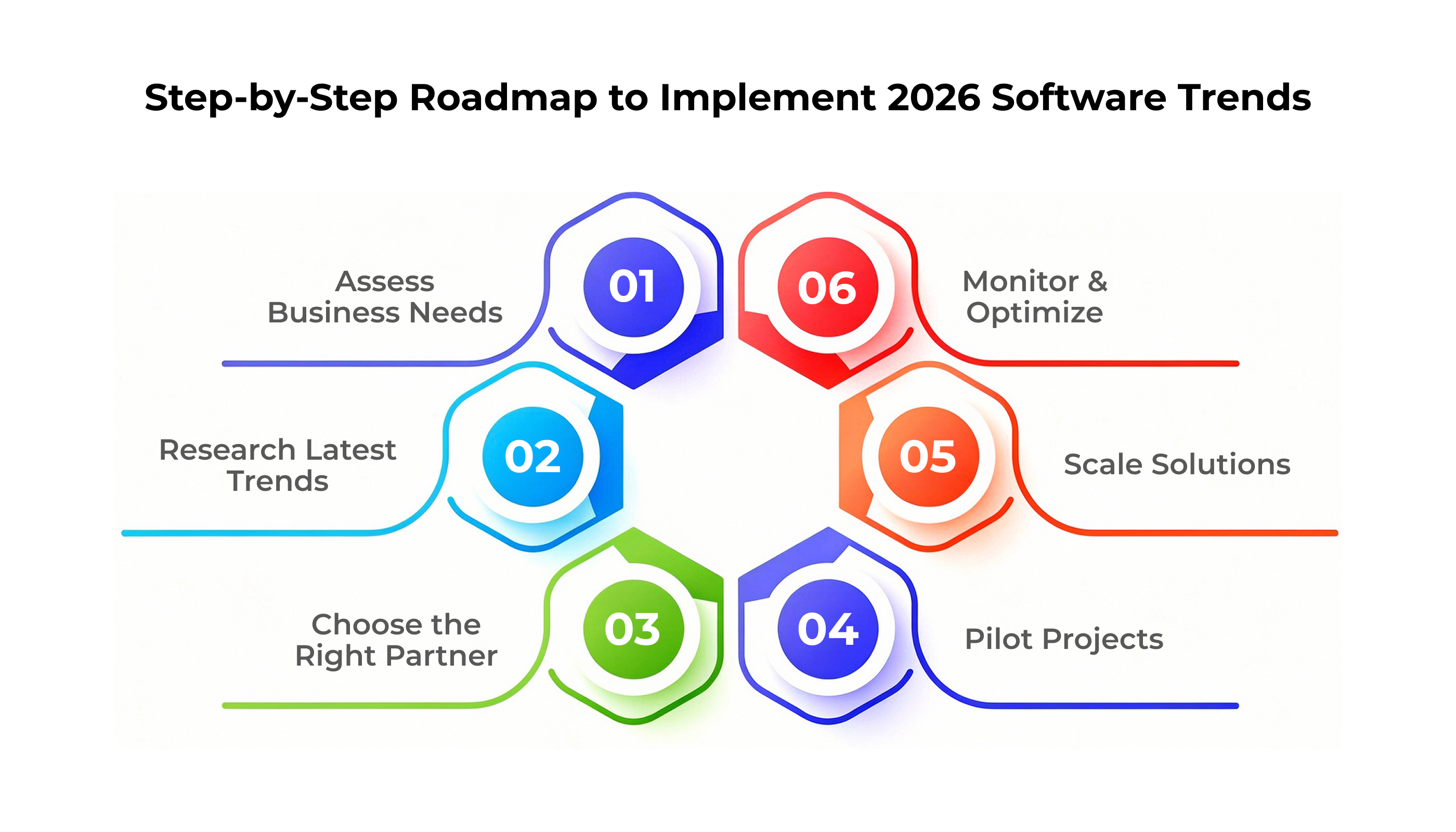
1. Assess Business Needs
Start by identifying areas where software innovation can add the most value to your business. Focus on pain points like customer engagement, compliance, or efficiency, and match them with the right technology solutions.
2. Research Latest Trends
Stay updated on the latest software development trends and software development outsourcing trends. This helps you understand which technologies—like AI, blockchain, or cloud-native apps—are most relevant to your industry.
3. Choose the Right Partner
Select a trusted software development company UK or an innovation software company that specializes in your sector. The right partner ensures expertise, scalability, and long-term support for your projects.
4. Pilot Projects
Begin with small proof-of-concept projects to test new technologies. This reduces risk and allows you to measure real-world impact before committing to large-scale implementation.
5. Scale Solutions
Once pilot projects succeed, expand them across departments or the entire organization. Scaling ensures maximum ROI and helps you fully leverage new trends in software development.
6. Monitor & Optimize
Use innovation management software or the best innovation management software to track progress, measure performance, and refine solutions. Continuous monitoring ensures your systems remain effective and future-ready.
How PerfectionGeeks Helps UK Enterprises Navigate Software Development Trends in 2026
PerfectionGeeks enables UK enterprises to confidently embrace the latest software development trends by offering tailored, future-ready solutions. As a trusted software development company UK, we combine innovation, industry expertise, and global outsourcing strategies to help businesses adapt to new trends in software development while ensuring compliance, scalability, and efficiency.
Ready to Build?
Talk to our experts at PerfectionGeeks about your next software project. We work with UK businesses across healthcare, fintech, retail, and enterprise — bringing the latest trends to life in practical, scalable software.
Book a Free Consultation →
Frequently Asked Questions
Quick answers related to this article from PerfectionGeeks.
1. What is the single most important software development trend for UK businesses in 2026?
2. How do these software development trends affect my industry specifically?
3. What are the benefits of adopting new software development trends early?
4. How long does it take to implement these trends in an existing business?
5. What are the best tools for keeping up with software development trends in 2026?
Conclusion
The top UK software development trends in 2026 are not abstract concepts for conference talks — they are the practical toolkit that determines which businesses grow and which stagnate. From AI-embedded development to security-by-design, from cloud maturity to sustainable software practices, the organisations winning in 2026 are those that have made deliberate, informed choices about how they build and maintain their digital products.
The good news is that you do not need to adopt every trend simultaneously. A clear-eyed assessment of your business priorities, your existing infrastructure, and your budget will reveal the two or three trends with the highest ROI for your specific situation. Start there. Build momentum. Iterate.
And if you need an experienced partner to help navigate these decisions — one with deep UK market experience, real sector expertise, and a track record of delivering modern software solutions — PerfectionGeeks is ready to help.

Written By Shrey Bhardwaj
Director & Founder
Shrey Bhardwaj is the Director & Founder of PerfectionGeeks Technologies, bringing extensive experience in software development and digital innovation. His expertise spans mobile app development, custom software solutions, UI/UX design, and emerging technologies such as Artificial Intelligence and Blockchain. Known for delivering scalable, secure, and high-performance digital products, Shrey helps startups and enterprises achieve sustainable growth. His strategic leadership and client-centric approach empower businesses to streamline operations, enhance user experience, and maximize long-term ROI through technology-driven solutions.