Published 20 May 2026 | Updated 29 May 2026
Technology
Vector Databases in 2026: Pinecone vs Weaviate vs pgvector Compared
Artificial intelligence applications in 2026 are no longer experimental side projects. Enterprises now rely on Retrieval-Augmented Generation (RAG), AI agents, recommendation systems, semantic search, and multimodal AI pipelines every day. At the center of all these systems is one critical infrastructure layer: the vector database.
As AI adoption grows, businesses are increasingly searching for the best vector database for AI applications. The debate around Pinecone vs Weaviate vs pgvector differences has become one of the most important architecture discussions for engineering teams.
At PerfectionGeeks Technologies, we help businesses design scalable AI ecosystems, and one of the most common questions clients ask is:
“Which vector database should we choose in 2026?”
The answer depends on scalability, operational complexity, hybrid search capabilities, infrastructure preferences, cost, and AI workload requirements.
This detailed vector database comparison 2026 explains everything businesses need to know about Pinecone, Weaviate, and pgvector, including architecture, performance, use cases, pricing considerations, strengths, weaknesses, and industry adoption trends.
Transform Your Digital Experience
Vector database comparison 2026 refers to evaluating modern vector databases based on performance, scalability, pricing, AI integration capabilities, search accuracy, and deployment flexibility. As AI applications increasingly rely on Retrieval-Augmented Generation (RAG), semantic search, recommendation systems, and multimodal AI, choosing the right vector database can significantly impact system performance and operational costs.
- Vector databases are essential for modern AI applications such as RAG systems, semantic search, recommendation engines, and AI assistants in 2026.
- The right choice in this vector database comparison 2026 depends on scalability, infrastructure preferences, operational complexity, and AI workload requirements.
- Pinecone is best for businesses that want a fully managed, enterprise-ready AI vector search database solution with minimal DevOps effort.
- Weaviate stands out among open-source vector databases for embeddings because of its powerful hybrid search, metadata filtering, and customization capabilities.
- pgvector is a cost-effective option for organizations already using PostgreSQL and looking to integrate vector search directly into their existing infrastructure.
- Hybrid search combining keyword and semantic retrieval is becoming a critical requirement for enterprise AI systems and RAG applications.
- Infrastructure costs, scalability needs, and long-term flexibility should be considered before choosing between Pinecone, Weaviate, and pgvector.
- Industries such as healthcare, finance, legal, eCommerce, and SaaS are rapidly adopting AI vector search database solutions to improve automation and intelligent retrieval.
- RAG architectures are driving massive demand for efficient vector databases that can support accurate and low-latency AI responses.
- At PerfectionGeeks Technologies, businesses can build scalable AI systems using the most suitable vector database architecture for their specific goals and workloads.
Why Vector Database Comparison 2026 Matters in 2026
The explosion of generative AI has fundamentally changed how organizations manage and retrieve information.
According to Gartner, more than 80% of enterprise applications are expected to integrate AI capabilities by 2027, creating significant demand for vector search infrastructure.
Traditional relational databases struggle with:
- Semantic similarity searches
- Embedding storage
- High-dimensional vector indexing
- Real-time AI retrieval
- Multimodal data search
Vector databases solve these challenges by enabling rapid nearest-neighbor searches across millions or billions of embeddings.
Organizations in the USA, UK, UAE, Canada, and Australia are increasingly investing in vector databases to power:
- AI chatbots
- RAG systems
- Enterprise search
- Product recommendations
- Fraud detection
- Healthcare AI
- Financial intelligence systems
Get a Free Consultation
Planning an AI application that requires semantic search or RAG architecture?
PerfectionGeeks helps businesses design, build, and scale AI platforms powered by modern vector databases.
What is a Vector Database?
A vector database is a specialized storage system designed to manage vector embeddings generated by machine learning models.
Instead of searching for exact keywords, vector databases identify meaning and context.
For example:
Traditional Search
Query:
"Best smartphone under $500"
Returns:
Pages containing those exact words.
Vector Search
Query:
"Affordable mobile with excellent camera"
Returns:
Relevant products even if the wording differs.
This semantic understanding makes vector databases the foundation of modern AI systems.
How Vector Database Comparison 2026 Works: Step-by-Step
Step 1: Define Your AI Use Case
Determine whether you need:
- RAG applications
- Semantic search
- Recommendation engines
- Fraud detection
- Computer vision systems
Different databases excel in different workloads.
Step 2: Evaluate Performance
Key metrics include:
| Metric | Importance |
|---|---|
| Query Latency | User experience |
| Throughput | Concurrent requests |
| Recall Accuracy | Search quality |
| Index Build Time | Data ingestion speed |
| Scalability | Growth readiness |
Step 3: Review Deployment Options
Consider:
Cloud Managed
Examples:
- Pinecone
- Weaviate Cloud
Pros:
- Easy setup
- Auto scaling
Cons:
- Higher recurring costs
Self-Hosted
Examples:
- Milvus
- Qdrant
Pros:
- Full control
- Lower long-term costs
Cons:
- Requires DevOps expertise
Step 4: Compare Integration Ecosystems
Modern AI stacks often use:
- LangChain
- LlamaIndex
- OpenAI
- Claude
- Gemini
- Hugging Face
The best vector databases provide native integrations.
Step 5: Analyze Pricing
Infrastructure costs often become significant as datasets exceed hundreds of millions of vectors.
Cost modeling should include:
- Storage
- Compute
- Data transfer
- Replication
- Monitoring
Vector Database Comparison 2026: Side-by-Side Analysis
| Feature | Pinecone | Weaviate | Milvus | Qdrant | Chroma |
|---|---|---|---|---|---|
| Open Source | No | Yes | Yes | Yes | Yes |
| Managed Cloud | Yes | Yes | Limited | Limited | No |
| Hybrid Search | Yes | Yes | Yes | Yes | Partial |
| Scalability | Excellent | Excellent | Excellent | High | Medium |
| Enterprise Support | Strong | Strong | Moderate | Growing | Limited |
| Kubernetes Ready | Yes | Yes | Yes | Yes | Basic |
| RAG Integration | Excellent | Excellent | Excellent | Excellent | Good |
| Learning Curve | Low | Medium | High | Medium | Very Low |
Pinecone
Best For:
- Enterprise AI
- Production RAG systems
Advantages:
- Fully managed
- High availability
- Excellent developer experience
Limitations:
- Higher pricing
- Proprietary ecosystem
Weaviate
Best For:
- AI-native applications
- Hybrid search
Advantages:
- Open source
- Rich module ecosystem
- Strong community support
Limitations:
- Requires tuning for large deployments
Milvus
Best For:
- Large-scale enterprise deployments
Advantages:
- Massive scalability
- Advanced indexing
- Open source
Limitations:
- Operational complexity
Qdrant
Best For:
- Cost-efficient AI applications
Advantages:
- Lightweight architecture
- Strong filtering
- Excellent performance
Limitations:
- Smaller ecosystem than Pinecone
Chroma
Best For:
- AI prototypes
- Startups
Advantages:
- Easy implementation
- Developer friendly
Limitations:
- Limited enterprise features
Key Benefits of Vector Databases
Faster Semantic Search
Users receive contextually relevant results instead of keyword matches.
Improved AI Response Quality
RAG systems retrieve more accurate information before generating responses.
Better Recommendation Systems
Vector search significantly improves:
- Product recommendations
- Content suggestions
- User personalization
Scalability
Modern vector databases support:
- Millions of vectors
- Billions of vectors
- Distributed architectures
Multimodal AI Support
Store embeddings from:
- Text
- Images
- Audio
- Video
within a unified search infrastructure.
Tools and Technologies Used with Vector Databases
Most AI teams combine vector databases with:
| Category | Popular Tools |
|---|---|
| Embeddings | OpenAI, Cohere, Voyage AI |
| LLMs | GPT-5, Claude, Gemini |
| Frameworks | LangChain, LlamaIndex |
| Monitoring | LangSmith, Arize AI |
| Deployment | Kubernetes, Docker |
| Cloud | AWS, Azure, GCP |
Cost and Timeline
Startup MVP
Cost
$5,000–$15,000
Timeline
4–8 Weeks
Features:
- Basic semantic search
- Limited vector storage
- Cloud deployment
Mid-Size Enterprise Platform
Cost
$20,000–$80,000
Timeline
2–4 Months
Features:
- RAG implementation
- Advanced indexing
- Analytics dashboards
Enterprise AI Infrastructure
Cost
$100,000–$500,000+
Timeline
4–12 Months
Features:
- Billion-vector scale
- High availability
- Global deployment
- Compliance controls
Real-World Example #1
E-Commerce Product Search
A retail company replaced keyword search with vector search.
Results:
- 41% increase in conversions
- 28% lower bounce rate
- Improved search relevance
Real-World Example #2
Financial Services Knowledge Assistant
A bank implemented a RAG platform using vector databases.
Results:
- 65% faster document retrieval
- Reduced support workload
- Improved compliance accuracy
Real-World Example #3
Healthcare Research Platform
A healthcare provider indexed millions of research papers.
Results:
- Faster clinical discovery
- Better treatment recommendations
- Reduced manual review time
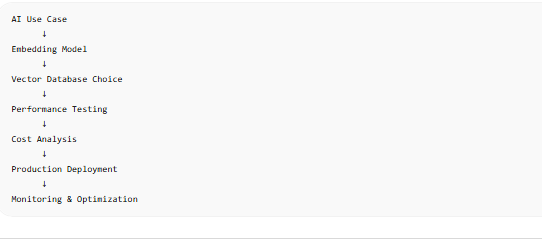
Infographic: Vector Database Selection Framework
Future Trends in Vector Databases
The vector database market continues evolving rapidly.
Key developments expected through 2026 include:
Hybrid Search Everywhere
Combining:
- Keyword search
- Vector search
- Graph search
into a single query layer.
Multimodal Retrieval
Organizations increasingly search across:
- Documents
- Images
- Audio
- Videos
using unified embeddings.
AI-Native Databases
Future platforms will include:
- Built-in embedding generation
- RAG orchestration
- LLM integrations
reducing infrastructure complexity.
Frequently Asked Questions
Quick answers related to this article from PerfectionGeeks.
1. What is vector database comparison 2026?
2. How does vector database comparison 2026 work?
3. Why are vector databases important for AI applications?
4. How long does vector database comparison 2026 take?
5. What are the best tools for vector database comparison 2026?
Conclusion
Choosing the right vector database in 2026 is no longer just a technical decision—it is a strategic AI infrastructure decision. The optimal platform depends on your scale, budget, compliance requirements, deployment preferences, and AI roadmap.
For startups, lightweight solutions such as Chroma or Qdrant may be sufficient. For growing enterprises, Weaviate and Milvus offer scalability and flexibility. Organizations seeking managed simplicity often choose Pinecone.
As generative AI adoption accelerates across the USA, UK, UAE, Canada, and Australia, investing in the right vector database architecture today can significantly improve search relevance, AI response quality, operational efficiency, and long-term scalability.

Written By Shrey Bhardwaj
Director & Founder
Shrey Bhardwaj is the Director & Founder of PerfectionGeeks Technologies, bringing extensive experience in software development and digital innovation. His expertise spans mobile app development, custom software solutions, UI/UX design, and emerging technologies such as Artificial Intelligence and Blockchain. Known for delivering scalable, secure, and high-performance digital products, Shrey helps startups and enterprises achieve sustainable growth. His strategic leadership and client-centric approach empower businesses to streamline operations, enhance user experience, and maximize long-term ROI through technology-driven solutions.