
Published 13 February 2026 | Updated 13 February 2026
Technology
How to Develop AI Agents for Insurance in 2026: Framework, Cost & ROI Insights
The insurance industry is changing faster than ever. In 2026, companies are moving beyond traditional software and adopting intelligent systems that can think, analyze, and make decisions. One of the biggest innovations driving this change is AI agents for insurance. From automating claims to improving underwriting accuracy, AI is helping insurers reduce costs and increase efficiency. In this detailed guide, we will explain everything you need to know about developing ai agents insurance companies can rely on, including framework, cost, ROI, challenges, and more.
What Are AI Agents for Insurance?
AI agents are intelligent software systems that can perform tasks independently. They can analyze data, make decisions, learn from patterns, and interact with users.
In the insurance industry, AI agents can:
- Process claims automatically
- Detect fraud
- Assist in underwriting
- Answer customer queries
- Recommend insurance policies
- Analyze risk profiles
Unlike basic automation tools, AI insurance software can improve over time using machine learning and large language models.
Why Artificial Intelligence in Insurance Industry Is Growing Fast
Artificial intelligence in insurance industry is growing fast because insurers handle large volumes of data and complex processes every day. Manual systems are slow and costly, while AI helps automate claims, underwriting, and customer support efficiently. Another major reason is fraud detection. AI can quickly analyze patterns and identify suspicious claims, reducing financial losses. It also improves risk assessment and decision-making.
Cost savings and better customer experience are key drivers as well. AI speeds up claim approvals, reduces operational costs, and offers personalized policy recommendations. This gives insurance companies a strong competitive advantage.
Key Benefits of AI Insurance Automation
- Faster claim settlements
- Lower operational costs
- Better fraud detection
- Improved customer satisfaction
- Accurate underwriting
Companies adopting AI automation for insurance companies are seeing measurable business growth.
Types of AI Agents Insurance Companies Can Build
Different departments in an insurance company have different responsibilities, so they require specialized AI agents. Below are the most common and impactful use cases explained in simple terms.
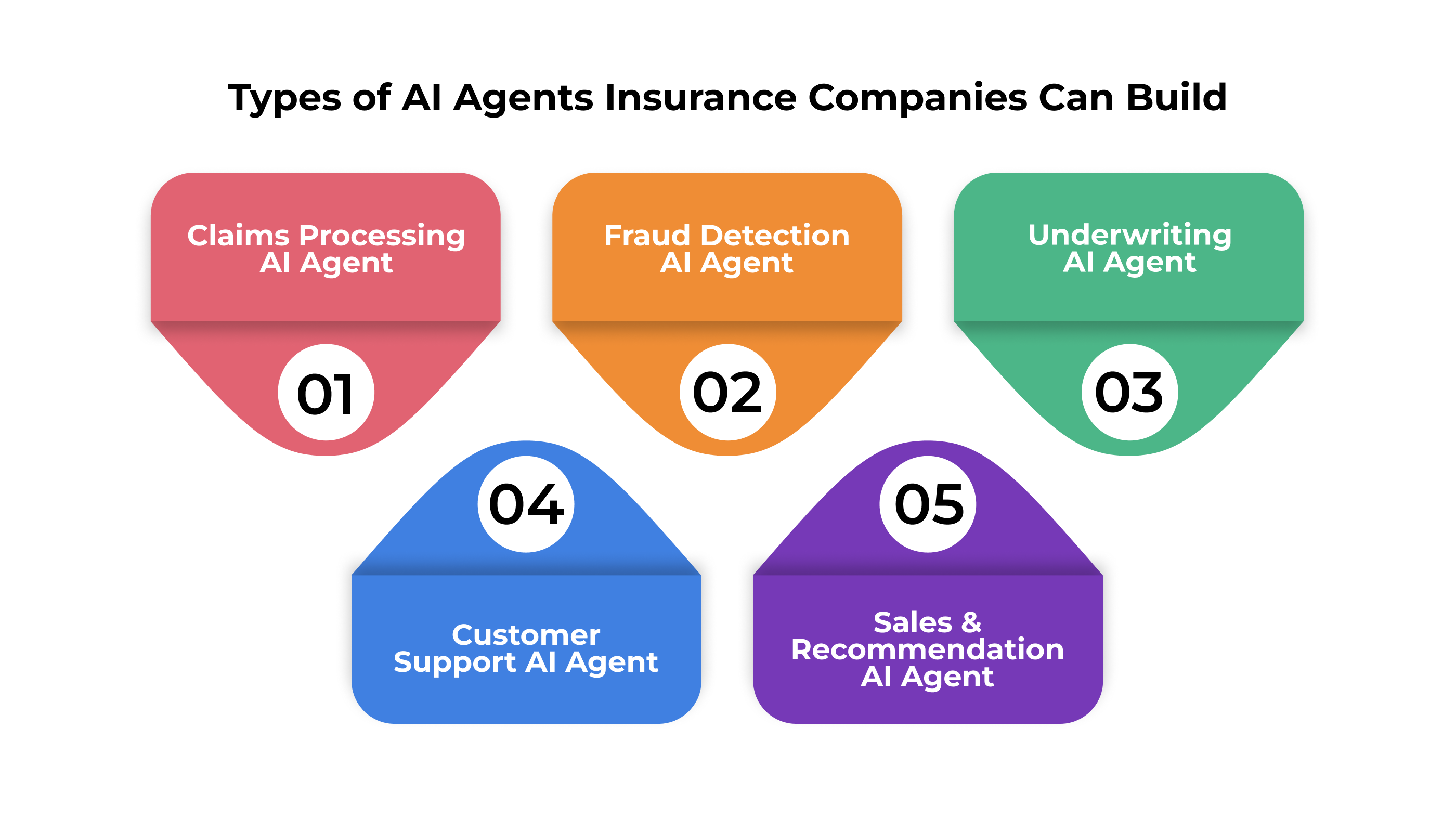
1. Claims Processing AI Agent
A claims processing AI agent automates the entire claim review process. It verifies documents, checks policy details, and even evaluates damage using data or images. This reduces manual work, speeds up approvals, and improves customer satisfaction.
2. Fraud Detection AI Agent
This AI agent analyzes historical data and behavioral patterns to identify suspicious claims. It can detect unusual activities that humans might miss. By reducing fraudulent payouts, it helps insurance companies save significant money.
3. Underwriting AI Agent
An underwriting AI agent evaluates customer risk profiles using past data, health records, or financial information. It suggests accurate premium pricing based on calculated risk levels. This improves decision-making and reduces human error.
4. Customer Support AI Agent
This AI agent works like a virtual assistant available 24/7. It answers policy-related questions, provides claim updates, and guides customers through processes. This improves response time and enhances the overall customer experience.
5. Sales & Recommendation AI Agent
A sales AI agent studies customer behavior and preferences to recommend the most suitable insurance policies. It personalizes offers and increases cross-selling opportunities. This helps companies boost revenue and improve customer engagement.
These advanced insurance AI solutions improve productivity, reduce operational costs, and make insurance processes faster and smarter.
Step-by-Step Framework to Build AI Agent for Insurance
Step 1: Define the Business Goal
Start by clearly identifying the problem you want to solve, such as slow claims processing or rising fraud cases. Decide which department needs automation and set measurable goals. Define expected ROI so you can track success after implementation.
Step 2: Collect and Prepare Data
Gather historical claims data, policy records, customer interactions, and fraud reports. Clean and organize the data to remove errors and duplicates. High-quality data is essential for accurate insurance AI development.
Step 3: Choose the Right Technology
Select technologies based on your use case, such as machine learning for risk scoring or NLP for chatbots. Computer vision can help with damage assessment, while predictive analytics supports fraud detection. The right tech stack ensures efficient AI insurance automation.
Step 4: Design AI Agent Architecture
Create a structured system with a data layer, AI model layer, decision engine, integration layer, and user interface. This ensures smooth data flow and intelligent decision-making. A strong architecture supports scalable enterprise AI insurance solutions.
Step 5: Integrate with Existing Systems
Connect the AI agent with claims software, CRM systems, payment gateways, and policy databases. Seamless integration avoids manual work and improves operational efficiency. This step enables smooth AI automation for insurance companies.
Step 6: Testing and Compliance
Test the AI system for accuracy, security, and performance. Ensure compliance with data privacy regulations and insurance laws. Bias detection and security checks are critical for safe insurance AI development.
Step 7: Deployment and Monitoring
Deploy the AI agent into the live system and monitor its performance continuously. Track accuracy, measure ROI, and update models regularly. Continuous improvement ensures long-term success and better business results.
Cost to Develop AI Agents for Insurance in 2026
The cost depends on complexity, features, and scale.
Below is an estimated cost table:
| Type of AI Agent | Estimated Cost (USD) |
| Basic chatbot | $15,000 – $30,000 |
| Claims automation AI | $40,000 – $80,000 |
| Underwriting AI system | $60,000 – $120,000 |
| Fraud detection system | $70,000 – $150,000 |
| Enterprise AI insurance solutions | $150,000 – $500,000+ |
Factors Affecting Cost
- Data volume
- Model complexity
- Cloud infrastructure
- Integration requirements
- Compliance costs
- Custom dashboard design
Companies looking for custom AI solutions for insurance should plan for long-term investment rather than short-term savings.
Free AI for Insurance Agents: Is It a Good Option?
Free AI for insurance agents can be helpful for small agencies that want to experiment with automation or improve basic customer communication. However, while these tools may seem cost-effective, they often lack advanced features, strong security, and proper customization needed for serious insurance operations.
1. Limited Features: Free AI tools usually offer basic chatbot or automation functions. They may not support complex tasks like claims analysis, underwriting support, or fraud detection.
2. Lack of Customization: Most free solutions are generic and not designed specifically for insurance workflows. This makes it difficult to align them with your company’s policies and processes.
3. Data Security Risks: Insurance companies handle sensitive customer data. Free platforms may not provide enterprise-level security or full compliance with data protection regulations.
4. Scalability Issues: As your business grows, free tools may not handle large data volumes or high customer traffic. Upgrading later can require rebuilding the system.
ROI of AI Agents for Insurance
ROI is one of the biggest reasons insurance companies invest in AI agents. Unlike many digital tools that offer indirect value, AI delivers measurable financial and operational improvements. When implemented correctly, AI agents reduce costs, improve efficiency, and increase revenue at the same time.
Direct Financial Benefits
Reduced Manual Labor Cost: AI agents automate repetitive tasks such as document verification, claim validation, and customer query handling. This reduces dependency on large operational teams and lowers salary and administrative expenses.
Lower Fraud Losses: Fraud detection AI can identify suspicious patterns early by analyzing historical data and behavior trends. Even a small reduction in fraudulent claims can save millions annually for large insurers.
Faster Claim Processing: AI speeds up claims approval by automatically reviewing documents and verifying policy details. Faster processing improves customer satisfaction and reduces operational bottlenecks.
Higher Policy Renewals: With better customer service and personalized policy recommendations, AI improves customer experience. Satisfied customers are more likely to renew policies, increasing long-term revenue.
Example ROI Scenario
If an insurer processes 100,000 claims per year and AI reduces the processing cost by $10 per claim, the company saves $1,000,000 annually. In addition to direct savings, faster service and improved fraud detection further increase profitability.
This clearly shows that AI insurance automation is not just a technology upgrade — it is a strong financial investment that delivers long-term business value
Enterprise AI Insurance Solutions vs Traditional Software
| Feature | Traditional Software | Enterprise AI Insurance Solutions |
| Decision Making | Manual | Intelligent & automated |
| Learning Capability | No | Yes |
| Fraud Detection | Limited | Advanced pattern detection |
| Customer Experience | Basic | Personalized |
| Scalability | Moderate | High |
Enterprise solutions offer long-term value and competitive advantage.
Challenges in Developing AI Agents Insurance Systems
Even though AI agents offer many benefits, developing them for insurance companies comes with certain challenges. Proper strategy and planning are necessary to overcome these obstacles.
1. Poor Data Quality: AI systems rely heavily on accurate and structured data. If the data is incomplete, outdated, or inconsistent, the AI model will produce incorrect results. Cleaning and organizing large volumes of insurance data can be time-consuming but is essential for success.
2. High Initial Investment: Building enterprise-level AI agents requires significant upfront investment. Costs include data preparation, model development, cloud infrastructure, integration, and compliance testing. Companies must plan their budget carefully and focus on long-term ROI.
3. Regulatory Complexity: The insurance industry is highly regulated, and laws differ from country to country. AI systems must comply with data protection rules and insurance regulations. Ensuring compliance can slow down development if not handled properly.
4. Integration Issues: Many insurance companies still use legacy systems that were not built to support AI. Integrating modern AI agents with older software can be technically challenging and may require system upgrades.
5. Security Risks: Insurance companies handle sensitive customer information such as personal details and financial data. AI systems must include strong encryption, access control, and cybersecurity measures to prevent data breaches.
6. Employee Resistance: Employees may worry that automation will replace their jobs. Without proper communication and training, resistance to change can affect adoption. Companies should focus on showing how AI supports teams rather than replaces them.
How PerfectionGeeks Helps in Insurance AI Development
PerfectionGeeks supports insurance companies in building secure, scalable, and result-driven AI systems tailored to their business needs. From strategy planning to deployment and optimization, the company ensures smooth insurance AI development with strong focus on performance, compliance, and ROI.
- Business & Use Case Analysis – Identifies high-impact areas like claims, underwriting, and fraud detection for AI implementation.
- Custom AI Solutions for Insurance – Develops tailored AI agents designed specifically for insurance workflows.
- Enterprise AI Insurance Solutions – Builds scalable systems that integrate seamlessly with existing enterprise platforms.
- Secure AI Insurance Software Development – Ensures strong data protection and regulatory compliance.
- System Integration & Deployment – Connects AI agents with CRM, claims systems, and policy databases.
- Ongoing Monitoring & Optimization – Continuously improves AI performance to maximize ROI and efficiency.
Important Things Insurance Companies Should Consider
Before implementing AI agents, insurance companies should carefully plan their strategy and long-term goals. It is important to start with a clear use case that delivers measurable business value, such as claims automation or fraud detection. Companies must ensure high-quality and well-structured data, since AI accuracy depends heavily on data reliability. Strong data security and regulatory compliance should be prioritized because insurance involves sensitive customer information. Insurers should also focus on seamless integration with existing systems to avoid operational disruption. Finally, continuous monitoring, performance tracking, and regular model updates are essential to maximize ROI and ensure long-term success in AI insurance development.
Future Trends in AI Agents for Insurance (2026 and Beyond)
The insurance industry is evolving rapidly, and AI agents will play a central role in shaping its future. As technology advances and customer expectations rise, insurers are adopting smarter and more capable systems. Here are the key trends to watch:
1. Generative AI for Policy Drafting
Generative AI models will help insurers automatically generate and customize policy documents. Instead of manually writing complex contract language, AI agents will produce clear and tailored policies faster, reducing human workload.
2. Real-Time Risk Prediction
AI agents will analyze live data — like driving behavior, weather patterns, and health indicators — to predict risk in real time. This helps insurers adjust pricing dynamically and proactively reduce exposure to losses.
3. Voice-Enabled AI Assistants
Voice AI is becoming more advanced. Customers will be able to talk naturally with digital assistants to get quotes, submit claims, or check policy status — improving customer experience without human support.
4. Hyper-Personalized Insurance Products
AI agents will use data from wearables, telematics, and online behavior to tailor insurance offers for individual needs. This trend moves the industry from “one-size-fits-all” policies to customized plans with better pricing and relevance.
5. Automated Claim Settlement in Minutes
Future AI systems will handle claim validation, fraud checks, and payout authorization within minutes, not days. With enhanced automation, insurers can provide faster service and higher customer satisfaction.
6. Integration of IoT and AI
With the growth of IoT devices like smart home sensors and connected cars, AI agents will receive continuous real-world data. This integration will improve predictive accuracy for risk and enable proactive loss prevention.
7. Enhanced Compliance and Risk Controls
AI will evolve to manage regulatory compliance automatically. Intelligent systems will monitor rules and adjust decision-making logic to meet changing legal requirements across regions.
8. Ethical and Explainable AI Models
As AI becomes more influential in insurance decisions, there will be a stronger focus on transparency. AI models will be designed to explain how decisions are made, helping insurers build trust with regulators and customers.
Frequently Asked Questions
Quick answers related to this article from PerfectionGeeks.
1. What are AI agents for insurance?
2. How long does it take to develop AI agents for insurance?
3. What is the average cost of insurance AI development?
4. Why choose PerfectionGeeks for insurance AI development?
Conclusion
In 2026, adopting AI agents for insurance is no longer optional. It is a strategic necessity. From reducing operational costs to improving customer experience, AI is transforming the industry. While free ai for insurance agents tools can help in small experiments, real success comes from professional insurance AI development and scalable enterprise AI insurance solutions.
Whether you want to automate claims, detect fraud, or improve underwriting accuracy, AI offers measurable ROI. With the right strategy, technology, and partner like PerfectionGeeks, insurance companies can confidently move toward intelligent automation.

Written By Shrey Bhardwaj
Director & Founder
Shrey Bhardwaj is the Director & Founder of PerfectionGeeks Technologies, bringing extensive experience in software development and digital innovation. His expertise spans mobile app development, custom software solutions, UI/UX design, and emerging technologies such as Artificial Intelligence and Blockchain. Known for delivering scalable, secure, and high-performance digital products, Shrey helps startups and enterprises achieve sustainable growth. His strategic leadership and client-centric approach empower businesses to streamline operations, enhance user experience, and maximize long-term ROI through technology-driven solutions.