Published 17 February 2026 | Updated 29 May 2026
Technology
Top 10 Mobile App Trends in 2026 Shaping the Future of Digital Innovation
Mobile applications are no longer a luxury for businesses they are the foundation of digital growth and customer engagement. Across industries like fintech, healthcare, retail, and entertainment, apps have become the primary way brands connect, serve, and retain users. As we move into 2026, staying updated with the latest mobile app trends is essential for companies aiming to stay competitive. The future of mobile apps will be shaped by AI, immersive tech, faster connectivity, and smarter monetization strategies. Let’s start with a quick market overview before exploring the top trends.
Transform Your Digital Experience
Mobile App Trends 2026 refer to the technologies, development approaches, user experience innovations, and business strategies that are shaping the future of mobile applications. These trends include AI-powered experiences, on-device intelligence, super apps, augmented reality, 5G-enabled applications, privacy-first development, cross-platform frameworks, and intelligent automation. Businesses that adopt these trends can improve user engagement, increase retention, and gain a competitive advantage in the rapidly evolving digital landscape.
AI Is the Defining Force of 2026
- AI-powered personalization is no longer optional — it's the baseline expectation. Apps leveraging real-time behavioral intelligence and generative AI report up to 3x higher 90-day user retention. Whether it's smart recommendations, in-app assistants, or predictive notifications, AI is what separates growing apps from stagnant ones.
5G + Edge Computing = A New Performance Standard
- With 5G subscribers surpassing 2 billion globally, ultra-low latency experiences — live AR, real-time multiplayer, HD streaming — are no longer edge cases. Combined with edge computing, apps can now process data closer to users, dramatically reducing response times and unlocking entirely new feature categories.
Super Apps Are Redefining User Loyalty
- The era of single-purpose apps is giving way to consolidated digital ecosystems. Super apps generate 3 to 5x longer daily session times than single-feature alternatives. Businesses that bundle services into unified platforms build stickier, more monetizable user relationships.
AR Has Crossed From Novelty to Necessity
- Augmented Reality is delivering measurable business outcomes — not just buzz. Retail AR features reduce return rates by up to 35% and lift conversions by 25–40%. Industries like real estate, education, and healthcare are rapidly following retail's lead.
Voice & Conversational Interfaces Expand Accessibility
- Voice is becoming a primary navigation layer for hands-free, accessibility-focused, and convenience-driven users. Optimizing for voice search and conversational UI is now a core part of both product design and ASO strategy.
Security Is a Brand-Building Strategy, Not Just Compliance
- Biometric authentication, blockchain identity layers, and AI-driven fraud detection are standard expectations in 2026. Users and regulators alike demand transparency. A secure app is a trusted app — and trust directly impacts retention, ratings, and revenue.
What Are Mobile App Trends in 2026?
Mobile app trends refer to the dominant technological shifts, user behavior patterns, development methodologies, and business strategies that are reshaping how mobile applications are conceived, built, deployed, and monetized in a given period.
In 2026, these trends are not abstract buzzwords. They represent concrete, measurable changes in how leading companies are investing in technology and how users are responding. Understanding them means understanding the forces that separate high-growth apps from forgotten ones.
The 10 Core Trends Defining 2026
1. AI-Powered Personalization & Generative AI Apps no longer serve one-size-fits-all experiences. Artificial intelligence now drives real-time personalization — analyzing behavior, predicting preferences, and dynamically adjusting interfaces, content, and recommendations. Generative AI has added a new dimension: apps can now create content, generate visuals, draft messages, or power conversational assistants on the fly.
2. 5G & Edge Computing Revolution 5G is not just faster internet — it enables entirely new categories of app experiences. Real-time multiplayer gaming, live AR overlays, instant HD video, and ultra-responsive IoT integrations are all becoming baseline expectations. Edge computing complements this by processing data closer to the user, cutting latency dramatically.
3. Super Apps & Digital Ecosystems Super apps combine messaging, payments, shopping, bookings, and services into a single platform. What WeChat pioneered in China is now going global. Users increasingly prefer consolidated digital experiences over managing dozens of separate applications.
4. Augmented Reality (AR) & Immersive Technologies AR has crossed from novelty to necessity in sectors like retail, real estate, education, and healthcare. Virtual try-ons, 3D product previews, immersive training simulations, and spatial computing experiences are driving measurable uplift in conversion rates and user engagement.
5. Voice Search & Conversational Interfaces Voice is becoming the interface of choice for a growing segment of users, particularly in hands-free contexts. Natural language processing has matured to the point where AI assistants can understand intent, context, and nuance with impressive accuracy.
6. Advanced Security & Blockchain Integration With cyber threats growing in sophistication, security is no longer an afterthought. Biometric authentication, end-to-end encryption, AI-powered fraud detection, and blockchain-based identity verification are the new standards users and regulators expect.
7. Low-Code & No-Code Development Platforms like Bubble, FlutterFlow, and Retool are enabling businesses to build and iterate on apps significantly faster, without always needing large engineering teams. This democratization is accelerating market entry and experimentation.
8. Cross-Platform Development & Multi-Device Integration Users switch seamlessly between phones, tablets, wearables, smart TVs, and connected car systems. Apps built on cross-platform frameworks like Flutter and React Native allow businesses to serve all these contexts from a unified codebase.
9. Sustainable & Energy-Efficient App Development Green coding, optimized data processing, and energy-efficient architectures are becoming part of the development conversation. Users and enterprise buyers alike are paying attention to the digital carbon footprint of the tools they use.
10. Evolving Mobile App Monetization Strategies Subscription models, personalized in-app purchases, contextual advertising, and hybrid monetization strategies are replacing the blunt "paid download" model. Smart monetization balances revenue generation with user experience preservation.
Why Mobile App Trends 2026 Matter
Knowing what trends exist is only half the equation. Understanding why they matter is what drives smart business decisions. Here is why each of these shifts carries real-world weight for businesses in 2026.
The Business Case for Staying Current
User expectations have permanently shifted. Apps that felt impressive in 2022 now feel dated. Users exposed to AI-driven personalization in one app immediately expect it everywhere. Staying current with trends is not about novelty — it is about meeting the baseline of what users consider acceptable.
The competitive gap is widening. Early adopters of AI personalization, 5G experiences, and AR integrations are reporting measurably higher retention rates, session lengths, and conversion rates. Every month a business delays investment in relevant trends, the gap between it and its competitors grows.
Regulatory and security pressures are mounting. Governments across the US, EU, India, and beyond are tightening data protection laws, digital privacy standards, and app transparency requirements. Trends in security and blockchain are not optional nice-to-haves — they are increasingly compliance requirements.
Monetization models are under pressure. Apple and Google have changed app store policies, limiting certain ad-tracking mechanisms and increasing scrutiny of in-app purchase flows. Businesses that rely on a single outdated monetization model are vulnerable. Diversified, trend-aware strategies are more resilient.
The rise of multi-device users. The average consumer now owns 3 to 4 connected devices. An app that only works beautifully on one form factor is leaving engagement and revenue on the table. Cross-platform trends matter because your users are everywhere.
Market Statistics That Reinforce Urgency
- Global mobile app revenues are expected to exceed $750 billion in 2026, up from around $500 billion in 2023.
- AI-integrated apps see up to 3x higher user retention compared to apps without personalization.
- 5G subscribers globally surpassed 2 billion in 2025 and continue to grow rapidly.
- AR shopping features increase purchase conversion rates by 25–40% in retail applications.
- Super apps boast 3 to 5 times longer daily session times than single-purpose apps.
- 72% of enterprise IT leaders cite mobile security as their top digital priority for 2026.
How to Implement Mobile App Trends in 2026 — Step by Step
Understanding trends is strategic. Implementing them is operational. Here is a practical, step-by-step framework for businesses looking to integrate 2026 mobile app trends into their product roadmap.
Step 1: Conduct a Current-State Audit
Before adding anything new, honestly assess where your existing app stands.
- Performance audit: Measure load times, crash rates, session lengths, and churn rates. Identify your biggest pain points.
- Technology stack review: Is your backend cloud-native? Can it handle edge computing integrations? Is your frontend framework cross-platform capable?
- User feedback analysis: Review app store ratings, support tickets, and in-app survey data. What are users asking for that you haven't delivered?
- Competitive benchmarking: Download and analyze your top three competitors' apps. What features are they offering that you aren't?
This audit gives you a prioritized gap list — the foundation for a trend-informed roadmap.
Step 2: Define Your Strategic Priorities
Not every trend is relevant to every business. A fintech app has different priority trends than a retail app or a healthcare platform. Map trends to your specific goals:
- If your primary goal is user retention, focus on AI personalization and super app features.
- If your primary goal is conversion optimization, prioritize AR and voice interfaces.
- If your primary goal is trust and compliance, invest first in security and blockchain.
- If your primary goal is market speed, explore low-code development platforms.
- If your goal is cost efficiency, cross-platform development is your starting point.
Define 2 to 3 strategic priorities before building your roadmap. Trying to implement all 10 trends simultaneously is a recipe for overextension.
Step 3: Build a Phased Roadmap
A phased approach reduces risk and allows you to learn before scaling investment.
Phase 1 — Foundation (Months 1–3): Fix technical debt, improve app performance, and ensure your architecture is cloud-native and scalable. This phase is not glamorous, but it is the prerequisite for everything else.
Phase 2 — Quick Wins (Months 3–6): Implement one or two high-impact, relatively low-effort trends. AI-driven push notifications, voice search integration, or a cross-platform rebuild are good Phase 2 candidates. These deliver measurable results quickly and build internal momentum.
Phase 3 — Differentiators (Months 6–12): Tackle the bigger, more complex trends: AR features, super app functionality, blockchain security layers, or advanced generative AI integrations. These require more planning, development time, and user education, but deliver the most competitive differentiation.
Phase 4 — Optimize & Scale (Ongoing): Use data from previous phases to double down on what's working. A/B test monetization models, refine AI personalization algorithms, and continuously improve the energy efficiency of your codebase.
Step 4: Assemble the Right Team
The right team depends on which trends you are implementing:
- AI/ML engineers for personalization and generative AI features.
- AR developers (Unity or ARKit/ARCore specialists) for immersive experiences.
- Blockchain developers for security and identity verification layers.
- Cross-platform specialists in Flutter or React Native for multi-device consistency.
- UX designers who understand voice interface design, conversational UI, and accessibility.
- DevOps engineers for cloud-native infrastructure and edge computing deployment.
Many businesses complement in-house teams with specialized development partners — particularly for niche capabilities like AR or blockchain.
Step 5: Choose Your Technology Stack
Align your technology choices with your roadmap priorities. See Section 5 for a detailed breakdown of the leading tools and technologies for each trend.
Step 6: Develop, Test, and Iterate
Use agile development sprints (2-week cycles) to build, test, and deploy incrementally. Key testing priorities include:
- Performance testing under real 5G and 4G conditions, not just Wi-Fi.
- A/B testing of AI personalization variations to find what resonates with your audience.
- Security penetration testing for any features touching payments, identity, or sensitive data.
- Accessibility testing for voice interfaces and conversational UI.
- Device fragmentation testing across the most common device-OS combinations used by your audience.
Step 7: Measure, Learn, and Scale
Establish clear KPIs before launch for each new feature:
- AI personalization: measure session length, click-through rate on recommendations, and 30-day retention.
- AR features: measure conversion rate uplift, feature engagement rate, and return rate reduction.
- Voice interfaces: measure task completion rate and voice activation frequency.
- Super app features: measure cross-service usage and overall daily active users.
Let data drive your scaling decisions, not assumptions.
Key Benefits of Embracing Mobile App Trends in 2026
Businesses that strategically adopt 2026 mobile app trends gain a range of competitive, financial, and operational advantages.
Higher User Retention and Engagement
AI personalization is the single most impactful lever for retention. When users feel that an app understands them — surfaces relevant content, anticipates their next action, and delivers timely notifications — they return more often and stay longer. Apps with mature AI personalization layers report 40–60% higher 90-day retention rates compared to generic, static experiences.
Super app features amplify this further. When users can accomplish multiple goals inside one platform, their reasons to leave are greatly reduced. Average daily session times for super apps are 3 to 5 times longer than single-purpose alternatives.
Increased Revenue and Monetization Flexibility
Evolving monetization strategies allow businesses to generate revenue from multiple streams simultaneously. A well-implemented freemium model with AI-driven conversion triggers, personalized in-app purchase prompts, and contextual advertising can outperform a simple subscription model by 2 to 3x in total revenue per user.
AR features in retail and e-commerce have been shown to reduce return rates by up to 35% — a direct bottom-line benefit — while simultaneously increasing purchase confidence and conversion rates.
Faster Development and Lower Costs
Low-code and no-code platforms, combined with cross-platform frameworks, are compressing development timelines significantly. A feature that once required 3 months of native development on iOS and Android separately can now ship in 6 weeks using Flutter or React Native. For startups and SMEs, this speed advantage is transformational.
Stronger Security and Customer Trust
In an era where a single data breach can destroy years of brand equity, investing in advanced security infrastructure is not just a compliance exercise — it is a brand-building strategy. Apps that clearly communicate their security practices, offer transparent data controls, and use biometric authentication see measurably higher user trust scores and app store ratings.
Competitive Differentiation
In saturated markets, the apps that win are those that consistently deliver genuinely better experiences. AR try-ons, AI-generated personalization, voice-first navigation, and sustainability-conscious development are differentiators that translate into press coverage, word-of-mouth referrals, and higher app store rankings.
Operational Efficiency
AI automation within enterprise apps reduces manual processes. Voice interfaces reduce friction for field workers or mobility-impaired users. Edge computing reduces server load and operating costs. Sustainable development practices reduce infrastructure expenses. The operational benefits of trend adoption extend far beyond user-facing features.
Tools & Technologies Powering 2026 Mobile App Trends
AI & Machine Learning
- TensorFlow Lite / Core ML — On-device AI inference for personalization and image recognition.
- OpenAI API / Anthropic Claude API — Generative AI for in-app assistants, content generation, and conversational features.
- Firebase ML / AWS Personalize — Managed AI services for recommendation engines and behavioral analytics.
- LangChain — Framework for building complex AI agent workflows inside mobile backends.
5G & Edge Computing
- AWS Wavelength / Azure Edge Zones — Cloud-native edge computing infrastructure.
- Cloudflare Workers — Lightweight, globally distributed edge functions.
- NVIDIA Jetson — Edge AI hardware for IoT-integrated mobile applications.
Augmented Reality
- Apple ARKit 6 — Advanced AR framework for iOS, supporting spatial computing and LiDAR scanning.
- Google ARCore — Android AR development platform with environmental understanding capabilities.
- Unity AR Foundation — Cross-platform AR development framework.
- 8th Wall — Browser-based WebAR for no-install AR experiences.
Cross-Platform Development
- Flutter 3.x — Google's UI toolkit for building natively compiled apps from a single Dart codebase.
- React Native 0.73+ — Facebook's JavaScript framework for cross-platform mobile development.
- Expo — Managed workflow for React Native, simplifying build and deployment.
Security & Blockchain
- Auth0 / Firebase Authentication — Managed identity and access management with biometric support.
- Hyperledger Fabric / Ethereum — Blockchain platforms for decentralized identity and transaction transparency.
- CrowdStrike Falcon — AI-powered mobile threat detection.
- Apple CryptoKit / Android Keystore — Native cryptography libraries for secure data handling.
Low-Code & No-Code
- FlutterFlow — Visual Flutter app builder for rapid prototyping and production apps.
- Bubble — Full-stack no-code platform for web and mobile applications.
- Retool Mobile — Low-code platform for internal enterprise mobile tools.
- AppGyver (SAP Build) — Enterprise-grade no-code mobile development.
Voice & Conversational Interfaces
- Siri Shortcuts / Google Assistant Actions — Native voice assistant integrations for iOS and Android.
- Dialogflow CX — Google's enterprise conversational AI platform.
- Amazon Alexa Skills Kit — Voice interface development for Alexa-enabled contexts.
- Whisper API (OpenAI) — High-accuracy speech-to-text for custom voice interfaces.
Analytics & Personalization
- Amplitude — Product analytics platform with behavioral cohort analysis.
- Mixpanel — Event-based mobile analytics with funnel and retention analysis.
- Braze — Customer engagement platform for AI-driven push notifications and in-app messaging.
- Segment — Customer data platform for unified identity resolution across devices.
Sustainable Development
- Android Vitals / Xcode Energy Organizer — Native tools for measuring and optimizing battery consumption.
- GreenFrame — Carbon footprint measurement for digital applications.
- Lighthouse — Performance auditing for progressive web apps.
Ready to bring your mobile app vision to life with the right technology strategy? Connect with the experts at PerfectionGeeks Technologies — a digital product team specializing in mobile app development, AI integration, AR experiences, and enterprise-grade security solutions.
Cost & Timeline
One of the most common questions businesses ask when evaluating mobile app trends is: how much will this actually cost, and how long will it take? Here is a realistic framework.
Development Cost Ranges by Feature Category
| Feature / Trend | Estimated Development Cost | Timeline |
|---|---|---|
| Basic AI personalization (recommendations, push) | $15,000 – $40,000 | 6–10 weeks |
| Advanced generative AI assistant | $40,000 – $120,000 | 3–6 months |
| Basic AR feature (product overlay) | $20,000 – $60,000 | 8–14 weeks |
| Full AR shopping experience | $80,000 – $250,000 | 4–8 months |
| Voice search integration | $10,000 – $30,000 | 4–8 weeks |
| Biometric authentication | $8,000 – $20,000 | 2–4 weeks |
| Blockchain identity layer | $50,000 – $150,000 | 3–6 months |
| Cross-platform rebuild (Flutter/RN) | $60,000 – $200,000 | 3–6 months |
| Super app feature set | $150,000 – $500,000+ | 6–18 months |
| Low-code MVP | $5,000 – $30,000 | 2–8 weeks |
Estimates reflect mid-market development team rates. Costs vary significantly by region, team seniority, and project complexity.
Full App Development Cost by Scale
Startup MVP (1–3 core features, single platform): $30,000 – $80,000 | Timeline: 3–5 months
Mid-Market App (5–10 features, cross-platform, AI integration): $100,000 – $300,000 | Timeline: 5–10 months
Enterprise App (Complex feature set, security, AI, AR, multi-platform): $300,000 – $1,000,000+ | Timeline: 12–24 months
Cost Optimization Strategies
- Use low-code platforms for internal tools or non-core features to reduce engineering spend.
- Start with cross-platform development (Flutter) rather than separate native builds — this alone can reduce initial development cost by 30–40%.
- Prioritize features by user impact and business value. Not every trend needs to be implemented simultaneously.
- Partner with specialized agencies for niche capabilities (AR, blockchain) rather than building in-house expertise from scratch.
- Use managed cloud AI services (AWS, Google Cloud, Firebase) instead of training and hosting custom models, at least in early stages.
Ongoing Maintenance Costs
Mobile apps are not one-time investments. Plan for:
- Annual maintenance: 15–20% of initial development cost.
- Platform updates (iOS/Android OS changes): $5,000–$20,000 per major release cycle.
- AI model retraining and data infrastructure: $10,000–$50,000 per year depending on scale.
- Security monitoring and incident response: $12,000–$60,000 per year.
Real-World Examples
AI Personalization — Spotify & Netflix
Spotify's AI-powered Discover Weekly and Daily Mixes have become defining features of the product, with over 5 billion streams generated from personalized playlists each week. Their recommendation engine processes billions of data points to understand listening patterns and mood preferences. Netflix similarly uses AI to personalize thumbnails, row ordering, and content recommendations for each individual user — a strategy credited with saving an estimated $1 billion annually in reduced churn.
Lesson for businesses: Even a relatively simple personalization layer — personalized notifications, smart sorting, behavioral recommendations — can have a disproportionate impact on retention.
Augmented Reality — IKEA Place & Sephora Virtual Artist
IKEA Place allows users to virtually place true-to-scale furniture models in their own homes using ARKit. The result is a dramatic reduction in purchase uncertainty and return rates. Sephora's Virtual Artist lets users try on makeup shades through their phone camera in real time. Since launching AR features, Sephora reported a significant increase in app engagement and online conversion rates, with users who engaged with the AR feature converting at nearly 11 times the rate of those who didn't.
Lesson for businesses: AR works best when it eliminates a specific friction point in the purchase or decision journey, rather than being deployed as a gimmick.
Super App — Grab & Gojek (Southeast Asia)
Grab started as a ride-hailing app and evolved into a super app offering food delivery, grocery shopping, financial services, healthcare bookings, and hotel reservations — all in one platform. Users in Southeast Asia now spend an average of 25 minutes per day inside the Grab app. Gojek followed a similar path, building a loyalty ecosystem where every additional service increases the stickiness of the whole platform.
Lesson for businesses: Super app features are not just about adding services — they are about creating an ecosystem where each service makes every other service more valuable.
Voice Interfaces — Domino's & Bank of America
Domino's "Dom" voice ordering system, integrated with its mobile app, Alexa, and Google Assistant, processed millions of orders through voice commands. Bank of America's "Erica" AI assistant handles over 1.5 million client interactions per day, helping users check balances, dispute transactions, and receive financial guidance through conversational voice and text interfaces.
Lesson for businesses: Voice interfaces are most powerful when they simplify high-frequency, repetitive tasks that users already want to complete.
Low-Code Development — Unilever Internal Tools
Unilever deployed Retool-based low-code mobile tools for its field sales force across multiple markets, cutting development time for internal apps by 70% compared to traditional native development. Dozens of operational tools were built and deployed within weeks rather than months.
Lesson for businesses: Low-code is particularly powerful for internal tools, operational dashboards, and B2B workflows where development speed matters more than polished consumer-grade aesthetics.
Sustainable Development — Apple's Commitment
Apple has integrated energy efficiency benchmarks directly into its App Store review process, surfacing apps with excessive battery drain in App Store search results. Developers who optimize for energy efficiency not only benefit users — they benefit from better App Store visibility.
Lesson for businesses: Sustainable development is increasingly a practical advantage, not just an ethical choice.
The Bigger Shift: Aligning Technology With Strategy
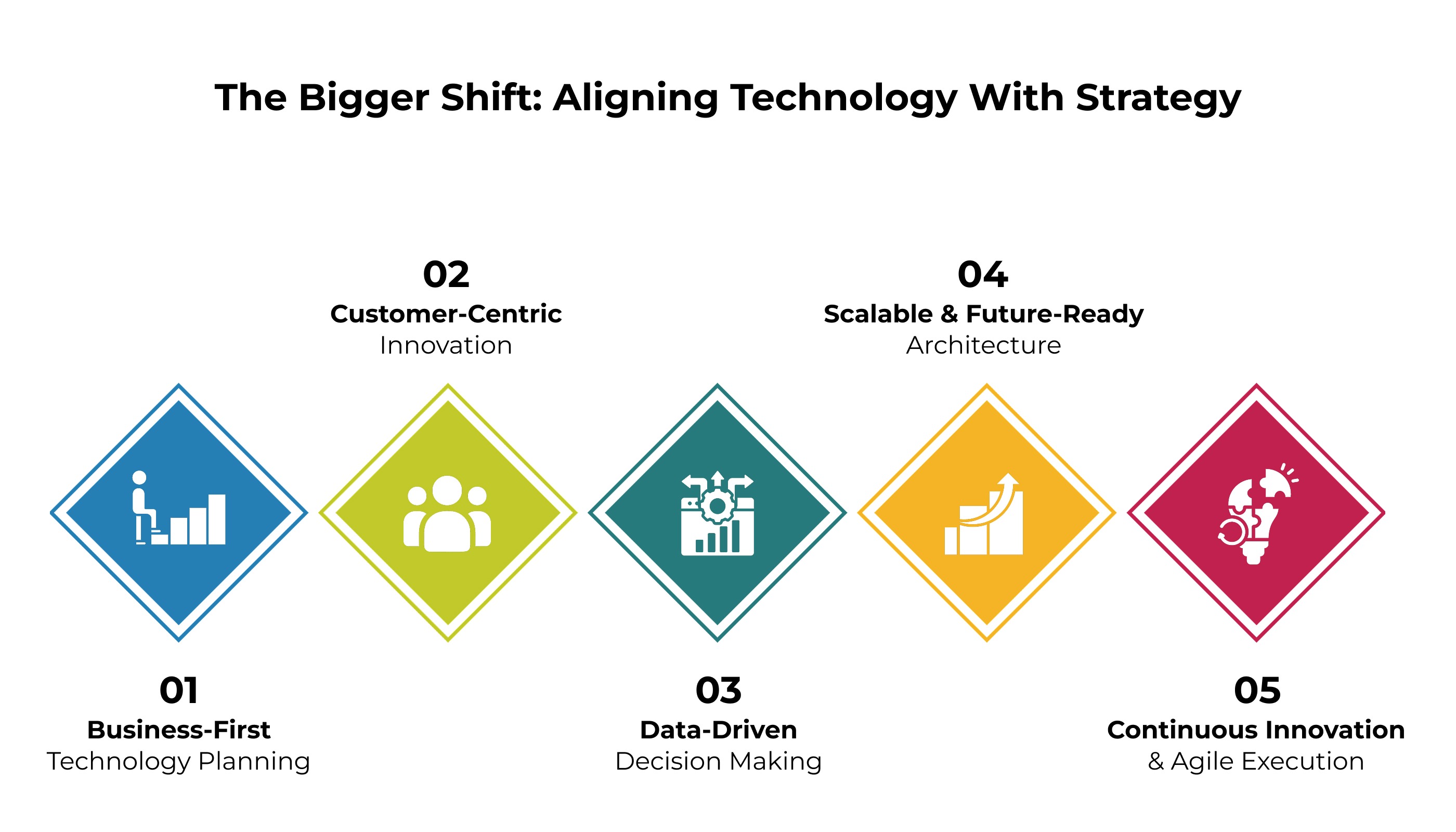
Business-First Technology Planning
Technology should support clear business goals, not just trends. Companies must align mobile app development trends with revenue targets, customer retention, and long-term growth strategy.
Customer-Centric Innovation
Every new feature should solve a real user problem. Aligning app development trends with user behavior, feedback, and personalization ensures sustainable growth and stronger engagement.
Data-Driven Decision Making
Successful companies use analytics, AI insights, and performance metrics to guide product improvements. Strategic use of data helps refine mobile app marketing trends and optimize monetization models.
Scalable & Future-Ready Architecture
Building apps with scalable infrastructure ensures they can adapt to the future of mobile apps. Cloud-native systems, modular design, and API-driven architecture allow easy upgrades and innovation.
Continuous Innovation & Agile Execution
Strategy is not static. Businesses must continuously test, iterate, and adapt to evolving mobile app trends, ensuring they stay competitive in a fast-changing digital landscape.
How Can PerfectionGeeks Help You Stay Ahead With Mobile App Trends?
In a rapidly evolving digital landscape, keeping up with mobile app trends requires the right strategy, technology, and execution partner. PerfectionGeeks helps businesses stay competitive by aligning innovation with real business goals. Their expertise in modern mobile app development trends ensures your app remains scalable, secure, and future-ready while adapting to changing user expectations and market demands.
Frequently Asked Questions
Quick answers related to this article from PerfectionGeeks.
1. How is AI transforming the future of mobile apps?
2. What are the latest mobile app marketing trends?
3. How does PerfectionGeeks stay updated with mobile app trends?
4. Can PerfectionGeeks help with mobile app marketing?
Conclusion
The mobile app landscape in 2026 is defined by intelligence, speed, security, and sustainability. Businesses that embrace these mobile app development trends will unlock new growth opportunities and strengthen customer engagement. Innovation alone is not enough strategic execution is what transforms trends into success. By understanding the evolving future of mobile apps, businesses can build powerful digital ecosystems that drive long-term value.

Written By Shrey Bhardwaj
Director & Founder
Shrey Bhardwaj is the Director & Founder of PerfectionGeeks Technologies, bringing extensive experience in software development and digital innovation. His expertise spans mobile app development, custom software solutions, UI/UX design, and emerging technologies such as Artificial Intelligence and Blockchain. Known for delivering scalable, secure, and high-performance digital products, Shrey helps startups and enterprises achieve sustainable growth. His strategic leadership and client-centric approach empower businesses to streamline operations, enhance user experience, and maximize long-term ROI through technology-driven solutions.