
Published 28 March 2026 | Updated 29 May 2026
Technology
Top Machine Learning Trends 2026: The Complete 2026 Guide
Artificial intelligence and machine learning are no longer emerging technologies. In 2026, they are the operating system of competitive business. The organisations pulling ahead are not those that are exploring machine learning for the first time — they are those that have identified which specific ML trends align with their business model, invested purposefully, and moved from pilot to production.
But the ML landscape moves fast. New architectures, new platforms, new paradigms, and new regulatory requirements emerge every quarter. For technology leaders, CTOs, and product teams, keeping pace is itself a full-time challenge.
This guide cuts through the noise. We cover the ten most impactful machine learning trends in 2026, why they matter, how to act on them, what they cost, and what real organisations are achieving with them right now.
Transform Your Digital Experience
What is Top Machine Learning Trends 2026?
The top machine learning trends in 2026 represent the most impactful advances in AI and ML technology shaping how businesses build intelligent systems — from agentic AI and multimodal models to edge ML, automated machine learning (AutoML), and responsible AI frameworks. These trends define where enterprise investment is flowing, which capabilities are moving from experimental to production-ready, and how organisations across every industry are using machine learning to drive competitive advantage, operational efficiency, and new revenue streams.
- Agentic AI is the defining ML trend of 2026 — autonomous AI systems that plan, reason, and act across multi-step workflows without constant human intervention
- Multimodal models now process text, image, audio, video, and code simultaneously — enabling entirely new categories of intelligent applications
- Edge ML is bringing real-time inference to devices, vehicles, factories, and hospitals — eliminating cloud latency for time-critical use cases
- AutoML and no-code ML platforms are democratising machine learning, enabling non-data-scientists to build and deploy models in days, not months
- Federated learning allows organisations to train models on sensitive data without centralising it — critical for healthcare, finance, and regulated industries
- The global machine learning market is projected to reach $503 billion by 2030, growing at a CAGR of 34.8%
- Organisations deploying ML in production report an average ROI of 3.5x within the first two years
- Responsible AI and explainability have moved from ethical aspiration to regulatory requirement in the EU, UK, and increasingly the USA
- ML Ops maturity is now the primary differentiator between organisations that experiment with ML and those that deliver sustained business value from it
- The average enterprise ML project takes 3–9 months from data preparation to production deployment — AutoML can compress this to 4–8 weeks for standard use cases
- Small Language Models (SLMs) are emerging as a cost-effective alternative to large LLMs for domain-specific enterprise tasks
- Every business function — from marketing and finance to operations and HR — now has viable, production-proven ML use cases available in 2026
- The talent gap remains real — demand for ML engineers exceeds supply by 3:1 in most markets, making AutoML and ML platforms strategically important
- Quantum ML is moving from theoretical to early practical application for specific optimisation and simulation problems
- In 2026, the question is not whether to invest in machine learning — it is which trends to prioritise first given your industry, data maturity, and business goals
What is Top Machine Learning Trends 2026?
Machine learning trends represent the directions in which ML research, tooling, and enterprise adoption are moving in a given period. They are not theoretical concepts — they are the practical advances that are moving from research papers into production systems, from startup experiments into enterprise deployments, and from competitive differentiators into baseline expectations.
In 2026, the top machine learning trends are defined by three broad forces:
Force 1 — Maturation: Technologies that were experimental in 2023–2024 (agentic AI, multimodal models, edge inference) have now crossed the production-readiness threshold. Enterprises can deploy them with confidence, supported by mature tooling, established best practices, and real-world benchmarks.
Force 2 — Democratisation: The barrier to building and deploying ML models has fallen dramatically. AutoML platforms, pre-trained foundation models, and no-code ML tools mean that organisations without large data science teams can now access ML capabilities that previously required PhDs and years of custom development.
Force 3 — Regulation and Responsibility: The EU AI Act is now in enforcement. The UK AI framework is established. US federal agencies are issuing ML governance guidance. Responsible AI — explainability, fairness, bias detection, audit trails — has moved from a values conversation to a compliance requirement.
Understanding these three forces is the foundation for understanding why the specific trends below matter and which ones deserve your investment attention in 2026.
📊 Stat: The global machine learning market is projected to reach $503.4 billion by 2030, growing at a CAGR of 34.8% from 2023. Source: Grand View Research ML Market Report 2025
Why Top Machine Learning Trends 2026 Matters
The Competitive Stakes Are Higher Than Ever
In 2026, machine learning is not a technology experiment — it is a competitive weapon. Organisations that have deployed ML in production are outperforming peers on virtually every business metric: faster product development, lower operational costs, higher customer retention, more accurate forecasting, and faster decision-making.
The gap between ML-mature organisations and those still in the experimentation phase is widening. Early movers have accumulated data advantages, model performance improvements from production feedback loops, and institutional knowledge that is extremely difficult for late entrants to replicate quickly.
Every Industry Has Reached an ML Inflection Point
In 2026, there is no industry sector where ML is not delivering production value:
- Financial services: Fraud detection, credit risk modelling, algorithmic trading, regulatory compliance automation
- Healthcare: Medical imaging diagnosis, drug discovery acceleration, patient outcome prediction, clinical workflow automation
- Retail and e-commerce: Demand forecasting, personalisation engines, dynamic pricing, supply chain optimisation
- Manufacturing: Predictive maintenance, quality control vision systems, production scheduling optimisation
- Professional services: Document intelligence, contract analysis, research automation, client insights
The Regulatory Environment Has Changed the Stakes
The EU AI Act, now in enforcement for high-risk AI systems, has made responsible ML practices a legal requirement for any organisation selling into European markets. The financial penalties for non-compliance — up to €30 million or 6% of global annual revenue — make AI governance investment not just ethically correct but financially essential.
📊 Stat: 72% of enterprises report that machine learning is now embedded in at least one core business process, up from 48% in 2023. Source: McKinsey Global AI Survey 2025
Key Benefits of Machine Learning for Enterprises
There are many benefits of machine learning in business, especially for enterprises handling large-scale operations.
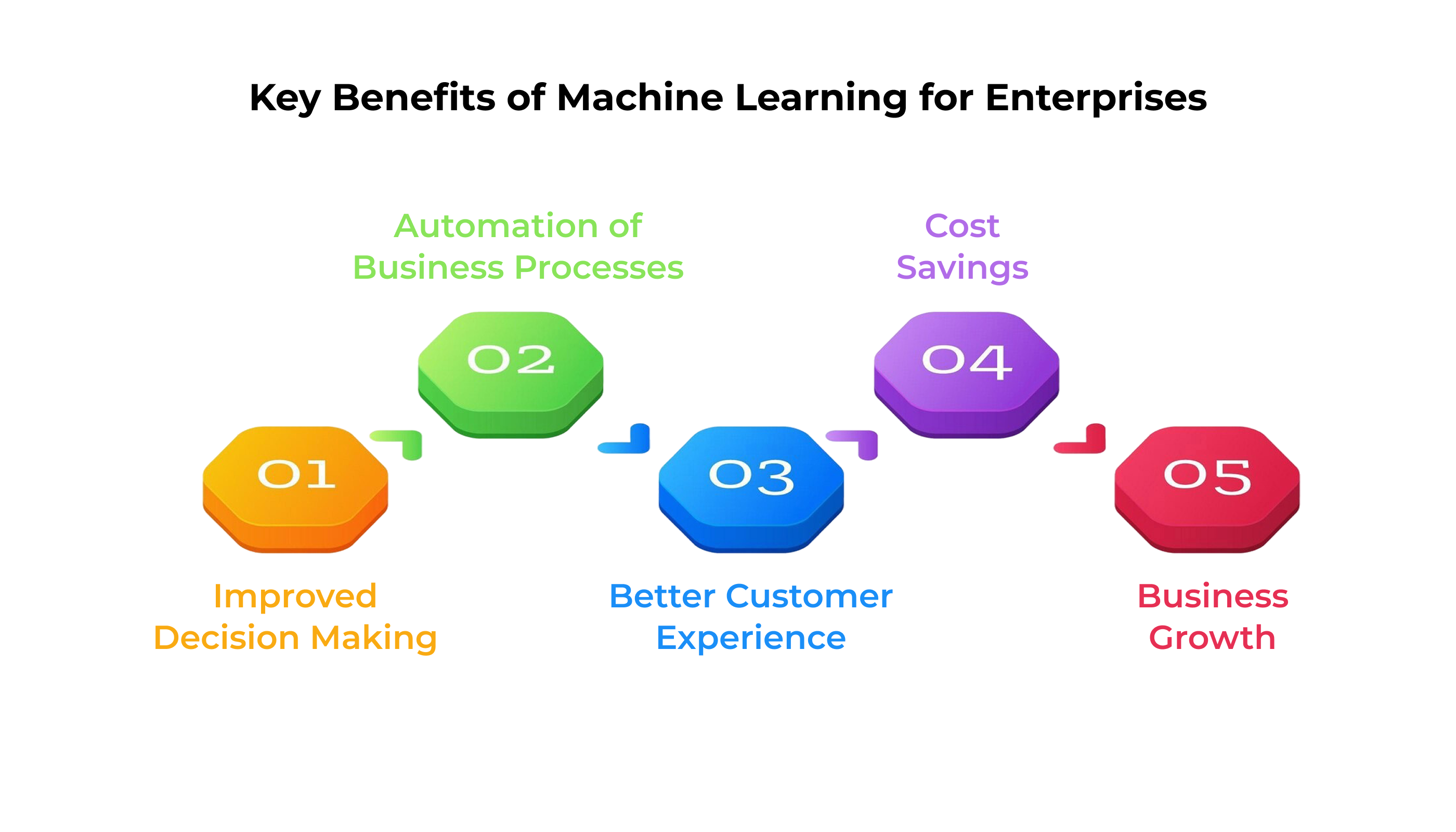
Improved Decision-Making: ML processes large datasets quickly, uncovering patterns and insights that help leaders make smarter, data-driven decisions with confidence.
Automation of Business Processes: By automating repetitive tasks, ML reduces manual effort, increases efficiency, and frees employees to focus on higher-value work.
Better Customer Experience: ML analyzes customer behavior to deliver personalized recommendations, improving satisfaction and loyalty through tailored interactions.
Cost Savings: Automation and optimized processes cut down operational expenses, helping enterprises achieve more with fewer resources.
Business Growth: ML-powered business intelligence identifies new opportunities, predicts market trends, and drives profitability through innovation.
The Top 10 Machine Learning Trends 2026: Step-by-Step Breakdown
Trend 1 — Agentic AI: From Assistants to Autonomous Actors
What it is: Agentic AI systems are ML-powered agents that can plan, reason, use tools, and execute multi-step tasks autonomously — without requiring a human to prompt every action. They combine LLMs with memory, tool use, and goal-directed behaviour to complete complex workflows end-to-end.
Why it matters in 2026: This is the single most transformative ML trend of the year. Agentic AI moves machine learning from a technology that helps humans do tasks to a technology that does tasks on behalf of humans. Enterprise applications include autonomous research agents, AI-powered sales development representatives, automated code review and deployment pipelines, and self-healing infrastructure management.
How to act on it: Start with a single, bounded agentic use case — not an open-ended autonomous system. Define the task scope clearly, establish human-in-the-loop checkpoints for consequential decisions, and measure performance against a manual baseline before expanding agent autonomy.
📊 Stat: 45% of enterprise knowledge work tasks are automatable using agentic AI systems available in 2026, according to analysis of current agentic AI capabilities. Source: McKinsey Technology Outlook 2025
Trend 2 — Multimodal Foundation Models
What it is: Multimodal models process and generate multiple types of data simultaneously — text, images, audio, video, structured data, and code — within a single model architecture. GPT-4o, Gemini 2.0, and Claude 3.5 are mature examples; purpose-built enterprise multimodal models are now widely available.
Why it matters in 2026: Real-world business problems are inherently multimodal. A quality control system needs to analyse both visual data and production logs. A customer service system needs to understand spoken audio, account history, and product images simultaneously. Multimodal models unlock these cross-modal intelligence applications at scale.
How to act on it: Identify processes in your business that currently require humans to manually combine information from different formats. These are your highest-value multimodal ML opportunities.
Trend 3 — Edge Machine Learning
What it is: Edge ML runs inference (and increasingly, training) directly on devices — smartphones, IoT sensors, industrial machinery, medical devices, autonomous vehicles — rather than sending data to a cloud server for processing.
Why it matters in 2026: For time-critical applications, cloud latency is unacceptable. A manufacturing defect detection system cannot wait 200ms for a cloud API call. A medical device monitoring vital signs cannot depend on network connectivity. Edge ML enables real-time, offline-capable, privacy-preserving intelligent applications. The proliferation of purpose-built ML chips (Apple Neural Engine, NVIDIA Jetson, Google Edge TPU) has made edge inference practical at commercial scale.
How to act on it: Map your use cases against latency requirements. Any application requiring sub-50ms response times, operating in connectivity-constrained environments, or handling sensitive data that cannot leave the device is a candidate for edge ML deployment.
Trend 4 — AutoML and No-Code Machine Learning
What it is: AutoML platforms automate the most time-consuming parts of the ML development process — data preprocessing, feature engineering, model selection, hyperparameter tuning, and deployment — enabling faster model development with less specialised expertise required.
Why it matters in 2026: The global shortage of ML engineers means that waiting for specialist talent to build every model is not a viable strategy. AutoML platforms like Google Vertex AI AutoML, Microsoft Azure AutoML, H2O.ai, and DataRobot allow data analysts and business domain experts to build and deploy production-quality models in weeks rather than months.
How to act on it: Identify your highest-volume, most repetitive ML use cases — demand forecasting, churn prediction, lead scoring — and evaluate AutoML platforms against them. These structured prediction problems are where AutoML delivers the fastest and most reliable results.
Trend 5 — Federated Learning and Privacy-Preserving ML
What it is: Federated learning trains ML models across multiple decentralised data sources without centralising the raw data. Each node trains a local model on local data, and only model updates (not the underlying data) are shared and aggregated into a global model.
Why it matters in 2026: For healthcare, financial services, and any industry handling sensitive personal data, the ability to train on distributed datasets without centralising them is transformative. It enables collaboration across organisations that would never share raw data, and it satisfies GDPR, HIPAA, and other data localisation requirements that make centralised ML training legally problematic.
How to act on it: If your highest-value ML use cases involve sensitive data that cannot be centralised, federated learning is the enabling technology. Evaluate platforms including Google Federated Learning, PySyft, and Flower for your specific data architecture.
Trend 6 — Small Language Models (SLMs) for Enterprise
What it is: Small Language Models are purpose-built, fine-tuned language models optimised for specific domains or tasks. Unlike general-purpose LLMs with hundreds of billions of parameters, SLMs have 1–13 billion parameters but can outperform much larger models on their specific target tasks.
Why it matters in 2026: Running GPT-4-scale models for every enterprise task is expensive, slow, and often unnecessary. A fine-tuned SLM trained on your company's legal contracts will outperform a general LLM on contract analysis tasks at 10–20% of the inference cost. Microsoft Phi-3, Meta Llama 3, and Google Gemma are driving SLM adoption in enterprise settings.
How to act on it: Identify high-frequency, domain-specific language tasks in your business. These are your SLM candidates. The economics of fine-tuning an SLM vs. paying per-token for a large LLM API typically favour SLMs at volumes above 1 million tokens per month.
Trend 7 — ML Ops Maturity and Production ML Reliability
What it is: MLOps (Machine Learning Operations) encompasses the practices, tools, and cultural approaches that make ML models reliable, reproducible, and continuously improving in production environments — covering versioning, monitoring, retraining, drift detection, and deployment automation.
Why it matters in 2026: The majority of enterprise ML projects fail not because the models are bad, but because the operational infrastructure to keep them accurate and reliable in production does not exist. ML model performance degrades over time as data distributions shift. Without MLOps, models become liabilities rather than assets.
How to act on it: Before adding more ML models, audit your ability to monitor and maintain the ones you already have. Implement data drift detection, model performance monitoring, automated retraining pipelines, and model versioning as your foundational MLOps capabilities.
Trend 8 — Responsible AI and Explainable ML
What it is: Responsible AI encompasses the practices, tools, and governance frameworks that ensure ML systems are fair, transparent, explainable, accountable, and compliant with applicable regulations. Explainable ML specifically refers to techniques (SHAP, LIME, attention visualisation) that make model decisions interpretable to humans.
Why it matters in 2026: The EU AI Act mandates explainability for high-risk AI applications. Financial regulators require explainable credit decisions. Healthcare regulators require auditable diagnostic AI. Beyond compliance, explainability drives analyst trust, enables bias detection, and supports the human oversight that makes autonomous ML systems safe to deploy.
How to act on it: Classify your ML applications by risk tier (following EU AI Act categories). For high-risk applications, implement explainability tooling and bias auditing before deployment. For all applications, establish documentation, audit trails, and human oversight mechanisms.
Trend 9 — Real-Time ML and Streaming Intelligence
What it is: Real-time ML systems apply model inference to data streams as they are generated — rather than in batches — enabling decisions and actions within milliseconds of an event occurring. This combines ML models with streaming data infrastructure (Apache Kafka, Apache Flink, AWS Kinesis).
Why it matters in 2026: Fraud detection, dynamic pricing, personalisation, supply chain response, and cybersecurity all benefit fundamentally from real-time inference. The difference between detecting fraud in real-time vs. in a nightly batch run is the difference between preventing a transaction and recovering from it.
How to act on it: Map your ML use cases against time sensitivity. Any decision that needs to be made in under 1 second to have business value is a real-time ML candidate. Start with your highest-value, lowest-latency-tolerance use case and build your streaming ML infrastructure around it.
Trend 10 — Domain-Specific Foundation Models
What it is: Domain-specific foundation models are large pre-trained models built and fine-tuned for specific industries — medical imaging (MedPaLM, BioMedCLIP), legal document analysis (Harvey AI), financial modelling (BloombergGPT), and scientific research (AlphaFold 3, materials discovery models).
Why it matters in 2026: General-purpose models trained on broad internet data perform adequately across many tasks but fall short on deep domain expertise. A model trained on 10 million medical imaging scans with clinical outcome labels will outperform GPT-4 on radiology tasks — and do so with greater reliability and safety for clinical use.
How to act on it: Identify whether your industry has established foundation models available. For healthcare, legal, financial, and scientific applications, evaluate domain-specific models against general-purpose alternatives before defaulting to general LLMs.
Key Benefits of Adopting ML Trends in 2026
Operational Efficiency at Scale
Machine learning automates repetitive cognitive tasks that previously required large human teams — document processing, data classification, report generation, anomaly detection. Organisations deploying ML across operations consistently report 30–60% reductions in manual processing time for targeted workflows.
Superior Decision-Making Through Prediction
ML models trained on historical data outperform human intuition for structured prediction tasks — demand forecasting, credit scoring, churn prediction, equipment failure prediction — at virtually every scale. The advantage is not just accuracy; it is consistency, speed, and the ability to process vastly more variables simultaneously than any human analyst.
Personalisation at Individual Level
Recommendation engines, personalised pricing, adaptive content, and tailored customer journeys — powered by ML — drive measurable revenue impact. Netflix attributes $1 billion per year in subscriber retention to its ML-powered recommendation system. In 2026, this capability is accessible to organisations far beyond Netflix scale through pre-built ML personalisation platforms.
Competitive Differentiation Through Speed
ML-powered organisations make better decisions faster. Faster product iterations, faster market response, faster risk detection, faster customer service. In markets where competitive windows are measured in weeks rather than years, the speed advantage that ML delivers is a genuine strategic moat.
📊 Stat: Organisations that have deployed ML across three or more business functions report 2.4x higher revenue growth than those using ML in a single function. Source: Deloitte AI Leaders Survey 2025
Tools & Technologies
| Tool / Platform | Category | Key ML Capability | Best For |
|---|---|---|---|
| Google Vertex AI | End-to-end ML platform | AutoML, custom training, model deployment, MLOps | Enterprises on Google Cloud |
| Microsoft Azure ML | End-to-end ML platform | AutoML, responsible AI tools, Azure OpenAI integration | Microsoft-ecosystem enterprises |
| AWS SageMaker | End-to-end ML platform | Managed training, deployment, MLOps, SageMaker Canvas (no-code) | AWS-native organisations |
| Hugging Face | Model hub + ML platform | Open-source foundation models, fine-tuning, deployment | Teams building custom models |
| DataRobot | AutoML platform | Automated model building, deployment, monitoring | Business analysts, non-ML teams |
| MLflow | MLOps | Experiment tracking, model versioning, deployment | Any ML team needing MLOps |
| Weights & Biases | ML experiment tracking | Training visualisation, model comparison, collaboration | ML research and development teams |
| NVIDIA TensorRT / Triton | Edge and inference optimisation | High-performance model serving, edge deployment | Performance-critical inference |
| Apache Kafka + Flink | Streaming data infrastructure | Real-time data pipelines for ML inference | Real-time ML applications |
| Seldon / BentoML | Model serving | Production model deployment, A/B testing, monitoring | MLOps and deployment teams |
| Shapash / SHAP | Explainable AI | Model explainability, feature importance, bias detection | Regulated industries, responsible AI |
| Flower / PySyft | Federated learning | Privacy-preserving distributed ML training | Healthcare, finance, regulated data |
Cost & Timeline Breakdown
| ML Implementation Type | Description | Estimated Cost (USD) | Timeline |
|---|---|---|---|
| AutoML / No-Code Project | Use AutoML platform for structured prediction (churn, demand, lead scoring). Minimal data science required. | $5,000–$25,000 setup + $1,000–$5,000/month platform | 4–8 weeks |
| Custom ML Model (Single Use Case) | Full data science engagement: data prep, feature engineering, model training, validation, deployment | $30,000–$120,000 | 3–6 months |
| Enterprise ML Platform Build | End-to-end ML infrastructure: data pipelines, training platform, MLOps, monitoring, multiple use cases | $150,000–$500,000+ | 6–18 months |
| Foundation Model Fine-Tuning | Fine-tune an open-source LLM or foundation model on proprietary data for domain-specific tasks | $20,000–$80,000 + compute costs | 6–14 weeks |
| Edge ML Deployment | Optimise and deploy ML models to edge devices (IoT, mobile, embedded systems) | $40,000–$150,000 | 3–9 months |
| Managed ML Service (MSSP/Vendor) | Outsourced ML development and operations via a specialist partner | $8,000–$30,000/month | 4–8 weeks onboarding |
Cost vs. Value Context
The ROI on ML investment in 2026 is well-documented. Organisations report an average 3.5x ROI within two years of production ML deployment. The most important cost consideration is not the technology — it is the data preparation and MLOps infrastructure, which typically represents 60–70% of total ML project cost and is consistently underestimated in initial budgets.
📊 Stat: Data preparation and feature engineering account for 60–80% of the total time and cost in a typical ML project. Source: Anaconda State of Data Science Report 2025
Three Real-World Examples
Example 1: UK Retail Bank — AutoML for Credit Risk Scoring
Organisation: A mid-sized UK retail bank with 1.2 million personal loan customers
Challenge: The existing credit scoring model was built in 2019 and had not been retrained since 2022. Default prediction accuracy had declined, leading to higher-than-expected bad debt provisions. The data science team lacked capacity to rebuild the model from scratch.
Solution: Deployed Microsoft Azure AutoML to retrain the credit scoring model on 3 years of updated customer data, incorporating 47 new features including open banking transaction patterns. The AutoML pipeline selected, trained, and validated 12 candidate models automatically, with the winning model reviewed and approved by the data science team before deployment.
Results:
- Model development time reduced from an estimated 6 months (manual) to 5 weeks (AutoML)
- Default prediction accuracy improved by 18% versus the legacy model
- Expected bad debt provision reduction: £4.2 million annually
- Model retraining now runs quarterly on an automated schedule
Example 2: US Healthcare Network — Federated Learning for Patient Outcome Prediction
Organisation: A network of 8 regional hospitals in the USA sharing clinical research goals but operating under separate data governance policies
Challenge: Each hospital had valuable patient outcome data, but HIPAA regulations and competitive concerns prevented centralising data for model training. Individually, each hospital had insufficient data volume to train a reliable predictive model for early sepsis detection.
Solution: Implemented a federated learning architecture using the Flower framework. Each hospital trained a local sepsis prediction model on its own patient data. Only model weight updates — not patient records — were shared and aggregated into a global model that outperformed any individual hospital's local model.
Results:
- Sepsis prediction model accuracy: 91.3% (vs. 78% average for individual hospital models)
- Early intervention rate for high-risk patients increased by 34%
- Zero patient data ever left any individual hospital's secure environment
- The federated model is now being expanded to cover 12 additional clinical prediction use cases
Example 3: Australian Logistics Company — Real-Time ML for Dynamic Route Optimisation
Organisation: A national logistics operator in Australia managing 2,400 daily delivery routes across 6 states
Challenge: Static route planning generated the day before delivery was failing to account for real-time conditions: traffic incidents, weather delays, last-minute delivery additions, and vehicle breakdowns. On-time delivery rates had fallen to 84% — below contractual SLA thresholds with major retail clients.
Solution: Built a real-time ML route optimisation system using Apache Kafka for streaming telemetry (GPS, traffic APIs, weather data), a custom reinforcement learning model for dynamic re-routing, and edge ML deployed to the driver app for offline-capable local inference when connectivity was poor.
Results:
- On-time delivery rate improved from 84% to 96.2% within 90 days of deployment
- Average fuel consumption per route reduced by 11.4% through optimised routing
- Driver app received highest-ever satisfaction scores due to fewer dead-end routing instructions
- SLA penalty exposure eliminated — saving an estimated AUD $3.1 million annually
Frequently Asked Questions
Quick answers related to this article from PerfectionGeeks.
1. What is top machine learning trends 2026?
2. How does top machine learning trends 2026 work in practice?
3. How does generative AI impact enterprise innovation?
4. What are the benefits of following top machine learning trends 2026?
5. How long does it take to adopt top machine learning trends 2026?
6. What are the best tools for top machine learning trends 2026?
Conclusion
Machine learning in 2026 is defined by a paradox: it has never been more powerful, and it has never been more accessible — yet the organisations that are genuinely capturing its value are still in the minority. The gap between ML potential and ML reality in most enterprises is not a technology problem. It is a strategy, data, and execution problem.
The ten trends covered in this guide — from agentic AI and multimodal models to federated learning and responsible AI — are not distant future capabilities. They are production-ready today, with established tooling, documented ROI, and clear implementation paths. The organisations that will look back on 2026 as a turning point are those that choose one or two of these trends strategically, invest in the data and MLOps infrastructure to support them properly, and build the institutional capability to keep improving.
The machine learning talent gap is real. The data preparation challenge is real. The governance requirement is real. But none of these are reasons to wait — they are reasons to partner with experienced ML practitioners who have navigated these challenges before and can compress your path from experimentation to production value. PerfectionGeeks has delivered ML solutions across financial services, healthcare, retail, logistics, and technology for clients in the USA, UK, UAE, Canada, and Australia. Whether you are building your first ML model or scaling an enterprise ML platform, our team brings the technical depth and commercial pragmatism to make it count.

Written By Shrey Bhardwaj
Director & Founder
Shrey Bhardwaj is the Director & Founder of PerfectionGeeks Technologies, bringing extensive experience in software development and digital innovation. His expertise spans mobile app development, custom software solutions, UI/UX design, and emerging technologies such as Artificial Intelligence and Blockchain. Known for delivering scalable, secure, and high-performance digital products, Shrey helps startups and enterprises achieve sustainable growth. His strategic leadership and client-centric approach empower businesses to streamline operations, enhance user experience, and maximize long-term ROI through technology-driven solutions.