.webp)
Published 18 February 2026 | Updated 24 May 2026
Technology
Behavioral Health Software Development in 2026: Benefits, Features, EHR Customization & Best Practices
Mental health and behavioral healthcare providers are rapidly adopting digital solutions to improve patient care, automate clinical workflows, and streamline compliance management. From therapy scheduling and telehealth to patient engagement and EHR integration, modern behavioral health software development helps clinics and healthcare organizations deliver more personalized and efficient care.
Quick AnswerBehavioral health software development involves building secure digital healthcare platforms for mental health clinics, therapists, rehabilitation centers, psychologists, and behavioral healthcare organizations. These solutions help providers manage patient records, appointments, telehealth consultations, billing, compliance, and treatment workflows efficiently. In 2026, custom behavioral health software and behavioral health EHR customization solutions are becoming essential for improving patient engagement, operational efficiency, HIPAA compliance, and data-driven healthcare delivery. |
- Behavioral health software development improves patient engagement, workflow automation, and telehealth delivery.
- Behavioral health EHR customization helps organizations tailor workflows for mental healthcare operations.
- HIPAA compliance and cybersecurity are critical for behavioral healthcare platforms.
- AI-powered analytics and telemedicine are major healthcare technology trends in 2026.
- Custom behavioral health software offers better scalability and flexibility than generic healthcare systems.
What Is Behavioral Health Software Development? (Quick Definition)
Behavioral health software development refers to the process of designing and building healthcare applications specifically for mental health and behavioral healthcare providers. These platforms support therapy management, patient records, telemedicine, treatment planning, appointment scheduling, secure communication, billing, and behavioral health EHR customization.
Unlike general healthcare software, behavioral health software solutions are tailored for mental health workflows, psychiatric evaluations, addiction treatment programs, counseling services, and long-term patient engagement.
Need a Custom Behavioral Health Software Solution?
PerfectionGeeks helps healthcare organizations build secure, scalable, and HIPAA-compliant behavioral health software platforms tailored to modern patient care requirements.
Whether you need telehealth integration, behavioral health EHR customization, appointment management, or AI-powered healthcare analytics, our experts can help you build a future-ready solution.
Why Behavioral Health Software Is Important in 2026
The global demand for mental health services continues to rise as healthcare organizations focus more on digital transformation, telemedicine, and patient-centered care. Traditional paper-based systems and generic healthcare software often fail to support the unique workflows involved in behavioral healthcare. This is why businesses increasingly invest in custom behavioral health software development solutions.
Modern behavioral health software platforms help clinics and hospitals streamline operations while improving the overall patient experience. Healthcare providers can automate appointment scheduling, securely manage patient records, conduct virtual consultations, and monitor treatment progress in real time.
Behavioral healthcare organizations also use advanced analytics and AI-powered reporting tools to improve decision-making and patient outcomes. In addition, behavioral health EHR customization enables organizations to personalize documentation templates, therapy notes, assessments, and compliance workflows according to their clinical requirements.
According to industry research:
- Telehealth adoption in behavioral healthcare continues to grow rapidly due to increased remote care demand.
- AI-powered healthcare analytics is improving treatment planning and patient engagement.
- Healthcare organizations are prioritizing HIPAA-compliant behavioral health software to improve data security and regulatory compliance.
As digital healthcare adoption accelerates globally, behavioral health software development is becoming a critical investment for mental healthcare providers seeking long-term scalability and operational efficiency.
How Behavioral Health EHR Customization Works
1. Requirement Analysis & Clinical Workflow Evaluation
The customization process begins with understanding the healthcare organization’s operational structure, therapy workflows, documentation requirements, and compliance challenges. Developers and healthcare consultants identify inefficiencies and determine which features should be customized within the EHR platform.
This stage ensures the behavioral health software solution aligns with the organization’s patient care model and business goals.
2. Personalized EHR Module Configuration
Behavioral health EHR customization includes configuring modules specifically for mental healthcare workflows such as:
- Therapy session documentation
- Psychiatric evaluations
- Behavioral assessments
- Treatment planning
- Medication tracking
- Patient progress monitoring
Customized EHR templates help clinicians reduce manual work and improve documentation accuracy.
3. UI/UX Design for Healthcare Teams
Healthcare-focused user interfaces are designed for therapists, psychiatrists, counselors, administrative staff, and patients. Easy navigation, accessibility, and mobile responsiveness are prioritized to improve operational efficiency and user adoption.
Well-designed behavioral health software platforms simplify complex healthcare workflows and reduce administrative burden.
4. Secure Software Development & HIPAA Compliance
The behavioral health software platform is developed using secure technologies and healthcare-grade encryption standards. Developers implement:
- Role-based access control
- Secure cloud infrastructure
- Encrypted patient data storage
- Multi-factor authentication
- HIPAA-compliant security measures
Security is one of the most critical aspects of behavioral health software development because healthcare organizations manage highly sensitive patient information.
5. Third-Party Integrations
Modern behavioral health software solutions integrate with multiple systems and healthcare tools, including:
- Telehealth platforms
- Insurance verification systems
- Payment gateways
- Pharmacy systems
- CRM platforms
- AI analytics tools
- Scheduling software
These integrations help organizations create a connected healthcare ecosystem with seamless data sharing and workflow automation.
6. Testing & Compliance Validation
Before deployment, the behavioral health software undergoes extensive testing to ensure:
- System reliability
- Data security
- Regulatory compliance
- Workflow efficiency
- Platform scalability
- Cross-device compatibility
Testing helps healthcare providers avoid operational disruptions and maintain patient trust.
7. Deployment & Staff Training
After successful testing, the platform is deployed across the organization. Healthcare teams receive onboarding and training sessions to ensure smooth adoption and efficient software utilization.
Training improves productivity and helps organizations maximize the value of behavioral health software development investments.
8. Ongoing Maintenance & Optimization
Behavioral healthcare organizations require continuous software updates, performance monitoring, and security improvements. Post-launch support services typically include:
- Bug fixing
- Feature upgrades
- Compliance updates
- Performance optimization
- Security patch management
- AI feature enhancements
Continuous optimization ensures the software remains scalable and aligned with evolving healthcare regulations and operational requirements.
Key Features of Custom Behavioral Health Software
Electronic Health Records (EHR)
Behavioral health EHR systems centralize patient data, therapy notes, diagnoses, prescriptions, treatment plans, and medical history within a secure platform.
Telehealth Integration
Secure video consultation tools allow therapists and psychiatrists to provide remote mental healthcare services efficiently.
Appointment Scheduling & Reminders
Automated scheduling systems help patients book appointments while reducing no-shows through reminders and notifications.
Billing & Insurance Management
Integrated billing modules simplify payment processing, claims management, and insurance verification workflows.
Patient Portal
Patients can securely access medical records, prescriptions, appointments, and communication tools through personalized portals.
Analytics & Reporting Dashboards
Healthcare organizations use analytics dashboards to monitor patient outcomes, operational KPIs, and financial performance.
Secure Messaging System
Encrypted messaging improves communication between clinicians, patients, and healthcare teams while maintaining data privacy standards.
Key Benefits of Behavioral Health Software Development
Investing in custom behavioral health software brings multiple advantages:
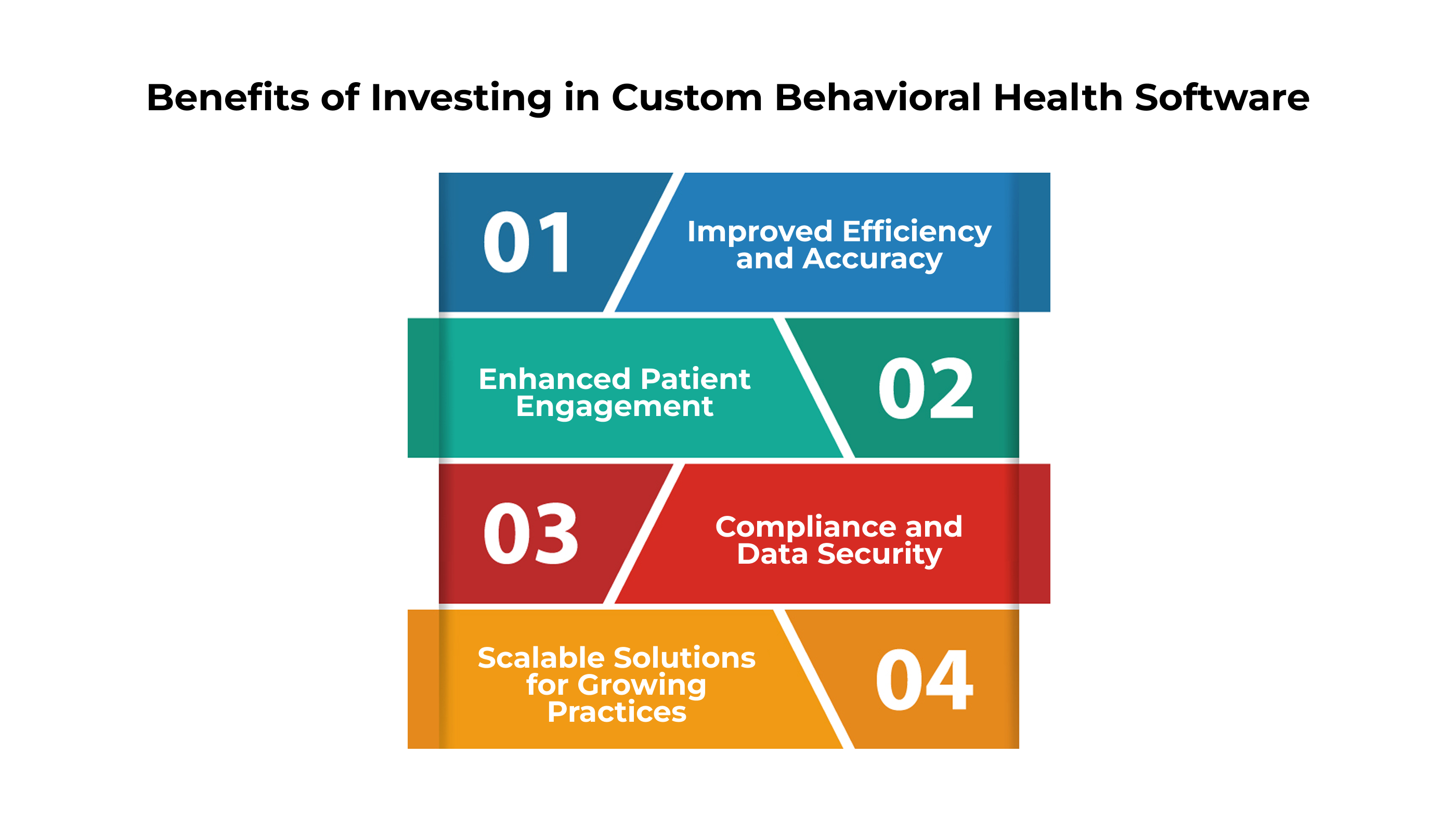
Improved Patient Care & Engagement
Behavioral health software enables healthcare providers to deliver more personalized care through centralized patient records, secure communication, automated reminders, and treatment monitoring tools. Patients can easily access appointments, therapy notes, and telehealth consultations through secure portals.
Better Telehealth & Remote Care Services
Telehealth integration has become one of the most valuable features in behavioral health software development. Providers can conduct secure virtual consultations, improving accessibility for patients in remote locations or those requiring ongoing therapy support.
Remote care capabilities also help healthcare organizations increase appointment attendance rates and improve treatment continuity.
Streamlined Administrative Workflows
Behavioral health software automates repetitive tasks such as appointment scheduling, billing, insurance verification, documentation, and patient onboarding. This significantly reduces administrative workload and improves operational efficiency.
Automation allows clinicians to focus more on patient care instead of manual processes.
Enhanced Data Security & Compliance
Healthcare organizations handling sensitive mental health records must comply with strict regulatory standards. Modern behavioral health software solutions include:
- HIPAA-compliant infrastructure
- Encrypted databases
- Secure access management
- Audit logs
- Data backup systems
Behavioral health EHR customization also helps organizations implement compliance workflows tailored to their operational requirements.
Better Decision-Making with Analytics
Advanced reporting dashboards and AI-powered analytics help healthcare providers monitor patient outcomes, operational performance, treatment success rates, and financial metrics.
Predictive analytics can also support early intervention strategies and improved treatment planning.
Scalable & Customizable Healthcare Solutions
Custom behavioral health software development provides healthcare organizations with complete flexibility to scale features, integrations, and infrastructure as operational needs grow.
Unlike generic healthcare software, customized behavioral health platforms can adapt to specific therapy models, patient management workflows, and long-term digital transformation strategies.
Behavioral Health EHR Customization vs Generic EHR
Choosing between behavioral health EHR customization and generic EHR software is one of the most important decisions for mental healthcare providers in 2026. While generic EHR systems may offer basic patient management capabilities, they often lack the specialized workflows required for behavioral and mental healthcare organizations.
Behavioral health software development focuses on creating healthcare platforms specifically designed for therapists, psychiatrists, counselors, rehabilitation centers, and mental health clinics. Customized systems improve operational efficiency, treatment planning, patient engagement, and compliance management.
Here’s how behavioral health EHR customization compares to generic EHR platforms:
| Feature | Behavioral Health EHR Customization | Generic EHR Software |
|---|---|---|
| Workflow Support | Designed specifically for therapy, counseling, and psychiatric care workflows | Built for general healthcare practices |
| Documentation Templates | Customized therapy notes, treatment plans, and behavioral assessments | Limited mental healthcare customization |
| Telehealth Features | Advanced teletherapy and remote patient monitoring support | Basic video consultation support |
| Compliance Support | Tailored HIPAA and behavioral healthcare compliance workflows | General compliance management |
| Patient Engagement | Mental health-focused communication and engagement tools | Standard patient portals |
| Scalability | Flexible customization for clinics and enterprise healthcare organizations | Limited flexibility |
| Reporting & Analytics | Behavioral analytics and treatment outcome tracking | Generic healthcare reporting |
| Integration Capabilities | Supports specialized healthcare integrations and AI tools | Standard integrations only |
Healthcare providers increasingly prefer behavioral health EHR customization because it helps create personalized workflows that improve patient outcomes and simplify clinical operations.
For example, a rehabilitation center may require addiction recovery tracking, group therapy management, relapse monitoring, and behavioral assessment templates that generic EHR systems cannot efficiently support.
Similarly, mental health clinics often need customized telehealth workflows, secure therapy documentation, and AI-driven patient monitoring capabilities that require specialized behavioral health software solutions.
By investing in custom behavioral health software development, organizations gain:
- Better operational efficiency
- Improved patient care coordination
- Faster clinical documentation
- Enhanced regulatory compliance
- Greater flexibility for future scalability
As digital healthcare transformation accelerates in 2026, behavioral health EHR customization is becoming a critical investment for organizations seeking long-term growth and better patient experiences.
Common Mistakes to Avoid
Choosing Generic Software Without Industry-Specific Features
Many healthcare organizations choose low-cost generic EHR systems without evaluating whether the platform supports behavioral healthcare workflows. This often leads to inefficient operations, poor documentation processes, and reduced staff productivity.
Behavioral health providers should prioritize software specifically designed for mental healthcare environments.
Ignoring HIPAA & Data Security Requirements
Behavioral healthcare organizations handle highly sensitive patient data. Failing to implement HIPAA-compliant infrastructure, encrypted storage, and secure access controls can create serious legal and cybersecurity risks.
Security and compliance should always be considered from the beginning of the development process.
Poor Telehealth Integration
Telehealth is now an essential part of behavioral healthcare delivery. Weak video consultation systems, unstable communication tools, or poor remote care experiences can negatively impact patient satisfaction and treatment continuity.
Organizations should invest in secure and scalable telehealth integration.
Lack of Workflow Customization
Every mental healthcare organization operates differently. Using rigid software systems without customized workflows often creates inefficiencies for therapists, clinicians, and administrative teams.
Behavioral health EHR customization helps organizations align software functionality with their exact operational requirements.
Underestimating Staff Training
Even the best behavioral health software platform may fail if healthcare teams are not properly trained. Lack of onboarding often leads to low adoption rates and workflow confusion.
Comprehensive staff training improves productivity and software utilization.
Ignoring Scalability Requirements
Many organizations build software solutions only for current operational needs without planning for future expansion. As patient volume grows, outdated systems can struggle with performance and integration limitations.
Scalable behavioral health software development ensures long-term operational flexibility.
Delaying System Maintenance & Updates
Behavioral healthcare software requires continuous updates for security, compliance, performance optimization, and feature enhancements. Delaying maintenance increases cybersecurity risks and operational inefficiencies.
Regular software optimization is essential for maintaining long-term reliability.
Expert Tips for 2026
Prioritize AI-Powered Healthcare Automation
AI is transforming behavioral health software development in 2026. Healthcare providers are increasingly using AI-powered tools for patient engagement, predictive analytics, appointment automation, documentation assistance, and treatment recommendations.
Integrating AI capabilities can improve operational efficiency and patient outcomes significantly.
Focus on Mobile-First Patient Experiences
Patients now expect mobile-friendly healthcare experiences, including teletherapy access, appointment scheduling, reminders, and secure messaging.
Behavioral health software platforms should be optimized for smartphones and tablets to improve accessibility and engagement.
Invest in Behavioral Health EHR Customization Early
Customized EHR systems help organizations streamline therapy workflows, improve documentation accuracy, and simplify regulatory compliance.
Healthcare providers that invest in behavioral health EHR customization early often achieve better operational scalability and staff productivity.
Build Scalable Cloud Infrastructure
Cloud-native healthcare platforms provide better scalability, remote access, data backup, and operational flexibility compared to traditional on-premise systems.
Modern behavioral health software solutions should support secure cloud deployment for future growth.
Strengthen Cybersecurity & Compliance
Healthcare cyber threats continue to rise globally. Behavioral healthcare organizations should implement:
- Multi-factor authentication
- End-to-end encryption
- Secure cloud hosting
- Role-based access control
- Regular security audits
Proactive cybersecurity planning reduces long-term risks and protects patient trust.
Use Data Analytics for Better Decision-Making
Advanced analytics dashboards help healthcare organizations track patient engagement, treatment effectiveness, operational performance, and financial KPIs. Data-driven decision-making improves healthcare efficiency and long-term strategic planning.
Integrate Telehealth as a Core Feature
Telehealth is no longer optional in behavioral healthcare. Secure video consultations, remote therapy management, and virtual patient communication should be integrated directly into the software ecosystem. This improves accessibility and expands patient reach.
Choose an Experienced Healthcare Software Development Partner
Working with an experienced behavioral health software development company ensures better compliance management, healthcare workflow expertise, and long-term technical support.
Healthcare organizations should prioritize partners with proven experience in HIPAA-compliant healthcare software development and EHR customization solutions.
Challenges in Implementing Behavioral Health Software
While the benefits are significant, implementing a new system can present challenges:
Initial Costs: Developing custom behavioral health software often involves a higher upfront investment than off-the-shelf solutions. While the long-term benefits are significant, practices must budget carefully for development and implementation expenses.
Staff Training: Employees need proper training to use the new system efficiently. Without it, workflow disruptions and errors can occur, affecting overall productivity and patient care.
Data Migration: Transferring existing patient records to a new platform can be complicated. Ensuring data accuracy, completeness, and security during migration requires careful planning and execution.
Integration: The software must be compatible with existing systems such as billing, EHRs, or telehealth tools. Poor integration can lead to workflow bottlenecks and operational inefficiencies.
Continuous Updates: Behavioral health software requires regular updates and maintenance to stay secure, compliant with regulations like HIPAA, and functional with new features. Neglecting updates can pose risks to both data security and operational efficiency.
With proper planning and support from an experienced software development partner, these challenges can be managed smoothly.
Why Choose PerfectionGeeks for Custom Behavioral Health Software
PerfectionGeeks Technologies specializes in custom behavioral health software that streamlines workflows, enhances patient engagement, and ensures compliance. With expertise in healthcare software development and mental health technology, they deliver secure, scalable solutions tailored to your practice’s needs, helping you save time, reduce errors, and grow your mental health services efficiently.
Looking to Build a Secure Behavioral Health Software Platform?
PerfectionGeeks specializes in behavioral health software development, telehealth integration, and behavioral health EHR customization solutions tailored for modern healthcare organizations.
Whether you need a mental health app, therapy management platform, or HIPAA-compliant EHR system, our experts can help you build scalable and future-ready healthcare software.
Frequently Asked Questions
Quick answers related to this article from PerfectionGeeks.
1. What is behavioral health software development?
2. What is behavioral health EHR customization?
3. Is behavioral health software HIPAA compliant?
4. How much does behavioral health software development cost?
5. Why is telehealth important in behavioral healthcare?
Conclusion
Investing in custom behavioral health software is no longer just an option—it’s a smart strategy for modern mental health practices. From streamlining administrative tasks to improving patient care, these solutions address the unique challenges of behavioral health management. With features like scheduling, EHR, billing, telehealth, and analytics, custom software improves efficiency, enhances patient engagement, ensures compliance, and boosts ROI. While challenges exist, working with an experienced partner like PerfectionGeeks Technologies ensures smooth implementation and long-term success.
By embracing mental health technology, your practice can not only improve operational performance but also provide better care and outcomes for your patients.

Written By Shrey Bhardwaj
Director & Founder
Shrey Bhardwaj is the Director & Founder of PerfectionGeeks Technologies, bringing extensive experience in software development and digital innovation. His expertise spans mobile app development, custom software solutions, UI/UX design, and emerging technologies such as Artificial Intelligence and Blockchain. Known for delivering scalable, secure, and high-performance digital products, Shrey helps startups and enterprises achieve sustainable growth. His strategic leadership and client-centric approach empower businesses to streamline operations, enhance user experience, and maximize long-term ROI through technology-driven solutions.