
Published 19 February 2026 | Updated 21 July 2026
Technology
Intelligent Process Automation Australia — Complete Guide 2026
Australian enterprises are facing growing pressure to reduce costs while improving performance. Rising labor expenses, compliance demands, and higher customer expectations are forcing businesses to rethink traditional processes. Intelligent automation is emerging as a powerful solution. By combining AI and advanced automation technologies, companies can eliminate repetitive tasks, reduce operational costs, and improve accuracy. This shift is helping businesses work smarter, faster, and more efficiently across Australia.In this blog, we guide you through how intelligent automation is transforming Australian enterprises and driving long-term efficiency.
Quick AnswerIntelligent Process Automation in Australia refers to the use of AI, machine learning, and robotic process automation (RPA) to automate business workflows, reduce manual tasks, and improve operational efficiency. It helps Australian businesses streamline processes, reduce costs, and enhance decision-making through intelligent automation technologies. |
- Intelligent Process Automation in Australia is transforming enterprise operations
- AI and RPA together improve efficiency and reduce costs
- It is widely used across banking, healthcare, and government sectors
- Businesses adopting automation gain competitive advantages in 2026
- Scalability and integration are key success factors
What is Intelligent Automation?
Automation in business refers to using technology to perform tasks with minimal human intervention. When artificial intelligence, machine learning, and robotic process automation (RPA) are combined, it becomes intelligent automation. Intelligent automation goes beyond simple task automation. It can analyze data, learn patterns, and make decisions. It supports automation in business process activities like invoice processing, customer support, payroll management, and supply chain tracking.
Many enterprises use intelligent automation software and intelligent automation solutions to streamline complex workflows. These solutions integrate with existing systems and help automate both rule-based and data-driven processes.
What Is Intelligent Process Automation Australia?
Intelligent Process Automation Australia refers to the use of AI-driven technologies such as machine learning, robotic process automation (RPA), and analytics tools to automate complex business workflows across Australian enterprises.
It goes beyond traditional automation by enabling systems to learn from data, make decisions, and continuously improve business processes. In 2026, it is a core part of digital transformation strategies across banking, healthcare, retail, and government sectors in Australia.
Looking to Implement Intelligent Automation in Australia?
PerfectionGeeks helps enterprises build scalable intelligent process automation solutions with:
- AI-powered workflow automation
- RPA development services
- Enterprise system integration
- Data-driven automation platforms
Step-by-Step Guide to Implement Intelligent Process Automation
Step 1: Identify Repetitive Processes
Analyze workflows that require manual effort and time.
Step 2: Define Automation Goals
Set clear objectives such as cost reduction or efficiency improvement.
Step 3: Choose Right Automation Tools
Select AI, RPA, or hybrid automation platforms.
Step 4: Design Workflow Automation
Map processes into automated workflows.
Step 5: Implement & Integrate
Integrate automation with existing enterprise systems.
Step 6: Test & Optimize
Monitor performance and continuously improve workflows.
Why Australian Enterprises Are Investing in Intelligent Automation
Australian enterprises are investing in intelligent automation for several important reasons.
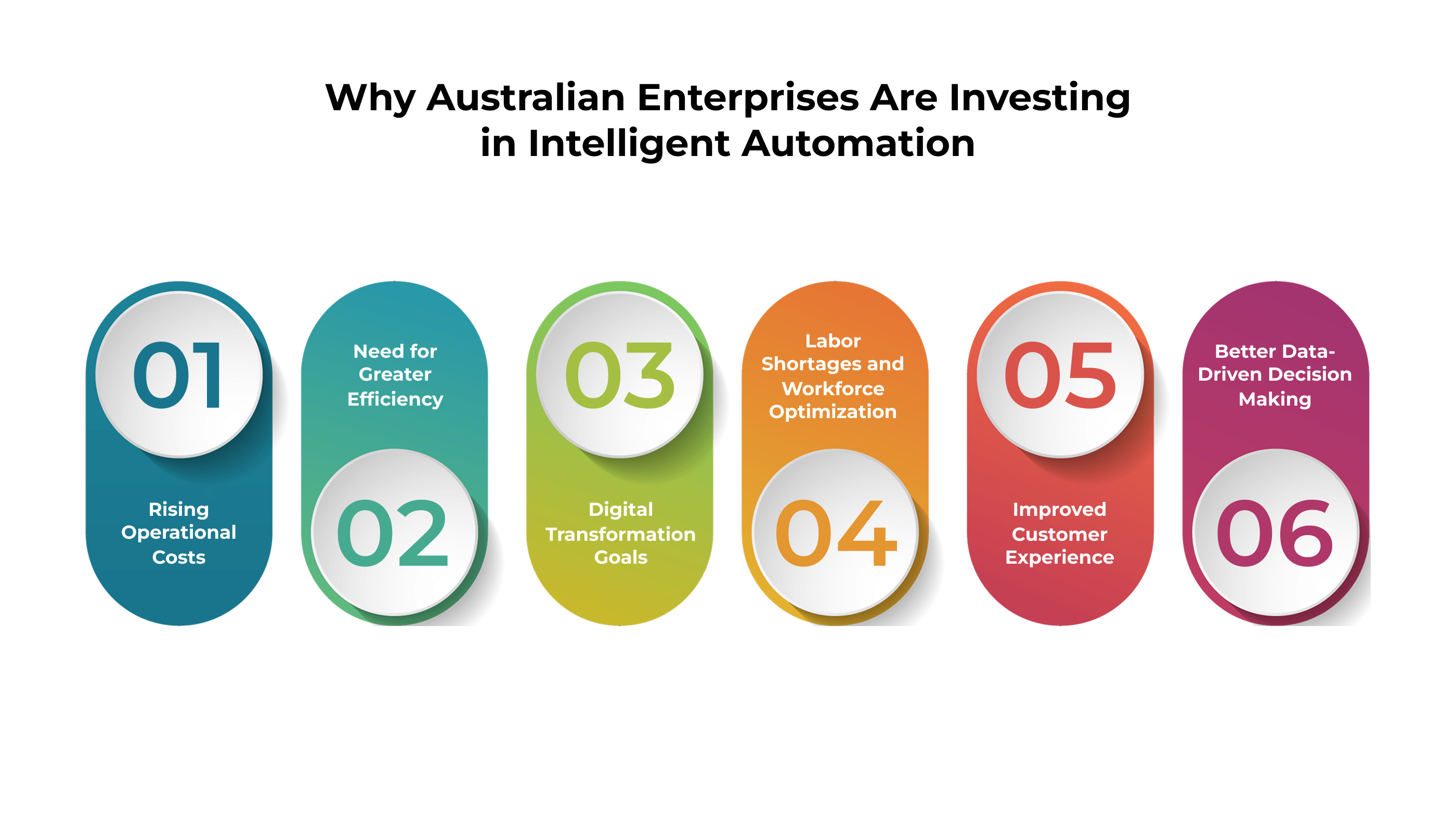
1. Rising Operational Costs
Australian businesses are facing higher expenses in labor, infrastructure, and compliance. Manual processes increase long-term operational costs. Intelligent automation helps reduce these costs by automating repetitive and time-consuming tasks efficiently.
2. Need for Greater Efficiency
Enterprises want faster workflows and better productivity across departments. Automation in business process management eliminates delays and reduces human errors. This improves overall operational performance and output.
3. Digital Transformation Goals
Many Australian enterprises are modernizing their systems to stay competitive. Intelligent automation supports digital transformation by integrating AI and advanced technologies into daily operations. It helps businesses become more agile and tech-driven.
4. Labor Shortages and Workforce Optimization
Finding and retaining skilled talent can be challenging. Intelligent automation reduces dependency on manual labor for routine tasks. This allows employees to focus on strategic and high-value activities.
5. Improved Customer Experience
Customers expect quick responses and seamless service. Automation tools like AI assistants and chatbots provide 24/7 support and faster issue resolution. This leads to higher customer satisfaction and loyalty.
6. Better Data-Driven Decision Making
AI in business process automation provides real-time insights and analytics. Enterprises can make informed decisions based on accurate data rather than assumptions. This improves strategic planning and reduces business risks.
Key Benefits of Intelligent Process Automation in Australia
Improved Operational Efficiency
Automates repetitive business tasks, allowing employees to focus on strategic work.
Reduced Business Costs
Eliminates manual errors and reduces workforce dependency for repetitive operations.
Faster Decision-Making
AI-powered systems analyze data in real-time for better business decisions.
Better Customer Experience
Automated workflows improve response time and service delivery.
Scalability for Enterprises
Businesses can scale operations without increasing operational complexity.
Key Areas Where Enterprises Are Reducing Operational Costs
Australian enterprises are using cost-saving automation solutions in several departments:
| Department | Automation Use Case | Cost-Saving Impact |
| Finance | Automated invoicing, fraud detection | Reduced manual errors, faster payments |
| HR | Recruitment automation, payroll processing | Lower administrative costs |
| Supply Chain | Inventory management, demand forecasting | Reduced wastage, optimized logistics |
| Customer Service | AI chatbots, ticket routing | Lower support costs, faster resolution |
| IT | Automated monitoring, cybersecurity alerts | Reduced downtime, lower IT overhead |
This table shows how business process automation services are helping enterprises cut costs across multiple functions.
Real-World Use Cases Across Australian Industries
Intelligent automation is no longer confined to theory—it’s actively reshaping how Australian enterprises operate across multiple industries. By combining AI with business process automation solutions, organizations are finding new ways to cut costs, improve efficiency, and deliver better services. Let’s look at some practical examples:
Banking and Financial Services: Banks are using business process automation software to streamline loan approvals, detect fraud faster, and simplify compliance reporting. This reduces manual paperwork, speeds up customer service, and lowers the risk of financial errors.
Healthcare: Hospitals and clinics rely on intelligent automation services to manage patient scheduling, billing, and medical records. By automating these administrative tasks, healthcare providers can spend more time on patient care while reducing operational costs.
Retail and E-commerce: Retailers are deploying business process automation tools for inventory management, personalized customer recommendations, and order fulfillment. This ensures products are always in stock, deliveries are faster, and customers enjoy a smoother shopping experience.
Manufacturing: Factories are implementing enterprises automation systems to optimize production lines, monitor equipment, and reduce waste. Predictive maintenance powered by AI helps prevent costly breakdowns and keeps operations running efficiently.
Government Services: Public sector organizations are adopting business process automation solutions to handle document processing, citizen service requests, and compliance workflows. This reduces delays, improves transparency, and makes government services more accessible.
Cost Savings Breakdown: Where Enterprises Save the Most
| Area of Savings | How Automation Helps | Impact on Enterprises |
| Labor Costs | Automates repetitive tasks such as data entry, payroll, and customer support | Significant reduction in staffing expenses and overtime costs |
| Error Reduction | AI-driven checks minimize human mistakes in finance, compliance, and reporting | Lower rework costs and improved accuracy in critical processes |
| Time Efficiency | Faster workflows in approvals, scheduling, and order processing | Shorter cycle times, quicker revenue generation, and improved customer satisfaction |
| Customer Retention | AI assistants and chatbots provide 24/7 support and personalized experiences | Reduced churn, stronger loyalty, and higher lifetime customer value |
| Resource Optimization | Predictive analytics in supply chain and manufacturing reduce waste | Lower inventory costs and better utilization of |
How Intelligent Automation Works
1. Data Collection
Intelligent automation begins by collecting data from multiple sources such as enterprise systems, applications, customer interactions, and databases. This data includes both structured and unstructured formats. It serves as the foundation for all further processing and decision-making.
2. Data Processing & Analysis
Once collected, the data is processed using AI and machine learning algorithms to identify patterns, trends, and relationships. This helps organizations gain meaningful insights from raw information. It also supports better business forecasting and planning.
3. Task Automation using RPA
Robotic Process Automation (RPA) is used to handle repetitive and rule-based tasks such as data entry, invoice processing, and report generation. It reduces manual effort and improves accuracy. This ensures faster and more efficient execution of routine operations.
4. Intelligent Decision-Making
AI systems analyze processed data to support intelligent decision-making. They can detect anomalies, predict outcomes, and recommend actions. This allows businesses to make faster and more accurate decisions.
5. System Integration
Intelligent automation systems are integrated with existing platforms such as ERP, CRM, and cloud systems. This enables smooth data flow across different departments. It helps create a unified and efficient business workflow.
6. Continuous Learning & Improvement
The system continuously learns from new data and past performance. It refines its models and improves accuracy over time. This makes intelligent automation more effective and adaptive with ongoing use.
Common Mistakes to Avoid in Intelligent Process Automation Australia
Most Australian enterprises that struggle with intelligent process automation Australia implementation don't fail because the technology doesn't work — they fail because of avoidable mistakes made before, during, and after deployment. Here are the most common pitfalls to watch out for in 2026.
Mistake 1: Automating the Wrong Processes First
Many businesses rush to automate complex, high-risk workflows before they are ready. This leads to expensive failures and loss of stakeholder confidence.
What to do instead: Start with high-volume, repetitive, rule-based processes — such as invoice processing, payroll, or data entry. These deliver fast ROI and build internal confidence before you tackle complex decision-based automation.
💡 Pro Tip: A good candidate for intelligent process automation Australia has three qualities — high volume, low exception rate, and clear rules.
Mistake 2: Ignoring Legacy System Compatibility
Many Australian organisations still run on outdated ERP or CRM systems. Businesses often assume their existing infrastructure is automation-ready — and discover too late that it is not.
What to do instead: Before selecting any intelligent process automation Australia platform, conduct a full IT infrastructure audit. Use API-based middleware or integration layers to bridge legacy systems with modern automation tools — avoiding costly full system replacements.
Mistake 3: No Clear Automation Goals or KPIs
Launching an automation project without defined success metrics is one of the most expensive mistakes an enterprise can make. Without KPIs, you cannot measure ROI — and without ROI data, leadership will not approve further investment.
What to do instead: Before implementation, define specific, measurable goals such as:
- Reduce invoice processing time by 60%
- Cut customer support response time from 24 hours to 2 hours
- Reduce payroll errors by 90%
These benchmarks allow you to track intelligent process automation Australia performance from day one.
Mistake 4: Underestimating Employee Resistance
Employees often fear that automation will replace their jobs. When this concern is ignored by leadership, it creates internal resistance that slows adoption and reduces the effectiveness of even the best intelligent process automation Australia solutions.
What to do instead: Communicate clearly and early. Explain that intelligent process automation Australia is designed to eliminate repetitive tasks — not people. Invest in upskilling programs so employees can move into higher-value roles alongside automation systems. Businesses that bring employees into the automation journey see 3× faster adoption rates than those that don't.
Mistake 5: Treating Automation as a One-Time Project
This is one of the most common mistakes among Australian enterprises in 2026. Businesses implement an automation solution, declare success, and then stop monitoring it. Over time, performance degrades as business processes evolve and data patterns change.
What to do instead: Intelligent process automation Australia requires ongoing maintenance, model retraining, and performance audits. Schedule quarterly reviews to assess accuracy, identify process drift, and update automation rules as your business grows.
Mistake 6: Overlooking Data Security and Compliance
Automation platforms process large volumes of sensitive customer and operational data. Many businesses focus so heavily on implementation speed that they neglect Australia's Privacy Act 1988, the Notifiable Data Breaches (NDB) scheme, and industry-specific compliance requirements.
What to do instead: Partner with an intelligent process automation Australia company that builds compliance into the architecture from day one — not as an afterthought. Ensure your platform includes role-based access control, data encryption, audit logging, and breach notification protocols.
Mistake 7: Choosing the Wrong Intelligent Process Automation Australia Company
Not all automation vendors understand the Australian regulatory environment, enterprise integration requirements, or industry-specific workflows. Choosing a generic global vendor without local expertise leads to costly customisation and compliance gaps.
What to do instead: Work with an experienced intelligent process automation Australia company like PerfectionGeeks — with a proven track record of 200+ enterprise projects, deep knowledge of Australian compliance standards, and end-to-end support from strategy to deployment.
How PerfectionGeeks Can Help Australian Enterprises Scale Intelligent Automation
PerfectionGeeks provides end-to-end intelligent automation solutions tailored to Australian enterprises. From consultation and strategy development to implementation and support, their intelligent automation services focus on measurable operational cost reduction.
They offer:
- Customized intelligent automation software
- Business process automation services
- AI in business process automation integration
- Scalable business process automation solutions
- Secure and compliant automation systems
With deep expertise in automation in business and enterprise transformation, PerfectionGeeks helps companies design cost-saving automation solutions that align with their long-term goals.
Expert Tips for 2026
1. Start with High-Impact Processes
In 2026, businesses should begin intelligent automation with high-impact, repetitive processes such as finance, HR, and customer support. These areas deliver quick ROI and measurable efficiency gains. Prioritizing them helps build confidence before scaling automation across the enterprise.
2. Focus on AI + RPA Integration
Combining AI with RPA is essential for modern automation strategies. AI enables decision-making while RPA handles execution of routine tasks. This hybrid approach ensures both intelligence and efficiency in business workflows.
3. Invest in Scalable Cloud Infrastructure
Cloud-based automation systems are critical for handling large data volumes and growing workloads. Scalable infrastructure ensures smooth performance during peak demand. It also reduces long-term operational costs and improves flexibility.
4. Improve Employee Collaboration with Automation
Successful automation is not about replacing employees but empowering them. Businesses should train teams to work alongside intelligent systems. Upskilling employees increases adoption and reduces resistance to change.
5. Use Real-Time Analytics for Decision Making
Enterprises should leverage real-time analytics to monitor performance and optimize processes instantly. This helps identify inefficiencies and improve outcomes quickly. Data-driven decision-making will be a key competitive advantage in 2026.
6. Prioritize Security and Compliance
With increasing data usage, security and compliance must be a top priority. Businesses should ensure automation systems follow strict data protection regulations. This builds trust and reduces operational risks.
Frequently Asked Questions
Quick answers related to this article from PerfectionGeeks.
1. 1. What is intelligent automation in business?
2. How does intelligent automation reduce operational costs?
3. Is intelligent automation suitable for all industries in Australia?
4. What makes PerfectionGeeks different from other automation providers?
Conclusion
Australian enterprises now see intelligent automation as a strategic necessity, not an optional upgrade. By adopting intelligent automation software, business process automation tools, and AI-driven systems, companies can reduce operational costs, improve efficiency, and enhance customer experience. Although implementation requires careful planning and investment, the long-term benefits are substantial. With the right technology partner like PerfectionGeeks, businesses can successfully scale automation initiatives and achieve sustainable growth while staying competitive in Australia’s evolving market.

Written By Shrey Bhardwaj
Director & Founder
Shrey Bhardwaj is the Director & Founder of PerfectionGeeks Technologies, bringing extensive experience in software development and digital innovation. His expertise spans mobile app development, custom software solutions, UI/UX design, and emerging technologies such as Artificial Intelligence and Blockchain. Known for delivering scalable, secure, and high-performance digital products, Shrey helps startups and enterprises achieve sustainable growth. His strategic leadership and client-centric approach empower businesses to streamline operations, enhance user experience, and maximize long-term ROI through technology-driven solutions.